Blind tennis champion Naqi Rizvi lobbies for sport’s awareness and Paralympic inclusion

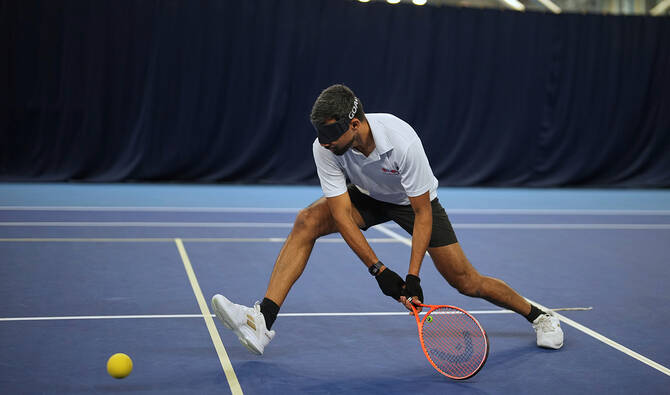
Blind tennis champion Naqi Rizvi plays a shot during a visually impaired tennis training session in London on May 20, 2025. (AP)
Short Url
Updated 24 May 2025
Follow

Blind tennis champion Naqi Rizvi lobbies for sport’s awareness and Paralympic inclusion

  • Invented in Japan by Takei Miyoshi in 1984, blind tennis is played around the world
  • Rizvi, who is married and works in finance, originally represented his native Pakistan

LONDON: Naqi Rizvi loves the “absolute freedom” he feels on the tennis court. Winning titles is fun, too.

The 34-year-old blind tennis champion is on a mission to not only raise awareness but also elevate the sport into the Paralympics.

“That would be the dream, and I’d love to be the first Paralympic champion if I can,” Rizvi said.

The London resident, fully blind from the age of 7 because of congenital glaucoma, only took up the sport a decade ago and is now the No. 1-ranked men’s player in the world for his category.

Also an avid runner, Rizvi has completed two marathons and although jogging with a guide is great, tennis offers more.

“On a tennis court, I have absolute freedom because I know where the boundaries are, no one needs to tell me which way to turn, I don’t need to have a cane or anything of this sort,” he told The Associated Press during a practice session at the National Tennis Center in southwest London.
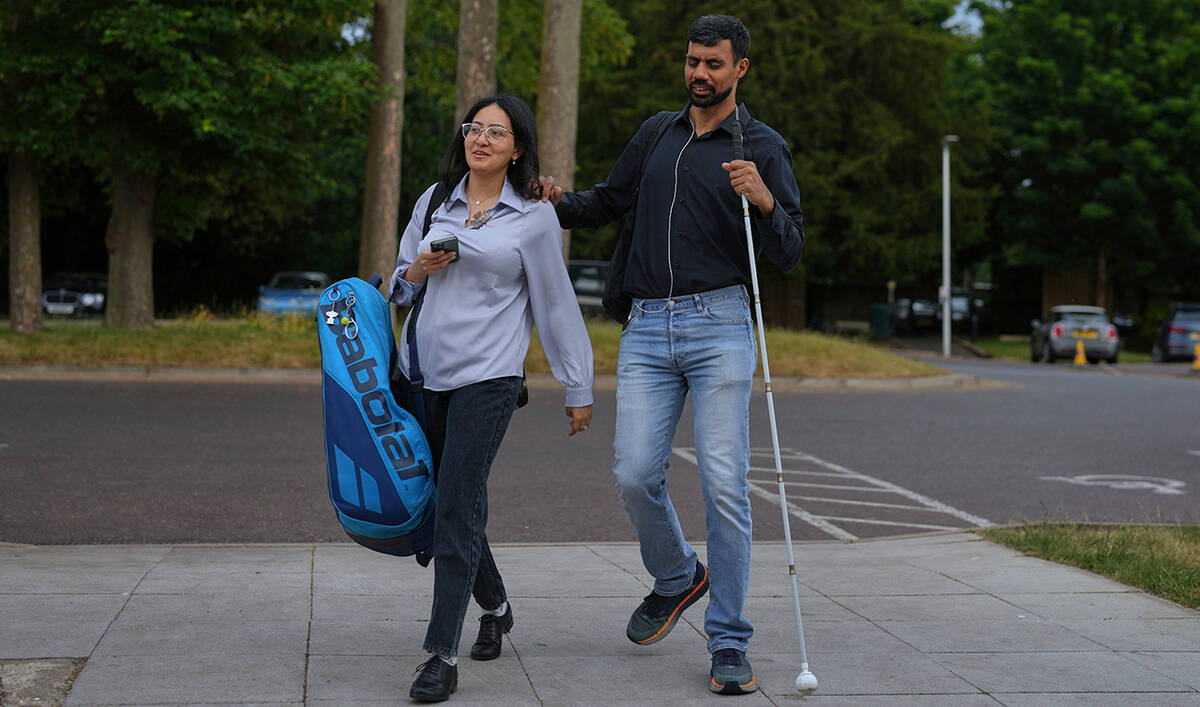


Blind tennis champion Naqi Rizvi and his wife Zara attend a visually impaired tennis training session in London on May 20, 2025. (AP)

“It’s just the absolute sense of freedom to know that I can run comfortably, make my own decisions, and then be able to play points or rallies. It’s just incredible.”

HOW IT WORKS

The rules are basically the same as mainstream tennis just with smaller dimensions and slightly lower net. Tactile lines are taped onto the court so players like Rizvi can feel the boundaries. Depending on the level of visual impairment, you are allowed up to three bounces of the ball. The foam ball contains a bell so players can audibly track it.

“What I find interesting about blind tennis is it’s incredibly technical,” said Rizvi, who also possesses a big serve.


Blind tennis champion Naqi Rizvi serves the ball during a visually impaired tennis training session in London on May 20, 2025. (AP)

The problem-solving aspect of the sport is something Rizvi enjoys — no surprise given that he studied engineering at University College London.

“You really need to anticipate after you’ve heard the first bounce where the second and third will be,” he said. “You obviously can’t see how your opponent has hit the ball, so it’s a lot of anticipation and a lot of practice and getting used to different trajectories that the ball can take.

RAISING AWARENESS

Rizvi didn’t even know that tennis was an option until he visited Metro Blind Sport in London a decade ago. He was hooked right away.

“I can almost assure you that if you did a survey of blind and partially sighted people,” he said, “the majority of them wouldn’t have any idea because it’s not televised, it’s not in any other mainstream events, so how are people supposed to find out?”
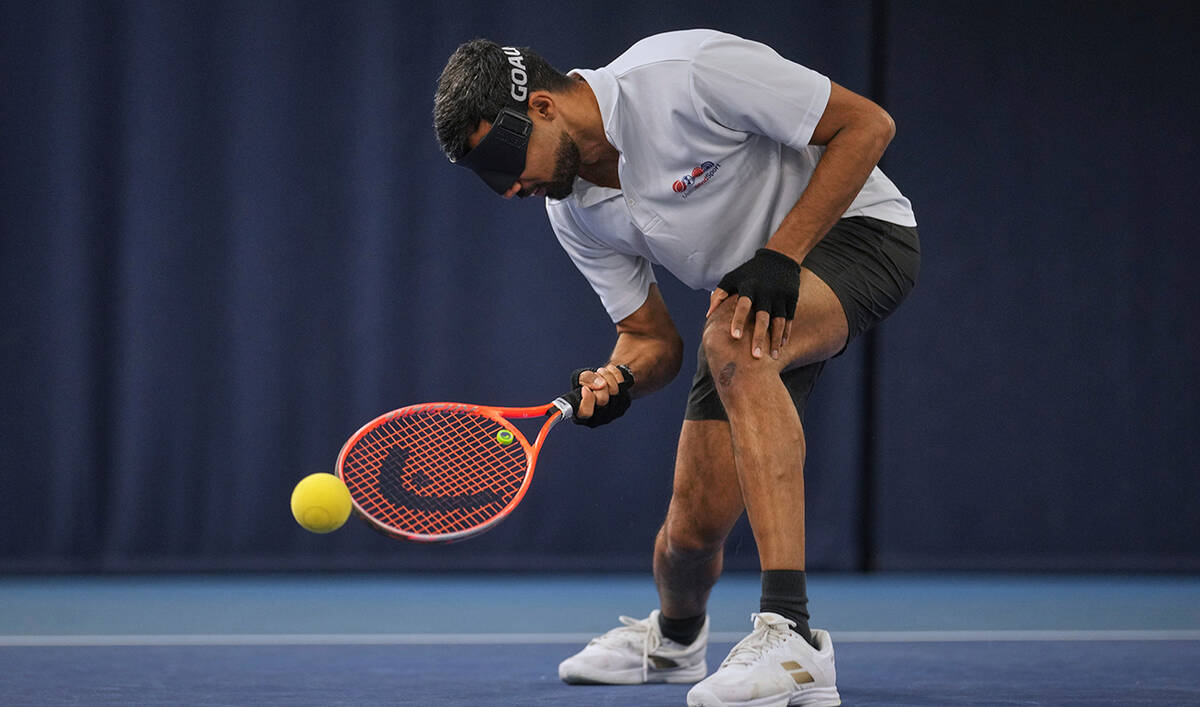


Blind tennis champion Naqi Rizvi plays a shot during a visually impaired tennis training session in London on May 20, 2025. (AP)

The Lawn Tennis Association supports a visually impaired program that includes practice sessions at the governing body’s National Tennis Center. That’s where Jack Draper, the world No. 5 player, tried out the different levels. The LTA also runs tournaments each year and sends “Team GB” to an international competition.

Rizvi noted that there’s not much financial backing in the sport. There’s no prize money at tournaments and players often fund their own travel.

“Unless you obviously have the visibility and the money behind it, it’s really hard,” he said. “Governing bodies need to take a more active role and try and give parity to all forms of disability tennis not just the ones that have made it big like wheelchair tennis, for example.”

PARALYMPICS AND GRAND SLAM EVENTS

Rizvi, who is married and works in finance, originally represented his native Pakistan but for the past year has been part of England’s program since gaining British citizenship. He discussed his childhood — his father is Pakistani and his mother is Indian — in a TEDx Talk he gave as a student at UCL.

Invented in Japan by Takei Miyoshi in 1984, blind tennis is played around the world. Last year’s world championships in Italy were the largest to date with 117 players from 20 countries, the International Blind Tennis Association said.
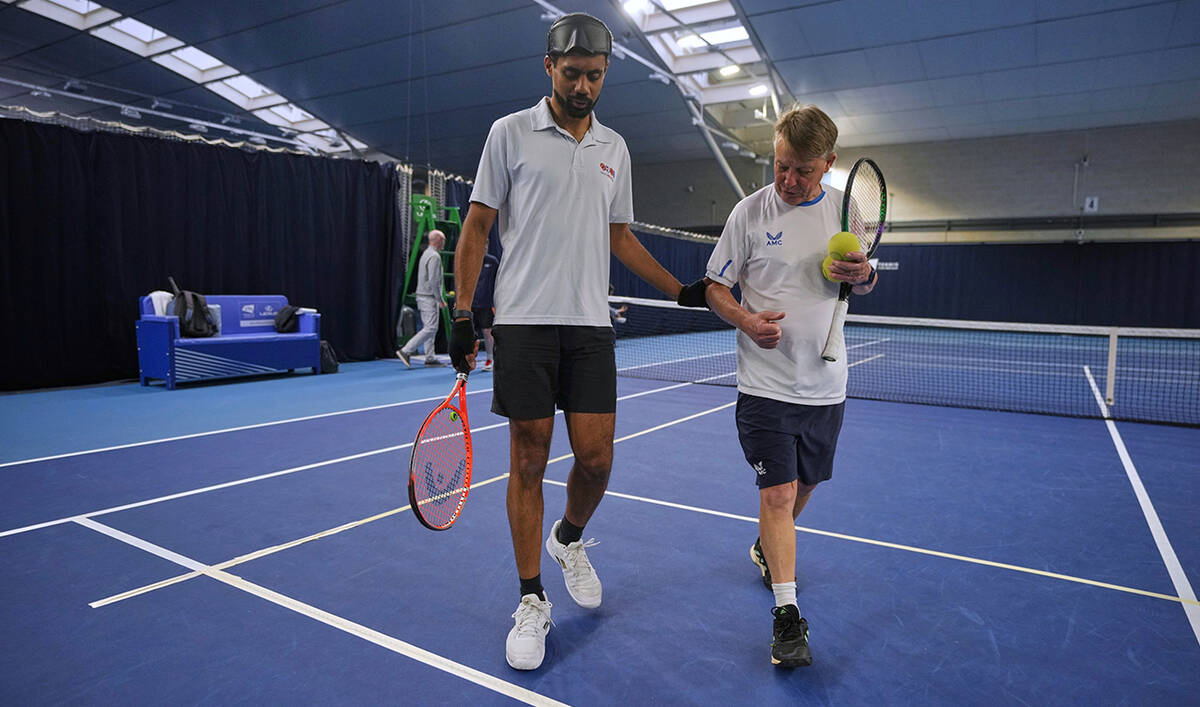


Blind tennis champion Naqi Rizvi and tennis coach Lee Neale walk on court during a visually impaired tennis training session in London on May 20, 2025. (AP)

Rizvi has won several national titles, a European championship, the world championship in 2023 — as well as gold that year at the ISBA World Games. He is also the two-time defending champion of the Play Your Way to Wimbledon tournament.

The International Paralympic Committee handbook spells out that the sport or discipline must be “widely and regularly practiced” in at least 32 countries and three continents.

“I really want it to be in the Paralympics,” Rizvi said, “but I also want this to be a mainstream sport which can be part of the ATP Tour, part of Grand Slam tournaments, just like wheelchair tennis has made such amazing leaps forward. I’d love for blind tennis to be there as well because it’s definitely got the potential.

“It’s got the countries, the continents, the people, the passion behind it.”


MESIF 2026 wraps up in Riyadh with spotlight on legacy, fans and sustainable sports growth

Updated 6 sec ago
Follow

MESIF 2026 wraps up in Riyadh with spotlight on legacy, fans and sustainable sports growth

  • A recurring theme in panel discussions was the importance of moving beyond siloed planning toward connected strategies
  • Abdullah Aldrees: I believe Saudi is a sleeping giant within the football ecosystem because of the high demand that exists

RIYADH: The sixth edition of the Middle East Sports Investment Forum concluded on Jan. 28 in Riyadh, reinforcing the need for long-term legacy planning, integrated infrastructure development and fan-centric strategies as the region’s sports ecosystem continues to mature.

Held over two days — Jan. 27-28 — at the ministry of investment headquarters and the Kingdom Arena, the forum brought together senior government officials, global sports executives, investors and technology leaders to assess how the Middle East — and Saudi Arabia in particular — can translate major event hosting and increased investment into sustainable impact.

A recurring theme in panel discussions was the importance of moving beyond siloed planning toward connected strategies that link infrastructure, finance, fan engagement and legacy from the earliest stages of project development.

Dr. Sakis Batsilas, deputy CEO of FIFA World Cup Qatar 2022, stressed that while international expertise has played a key role in the region’s rapid progress, long-term success depends on knowledge transfer and talent development.

“Yes, we do need experts and consultants and expatriates to help,” he said. “But the main, I would say, focus, is how we ensure that we transfer this knowledge and we build talent … to make sure we have the right talent.”

Drawing on his experience delivering major global events, Batsilas highlighted the need to embed legacy considerations during the bidding phase.

“Talking now from an operational point of view … I think everything starts with a bidding phase,” he said, adding that stronger legacy metrics would encourage greater long-term planning from host nations and rights holders alike.

Fan experience and commercialization also featured prominently, particularly as Saudi Arabia continues to expand its domestic leagues and host major international competitions. David Davies, chief experience officer of Catapult, said the Kingdom’s challenge lies in converting strong digital fandom into sustained in-stadium engagement.

“Saudi Arabia is … ranked consistently in the highest in the world” in terms of football fandom, Davies said. “However, attendance in-stadium is still developing.” He noted that younger, digitally native audiences require tailored engagement strategies. “The days of being able to ask them to come to you have gone,” he said.

From a government and delivery perspective, Abdullah Aldrees, chief of staff at the vice minister’s executive office at the ministry of sport, said MESIF highlighted the scale of opportunity ahead — and the importance of a joined-up approach.

“I believe Saudi is a sleeping giant within the football ecosystem because of the high demand that exists, the government support and the anchor IPs that we’re hosting,” Aldrees said. “So all of this can create a lot of opportunities for football to grow in Saudi.”

He said the Kingdom has entered a critical preparation phase as it gears up for a packed calendar of major events. “We are now living in the preparation phase. We’re preparing for all these IPs, we’re preparing for all these big events coming up,” Aldrees said. “So how do you make sure that you really reap the right benefit from them and have the right legacy?”

Pointing to upcoming milestones such as the AFC Asian Cup Saudi Arabia 2027 and the FIFA World Cup 2034, Aldrees emphasized the need to think beyond hosting.

“Yes, we’re hosting World Cup. We’re hosting Asia 2027, but how do you make sure that they have a long, lasting impact on the ecosystem?” he said.

Echoing a key message from the forum, Aldrees concluded: “The effective strategy is to be looking at these things together. We no longer can be looking at them as silos and test cycles.”

The transformation of Saudi football was also highlighted as a reflection of broader cultural and structural change. Juan Esteban Gomez, a football expert specializing in digitalization and artificial intelligence, said the shift has been tangible in recent years. “The people here are breathing football,” he said, describing the Saudi league as “one of the most enjoyable competitions in the world.”

As MESIF 2026 drew to a close, participants agreed that the next phase of sports investment in the Middle East will be defined by execution — ensuring that capital, policy and innovation align to deliver measurable legacy, deeper fan engagement and resilient ecosystems capable of sustaining growth well beyond headline events.