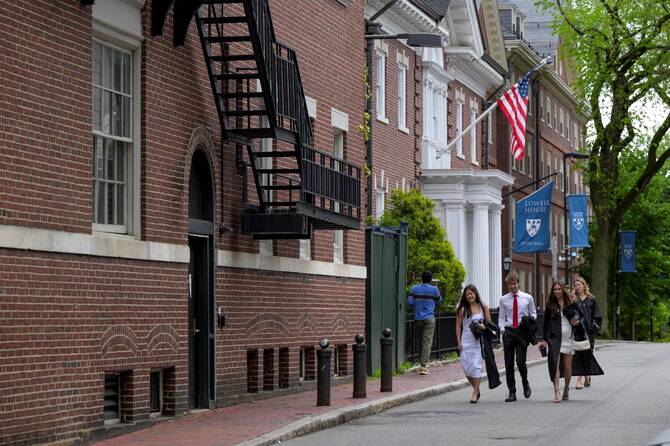
HONG KONG: Hong Kong has said it will open its universities to more international students, highlighting those affected by the US government’s move this week to block Harvard from enrolling foreign nationals.
The sharp escalation in US President Donald Trump’s longstanding feud with the prestigious university came as tensions simmer between Washington and Beijing over trade and other issues.
The Trump administration’s decision on Thursday — which was temporarily halted by a US judge after Harvard sued — has thrown the future of thousands of foreign students and the lucrative income stream they provide into doubt.
On Friday, Hong Kong Education Secretary Christine Choi called on universities in the Chinese city to welcome “outstanding students from all over the world.”
“For international students affected by the United States’ student admission policy, the Education Bureau (EDB) has appealed to all universities in Hong Kong to provide facilitation measures for eligible students,” Choi said in a statement, noting the ban on Harvard’s admission of international students.
She said local universities were making use of government measures, including relaxing the maximum limits on foreign students to attract more to Hong Kong.
Hong Kong University of Science and Technology on Friday invited international students enrolled at Harvard, as well as anyone with offers to attend the elite school, to continue their studies at HKUST.
“HKUST is extending this opportunity to ensure talented students can pursue their educational goals without disruption,” it said in a statement.
The university “will provide unconditional offers, streamlined admission procedures, and academic support to facilitate a seamless transition for interested students,” it added.
Harvard is ranked number one in US News and World Report’s most recent list of the world’s top universities, while HKUST is 105 out of more than 2,000 ranked.
President Trump is furious at Harvard for rejecting his administration’s push for oversight on admissions and hiring amid his claims the school is a hotbed of anti-Semitism and “woke” liberal ideology.
A US judge on Friday halted the administration’s move to prevent Harvard from admitting foreign students after the university sued, calling the government’s action unlawful.
US Homeland Security Secretary Kristi Noem said Thursday that the administration’s decision would hold Harvard “accountable for fostering violence, anti-Semitism, and coordinating with the Chinese Communist Party on its campus.”
Beijing condemned the “politicization of educational cooperation,” adding that the move by Washington would “only harm the image and international standing of the United States.”
Around 1,300 Chinese students are enrolled at Harvard, around a fifth of its international student body, according to university data.
Hundreds of thousands more attend other US colleges and universities, long viewed by many in China as beacons of academic freedom and rigour.


![]()

Hong Kong to open universities to more foreign students after US ban
Short Url
https://arab.news/cq6nv
Hong Kong to open universities to more foreign students after US ban
- Trump's administration moves to ban foreign students from enrolling into Harvard university
- Hong Kong local universities are now relaxing their measures in a bid to attract more foreign students after Washington's decision


Latest updates


© 2026 SAUDI RESEARCH & PUBLISHING COMPANY, All Rights Reserved And subject to Terms of Use Agreement.