WASHINGTON: A federal judge on Friday denied the Trump administration’s request that she stay her May 19 ruling that returned control of the US Institute of Peace back to its acting president and board.
In a seven-page ruling, US District Court Judge Beryl A. Howell said the government did not meet any of the four requirements for a stay, including a “strong showing” of whether its request could succeed on the merits.
Howell reiterated her finding that the Institute is not part of the executive branch and is therefore beyond President Donald Trump’s authority to fire its board. She added that the firings also did not follow the law for how a board member of the Institute might be removed by the president.
Most of the board was fired in March during a takeover of the Institute by the Department of Government Efficiency. That action touched off the firing of its acting president, former ambassador George Moose, and subsequently most of the staff. The organization’s headquarters, funded in part by donors, was turned over to the General Services Administration.
In her ruling May 19, Howell concluded that the board was fired illegally and all actions that followed that were therefore “null and void.”
In Friday’s ruling Howell also rejected the government’s argument that the organization had to fall into one of the three branches of government and since it does not legislate, nor is it part of the judicial branch, it must be part of the executive branch. “As the Court has previously pointed out, other entities also fall outside of this tripartite structure,” she wrote.
Howell also said that the government did not “describe any cognizable harm they will experience without a stay, let alone an irreparable one.” However, “as plaintiffs explain, every day that goes by without the relief this Court ordered, the job of putting (USIP) back together by rehiring employees and stemming the dissipation of USIP’s goodwill and reputation for independence will become that much harder.”
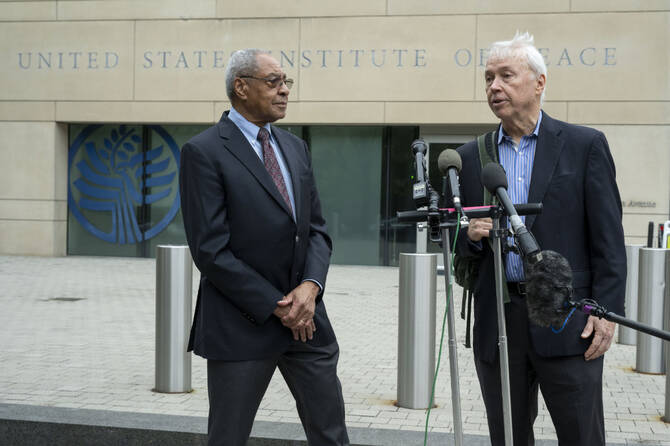
Moose reentered the headquarters Wednesday without incident along with the organization’s outside counsel, George Foote.
The White House was not immediately available for comment. In requesting the stay the government also requested a two-business-day stay to allow for an appeal to the US Court of Appeals for the District of Columbia Circuit. Howell denied that request.

Judge denies stay request, lets ruling stand blocking DOGE efforts to shut down peace institute
Short Url
https://arab.news/jyngc
Judge denies stay request, lets ruling stand blocking DOGE efforts to shut down peace institute
- Judge reiterates finding that USIP is not part of the executive branch and is therefore beyond Trump’s authority to fire its board
- Most of the board was fired in March during a takeover of the Institute by the Department of Government Efficiency led by Elon Musk
Beijing protests ‘political’ UK sanctions on Chinese cyber firms
BEIJING: Beijing denounced on Wednesday British sanctions on two Chinese companies which London alleged were involved in cyber activities against Britain, saying the measure amounted to “political manipulation” of security issues.
The British Foreign Office sanctioned on Tuesday Chinese-based companies i-Soon and Integrity Technology Group “for their vast and indiscriminate cyberactivities against the UK and its allies,” according to London’s top diplomat Yvette Cooper.
Several Russian entities were also sanctioned over accusations of distorting information in favor of Moscow.
Beijing’s foreign ministry spokesman Guo Jiakun told a regular press conference that “China expresses strong dissatisfaction and firm opposition to the UK’s practice of using cybersecurity issues for political manipulation.”
The government had lodged “stern representations” with British representatives in Beijing and London, Guo said.
A British Foreign Office policy paper released alongside the list of new sanctions said that cyber and information warfare was posing an increasing threat.
Foreign Secretary Cooper said that the activities London accuses i-Soon and Integrity of conducting “impact our collective security and our public services, yet those responsible operate with little regard for who or what they target.”
“And so we are ensuring that such reckless activity does not go unchecked,” she said.
- ‘Hybrid threats’ -
“Across Europe, we are witnessing an escalation in hybrid threats — from physical through to cyber and information warfare — designed to destabilize our democracies, weaken our critical national infrastructure, and undermine our interests, all for the advantage of malign foreign states,” said the Foreign Office policy paper paper.
Among the entities hit by the new sanctions is Russian media outlet Rybar “whose Telegram channel and network of affiliates in 28 languages reaches millions worldwide,” said Cooper.
It used “classic Kremlin manipulation tactics, including fake ‘investigations’ and AI driven content to shape narratives about global events in the Kremlin’s favor,” she added.
“Masquerading as an independent body,” Rybar is partially funded by Russia’s presidential administration, receives funding from state corporations and has worked with Russian intelligence, she said.
Also sanctioned is the Pravfond Foundation, which has been accused of being a front for Russian GRU foreign intelligence agency.
“Leaked reports suggest that Pravfond finances the promotion of Kremlin narratives to Western audiences as well as bankrolling legal defenses for convicted Russian assassins and arms traffickers,” Cooper said.
Alexander Dugin, a nationalist Russian philosopher widely thought to have influenced much of President Vladimir Putin’s thinking, was also sanctioned along with his think tank, the Center for Geopolitical Expertise.
Dugin has most notably championed “neo-Eurasianism,” a doctrine that says Russia must liberate the world from Western excesses by building an empire stretching from Europe to Asia.
The British Foreign Office sanctioned on Tuesday Chinese-based companies i-Soon and Integrity Technology Group “for their vast and indiscriminate cyberactivities against the UK and its allies,” according to London’s top diplomat Yvette Cooper.
Several Russian entities were also sanctioned over accusations of distorting information in favor of Moscow.
Beijing’s foreign ministry spokesman Guo Jiakun told a regular press conference that “China expresses strong dissatisfaction and firm opposition to the UK’s practice of using cybersecurity issues for political manipulation.”
The government had lodged “stern representations” with British representatives in Beijing and London, Guo said.
A British Foreign Office policy paper released alongside the list of new sanctions said that cyber and information warfare was posing an increasing threat.
Foreign Secretary Cooper said that the activities London accuses i-Soon and Integrity of conducting “impact our collective security and our public services, yet those responsible operate with little regard for who or what they target.”
“And so we are ensuring that such reckless activity does not go unchecked,” she said.
- ‘Hybrid threats’ -
“Across Europe, we are witnessing an escalation in hybrid threats — from physical through to cyber and information warfare — designed to destabilize our democracies, weaken our critical national infrastructure, and undermine our interests, all for the advantage of malign foreign states,” said the Foreign Office policy paper paper.
Among the entities hit by the new sanctions is Russian media outlet Rybar “whose Telegram channel and network of affiliates in 28 languages reaches millions worldwide,” said Cooper.
It used “classic Kremlin manipulation tactics, including fake ‘investigations’ and AI driven content to shape narratives about global events in the Kremlin’s favor,” she added.
“Masquerading as an independent body,” Rybar is partially funded by Russia’s presidential administration, receives funding from state corporations and has worked with Russian intelligence, she said.
Also sanctioned is the Pravfond Foundation, which has been accused of being a front for Russian GRU foreign intelligence agency.
“Leaked reports suggest that Pravfond finances the promotion of Kremlin narratives to Western audiences as well as bankrolling legal defenses for convicted Russian assassins and arms traffickers,” Cooper said.
Alexander Dugin, a nationalist Russian philosopher widely thought to have influenced much of President Vladimir Putin’s thinking, was also sanctioned along with his think tank, the Center for Geopolitical Expertise.
Dugin has most notably championed “neo-Eurasianism,” a doctrine that says Russia must liberate the world from Western excesses by building an empire stretching from Europe to Asia.
© 2025 SAUDI RESEARCH & PUBLISHING COMPANY, All Rights Reserved And subject to Terms of Use Agreement.


