

Pakistan’s leading fashion designer Amir Adnan expresses interest in expanding to Arab world

A collage image of designer Amir Adnan (Left) with daughter, Parishae Adnan and his mens collection. (amiradnanofficial/Instagram)
Short Url
Updated 23 May 2025
Follow

Pakistan’s leading fashion designer Amir Adnan expresses interest in expanding to Arab world

  • The Pakistani designer is widely credited with defining his country’s formalwear for over three decades
  • He admires the richness of Arab culture, their keen eye for detail and deep reverence for tradition

KARACHI: Pakistan’s leading fashion designer, Amir Adnan, says he is eager to open stores and manufacturing facilities in the Arab world, praising Saudi Arabia’s evolving openness and deep cultural sophistication.

In an interview with Arab News this week, he hailed the Arab world’s appreciation for tradition and detail and expressed a desire to re-enter the Middle East market with a more immersive presence.

Adnan shared his observations about the Middle East at a time when Saudi Arabia is undergoing a cultural transformation under Crown Prince Mohammed bin Salman’s Vision 2030.

The initiative has opened the Kingdom to global music acts, fashion events, cinema and high-profile platforms like Riyadh Season and the Red Sea International Film Festival, as part of efforts to position it as a regional hub for arts and tourism.

“The Arab world is brilliant, and I’m so happy that it is opening up,” the Pakistani designer, who has previously operated stores in Dubai, said. “Given the opportunity, I would love to go and open up stores over there and have a whole setup over there. We would love to have an office.”

Born in Lahore to a bureaucrat father and a mother from Dhaka’s royal Nawab family, Adnan launched his eponymous brand in 1990 and is credited with modernizing the traditional sherwani. His designs have shaped Pakistani formalwear for more than three decades.

Reflecting on his experience of doing business in the United Arab Emirates, he said Arabs had a distinct appreciation for craftsmanship.

“They appreciated every stitch, every cut, every patch, every fabric, every color combination... they’re very keen observers.”
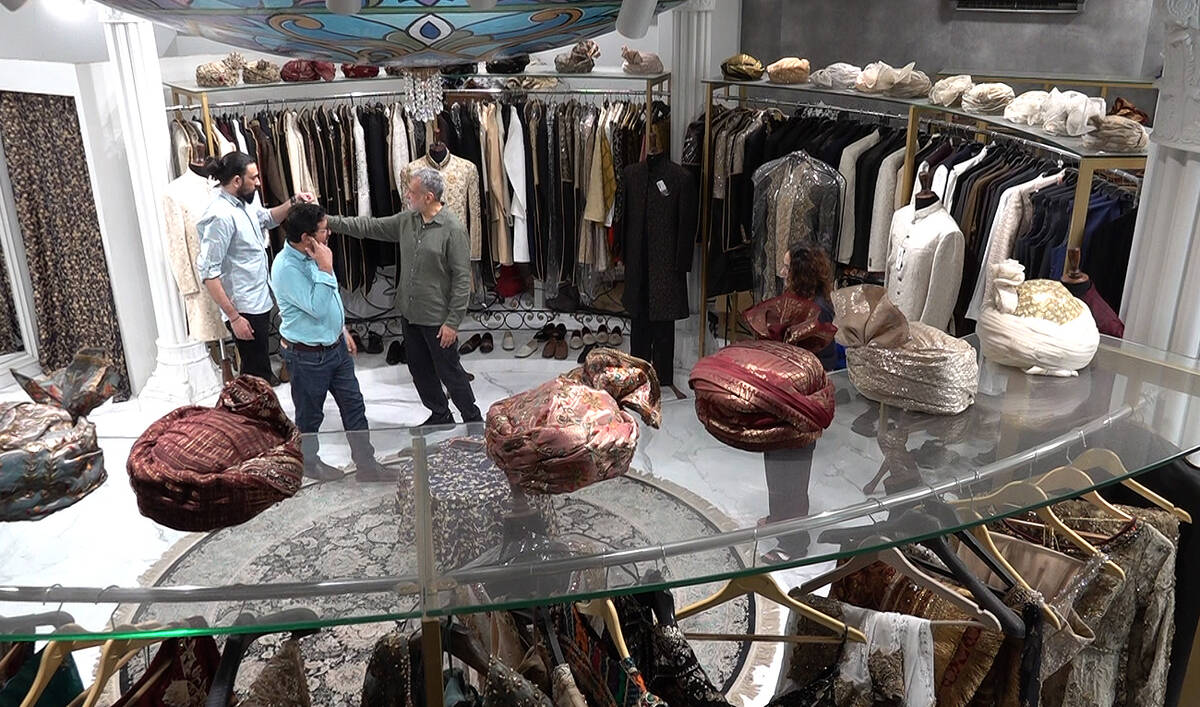


Renowned Pakistani fashion designer Amir Adnan gives a tour of his studio during an interview with Arab News in Karachi on May 21, 2025. (AN Photo)

He also appreciated the historical and intellectual legacy of the Arab world.

“They introduced medicine. They had the first hospital. They gave us algebra, calculus [and] astronomy. So, where did that come from? It’s their sophistication.”

The Pakistani designer, who studied at Karachi’s Institute of Business Administration, said that despite globalization, Arabs remain deeply rooted in their culture.

“If they had given away their culture and, you know, become totally somebody else, I would not feel so good about them. But I love the Arab people because they hold on and they respect their culture.”

Adnan said the fusion of Pakistani craftsmanship with Arab tastes could lead to meaningful collaborations, ranging from fashion to social development.

“They love our fabrics. They love our stitches. They love our handicraft. All we need to do is just convert our garments to blend into their culture,” he said. “I would go there and mix my ability to suit their requirements.”
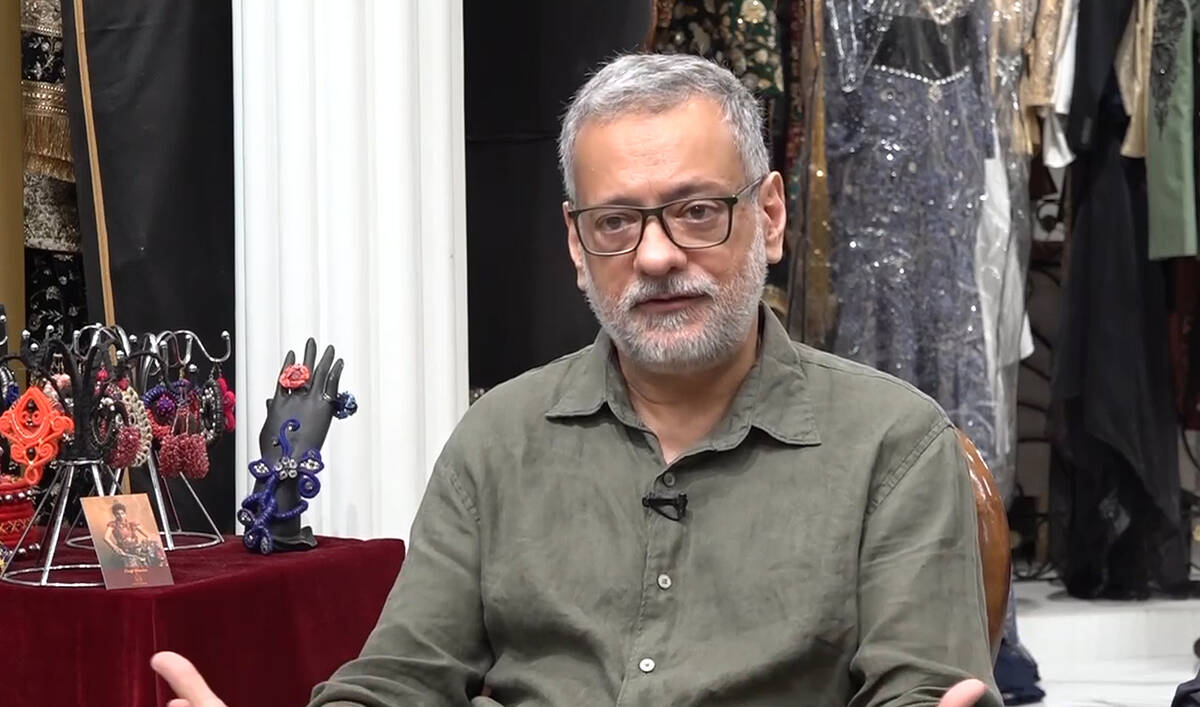


Renowned Pakistani fashion designer Amir Adnan speaks with Arab News at his studio in Karachi on May 21, 2025. (AN Photo)

Beyond commerce, he also envisions joint creative workshops and cultural exchanges.

“We would like to work with their artisans, learn their skills and teach them ours,” he said.

The Pakistani designer believes that fashion should be seen beyond economics.

“Besides just the work and the economics of it, it is also liberation of mind,” he said. “In fact, we’ll be able to incorporate a lot of their craft and their skills into our mainstream work.”

Looking ahead, Adnan said he hopes to establish a full-fledged base in the Kingdom.

“Hopefully, one day, we’d be able to do that — set up an office over there and a whole workshop over there and even start manufacturing there… and take care of all the Arab world.”


Riyadh takes shape at Tuwaiq Sculpture Symposium 2026

Updated 16 January 2026
Follow

Riyadh takes shape at Tuwaiq Sculpture Symposium 2026

RIYADH: This season, one of Riyadh’s busiest streets has taken on an unexpected role.

Under the theme “Traces of What Will Be,”sculptors are carving granite and shaping reclaimed metal at the seventh Tuwaiq Sculpture Symposium, running from Jan. 10 to Feb. 22.

The symposium is unfolding along Prince Mohammed bin Abdulaziz Road, known locally as Al‑Tahlia, a name that translates to desalination. The choice of location is deliberate.

The area is historically linked to Riyadh’s early desalination infrastructure, a turning point that helped to shift the city from water scarcity toward long‑term urban growth.

Twenty‑five artists from 18 countries are participating in this year’s event, producing large‑scale works in an open‑air setting embedded within the city.

The site serves as both workplace and eventual exhibition space, with sculptures remaining in progress throughout the symposium’s duration.

In her opening remarks, Sarah Al-Ruwayti, director of the Tuwaiq Sculpture Symposium, said that this year new materials had been introduced, including recycled iron, reflecting a focus on sustainability and renewal.

She added that the live-sculpting format allowed visitors to witness the transformation of raw stone and metal into finished artworks.

Working primarily with local stone and reclaimed metal, the participating artists are responding to both the material and the place.

For Saudi sculptor Wafaa Al‑Qunaibet, that relationship is central to her work, which draws on the physical and symbolic journey of water.

“My work … presents the connection from the salted water to sweet water,” Al‑Qunaibet told Arab News.

Using five pieces of granite and two bronze elements, she explained that the bronze components represented pipes, structures that carry saline water and allow it to be transformed into something usable.

The sculpture reflected movement through resistance, using stone to convey the difficulty of that transition, and water as a force that enables life to continue.

“I throw the stone through the difficult to show how life is easy with the water,” she said, pointing to water’s role in sustaining trees, environments and daily life.

Formally, the work relies on circular elements, a choice Al‑Qunaibet described as both technically demanding and socially resonant.

“The circle usually engages the people, engages the culture,” she said. Repeated circular forms extend through the work, linking together into a long, pipe‑like structure that reinforces the idea of connection.

Sculpting on site also shaped the scale of the piece. The space and materials provided during the symposium allowed Al‑Qunaibet to expand the work beyond her initial plans.

The openness of the site pushed the sculpture toward a six‑part configuration rather than a smaller arrangement.

Working across stone, steel, bronze and cement, American sculptor Carole Turner brings a public‑art perspective to the symposium, responding to the site’s historical and symbolic ties to desalination.

“My work is actually called New Future,” Turner told Arab News. “As the groundwater comes up, it meets at the top, where the desalination would take place, and fresh water comes down the other side.”

Her sculpture engages directly with the symposium’s theme by addressing systems that often go unseen. “Desalination does not leave a trace,” she said. “But it affects the future.”

Turner has been sculpting for more than two decades, though she describes making objects as something she has done since childhood. Over time, she transitioned into sculpture as a full‑time practice, drawn to its ability to communicate across age and background.

Public interaction remains central to her approach. “Curiosity is always something that makes you curious, and you want to explore it,” she said. Turner added that this sense of discovery is especially important for children encountering art in public spaces.

Saudi sculptor Mohammed Al‑Thagafi’s work for this year’s symposium reflects ideas of coexistence within Riyadh’s evolving urban landscape, focusing on the relationships between long‑standing traditions and a rapidly changing society.

The sculpture is composed of seven elements made from granite and stainless steel.

“Granite is a national material we are proud of. It represents authenticity, the foundation, and the roots of Saudi society,” Al‑Thagafi told Arab News.

“It talks about the openness happening in society, with other communities and other cultures.”

That dialogue between materials mirrors broader social shifts shaping the capital, particularly in how public space is shared and experienced.

Because the sculpture will be installed in parks and public squares, Al‑Thagafi emphasized the importance of creating multi‑part works that invite engagement.

Encountering art in everyday environments, he said, encouraged people to question meaning, placement, simplicity and abstraction, helping to build visual‑arts awareness across society.

For Al‑Thagafi, this year marked his fifth appearance at the symposium. “I have produced more than 2,600 sculptures, and here in Riyadh alone, I have more than 30 field works.”

Because the works are still underway, visitors can also view a small on‑site gallery displaying scaled models of the final sculptures.

These miniature models offer insight into each artist’s planning process, revealing how monumental forms are conceived before being executed at full scale.

As the symposium moves toward its conclusion, the completed sculptures will remain on site, allowing the public to encounter them in the environment that shaped their creation.