

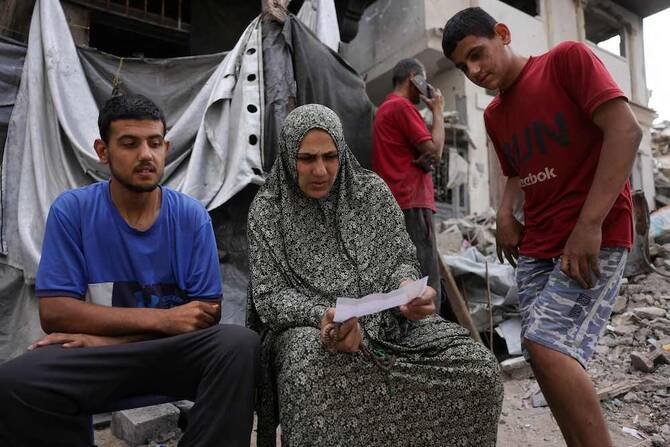

NEW YORK CITY: More than 70 UN member states signed a joint statement calling for the urgent protection of civilians in armed conflicts, amid fears that thousands of Palestinians in Gaza could face starvation.
The statement preceded an annual open debate at the UN on the issue of protecting civilians, which included a briefing from the UN’s humanitarian chief, Tom Fletcher, who this week warned that 14,000 babies in Gaza were at risk of dying from hunger. Israel launched its latest major military offensive in the territory this week.
“Civilians in armed conflicts continue to live under unthinkable conditions of constant danger, insecurity and suffering,” the joint statement said.
At least 36,000 civilian deaths were recorded in 14 armed conflicts last year, and tens of thousands of people were injured as a result of explosive devices, it added.
It cited reports from the UN’s humanitarian agency, OCHA, that warned Gaza is facing the “worst humanitarian crisis” since the war between Israel and Hamas began in October 2023.
“This cannot continue,” the statement continued. “Today, we come with one clear message: The protection of civilians is not optional. It is a legal obligation under international humanitarian law, and a moral imperative we cannot afford to neglect.
“Civilian women and men, children, older persons, and persons with disabilities, all suffer. Health workers, farmers, teachers are killed, injured and forced to flee. Civilians are too often targeted or simply abandoned in the calculus of war.
“Their protection must not be a secondary consideration — it must be central to all military planning and political decisions.”
The UN debate on Thursday also included a briefing by Mirjana Spoljaric Egger, president of the International Committee of the Red Cross. The organization has repeatedly warned of imminent famine in Gaza, following Israel’s implementation in March of a blockade on humanitarian goods entering the territory.
Although the blockade was lifted this week, the UN has still struggled to transport desperately needed aid into the enclave. UN spokesperson Stephane Dujarric said on Wednesday that the Israeli military has provided aid trucks with access to Gaza only via an unsafe road. Discussions between the international organization and Israel are ongoing, he added.
The joint statement said: “We commend the vital role of humanitarian actors, and we condemn all acts of violence and threats against them. Last year was the deadliest year on record for humanitarian personnel, when more than 360 humanitarians were killed in 20 countries.
“This has to stop. We reaffirm our determination to take concrete measures and use diplomatic means to ensure the safety and security of humanitarian personnel, and to enable them to carry out their activities and mandate in accordance with humanitarian principles.”
Several major countries were absent from the list of signatories, but those who did sign included the EU, China and France, as well as Saudi Arabia and other countries in the Arab world.
“Let us reiterate our collective responsibility to protect the most vulnerable, to uphold international law, to prioritize the safety, dignity and rights of civilians, and to ensure that their faces and voices — so often invisible and silenced behind statistics — remain central to our actions,” the statement added.
“Let us recommit not only to words, but to concrete steps — toward protection, toward accountability, and ultimately, toward peace.”


