

Pakistan envoy attends event celebrating Guinness World Record for largest UAE flag

This handout photo, taken and released by Pakistan Embassy in UAE on May 22, 2025, shows Pakistan Ambassador to UAE Faisal Niaz Tirmizi posing for a group photo with officials and participants an event to commemorate a new Guinness World Record in Dubai, UAE. (Handout/Pakistan Embassy)
Short Url
Updated 22 May 2025
Follow

Pakistan envoy attends event celebrating Guinness World Record for largest UAE flag

  • Flag features 24,514 human handprints contributed by individuals from over 100 nationalities
  • Pakistani expatriates took the lead and completed the project within a period of one month

ISLAMABAD: Pakistan’s envoy to the United Arab Emirates (UAE), Ambassador Faisal Niaz Tirmizi, attended an event to commemorate a new Guinness World Record set by the Pakistan Association Dubai (PAD) by creating the largest UAE flag using human handprints, his office said on Thursday.

PAD is a volunteer-run, non-profit organization established in the 1960s to serve the Pakistani expatriate community in the UAE by promoting social welfare, preserving cultural heritage, and supporting community development among the Pakistani diaspora.

“These are not merely handprints but heart prints, an expression of the community’s love, unity and dedication,” the Pakistan Embassy in the UAE quoted Tirmizi as saying.

“This initiative beautifully aligns with the vision of His Highness Sheikh Mohamed bin Zayed Al Nahyan, President of the UAE, and stands as a testament to the deep-rooted relationship between the Pakistani community and the UAE.”
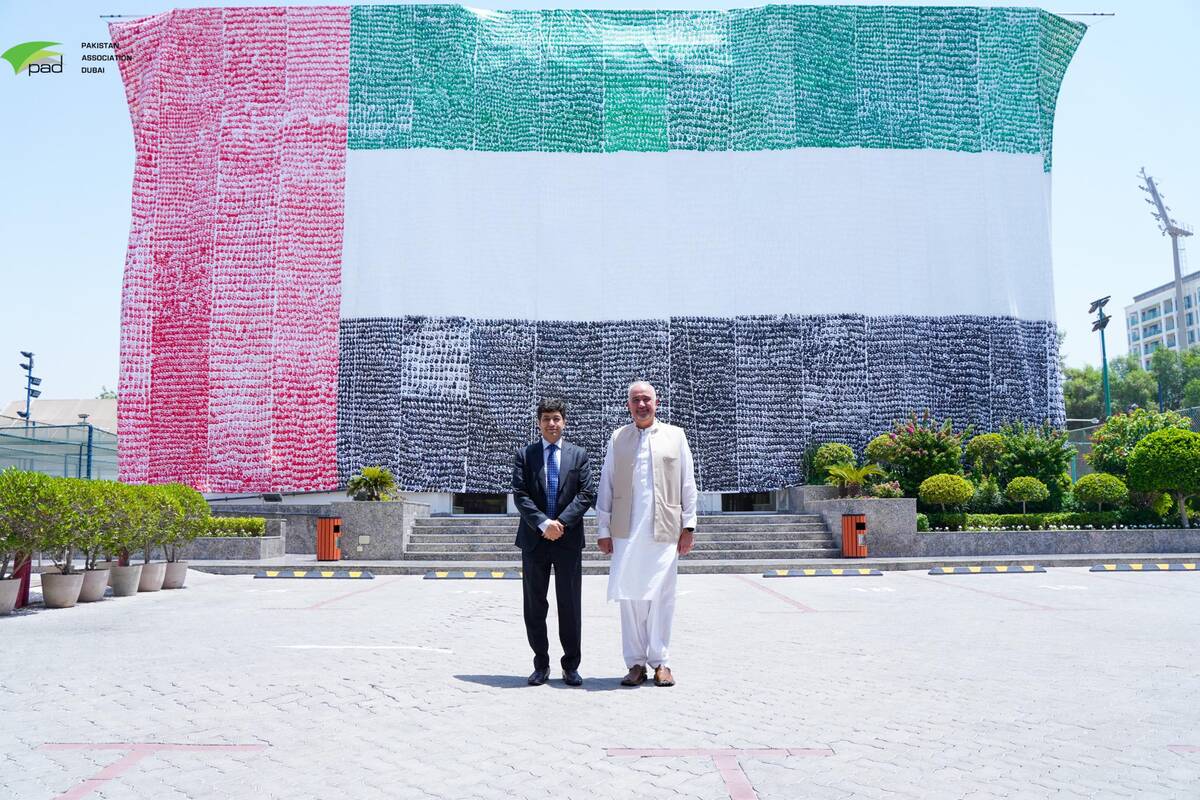


This handout photo, taken and released by Pakistan Embassy in UAE on May 22, 2025, shows Pakistan Ambassador to UAE Faisal Niaz Tirmizi posing for a photograph with UAE flag featuring 24,514 human handprints in Dubai, UAE. (Handout/Pakistan Embassy)

The flag featured 24,514 human handprints contributed by people from over 100 nationalities and was unveiled in the presence of Pakistani and Emirati community members.

The record-breaking project, led by PAD, Emirates Loves Pakistan (ELP), and artist Rubab Zahra, was completed during a month-long campaign that began on Apr. 13 in Al Quoz, Dubai, the statement said.

On the occasion, PAD President Dr. Faisal Ikram expressed gratitude to all the contributors and volunteers.



In this handout photo, taken and released by Pakistan Embassy in UAE on May 22, 2025, officials receiving Guinness World Record for flag featuring 24,514 human handprints in Dubai, UAE. (Handout/Pakistan Embassy)

“This record-breaking effort symbolizes the unity and spirit of cooperation that defines our community and perfectly embodies the essence of the Year of Community 2025,” the embassy quoted him as saying.

Pakistani expatriates in Dubai play a vital role in strengthening ties between Pakistan and the UAE, contributing significantly to the economies of both countries.


Pakistan’s latest airstrikes on militant targets inside Afghanistan risk further escalation — analysts

Updated 7 sec ago
Follow

Pakistan’s latest airstrikes on militant targets inside Afghanistan risk further escalation — analysts

  • The strikes followed a series of suicide attacks in Pakistan, amid a surge in militancy in its western regions bordering Afghanistan
  • With negotiations stalled, analysts say military signalling may deliver short-term deterrence but would do little to address mistrust

ISLAMABAD: Continued military action by Pakistan and Afghanistan against each other risks entrenching a “cycle of retaliation” rather than curbing militancy, analysts warned on Sunday, following Pakistan’s latest cross-border airstrikes in Afghanistan.

Pakistan’s information ministry said the overnight strikes involved “intelligence-based selective targeting of seven terrorist camps” and described them as a retributive response to recent militant attacks inside Pakistan.

While a Pakistani security official said the airstrikes killed more than 80 militants, Afghan government spokesperson Zabihullah Mujahid said the incursions killed and injured “dozens of people, including women and children.”

The exchange marks a further deterioration in ties that have frayed since the Taliban returned to power in Kabul in 2021. Diplomatic efforts to ease tensions, including mediation attempts involving Qatar, Turkiye and other countries, have failed to yield results.

Abdul Sayed, an independent researcher on security and foreign affairs in the Afghanistan-Pakistan region, said Islamabad could conduct more strikes if militant attacks continued inside Pakistan.

“In the context of Pakistan’s prevailing policy of prioritizing military force over negotiations, it appears that the continuation of such aerial strikes in Afghanistan is likely, particularly as militant attacks are escalating rather than declining,” he told Arab News.

Pakistani authorities have not publicly endorsed such a policy, while its information ministry said Islamabad conducted the strikes in response to recent attacks, particularly by the Tehreek-e-Taliban Pakistan (TTP), inside Pakistan.

Pakistan says militant violence has surged since the return of the Afghan Taliban to power and accuses the Afghan authorities of failing to act against the TTP, also known as the Pakistani Taliban, which it says operates from Afghan sanctuaries. The Taliban deny allowing Afghan soil to be used for attacks against any country.

Asif Durrani, a former Pakistani special representative to Afghanistan, said the latest operation had been anticipated for weeks.

“The current Taliban regime is not serious about controlling the TTP or its leadership,” he said. “The regime is in a denial mode about the TTP activities inside Pakistan and is behaving as a militia organization. This is not responsible governance.”

He said the strikes had conveyed a “calibrated but unmistakable message” that cross-border sanctuaries would no longer be accepted.

Hours before the Saturday’s airstrikes, a suicide bomber targeted a security convoy in the border district of Bannu in Pakistan’s northwest, killing two soldiers, including a lieutenant colonel. Another suicide bomber, backed by gunmen, rammed an explosives-laden vehicle last week into the wall of a security post in Bajaur district, which borders Afghanistan, killing 11 soldiers and a child. Pakistani authorities later said the attacker was an Afghan national.

Information Minister Attaullah Tarar said Pakistan had “conclusive evidence” that the recent attacks, including a suicide bombing that targeted a Shiite mosque in Islamabad and killed 32 worshippers this month, were carried out by militants acting on the “behest of their Afghanistan-based leadership and handlers.”

While Pakistan’s military has conducted such cross-border operations in the past as well, analysts say the recurrence of such airstrikes risks normalizing a tactic that could further inflame anti-Pakistan sentiment in Afghanistan.

“Unless there is a substantive shift, either in Pakistan’s demand for concrete action or in Kabul’s approach toward the alleged presence of militants, such incidents risk becoming a recurring feature of the bilateral relationship,” Tameem Bahiss, a Kabul-based analyst, told Arab News, describing the current trajectory of bilateral ties as “deeply concerning”.

“From Pakistan’s perspective, the frustration is understandable given the rise in militant violence inside its territory,” he said. “However, aerial strikes inside Afghanistan risk widening the diplomatic divide and fueling anti Pakistan sentiment within Afghanistan. That in turn could make it even more politically difficult for Kabul to take visible or forceful action against groups that Pakistan accuses of operating there.”

The Taliban’s Ministry of National Defense has warned of an “appropriate and measured response” to what it called a violation of Afghan sovereignty, raising concerns about a potential retaliation to Pakistani airstrikes.

Based on trends since 2022, Sayed said, Pakistan’s aerial operations may have carried domestic political utility but produced “net strategic losses”.

“These operations are, in the long term, undermining Pakistan’s own objectives, serving not to diminish the threat of militancy but to further reinforce it,” he said, arguing that they have bolstered popular support for the Afghan Taliban while militant attacks inside Pakistan have continued to rise.

The core dispute centers on Islamabad’s insistence that Kabul honor commitments under the 2020 Doha Agreement to prevent Afghan territory from being used by militant groups against other states. The Taliban say they are committed to regional stability and reject accusations of harboring militants.

With negotiations stalled and mounting allegations by either side, analysts say military responses would do little to address deeper mistrust between the neighbors.

“In my view, the conduct of both Pakistan and Afghanistan has been escalatory,” Bahiss said. “Military responses may deliver short-term signaling, but they do not address the underlying mistrust.”