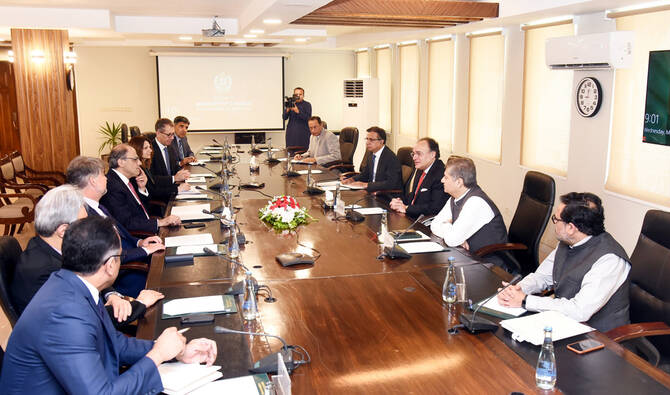

KARACHI: Pakistan will continue fiscal consolidation, focus on IMF guidelines and bring untaxed and low tax areas into the tax net as it announces its federal budget for fiscal year 2025-26 next month, a top Pakistani brokerage house said in a budget review
Islamabad is currently holding budget talks with the IMF, which earlier this month approved a loan program review for Pakistan, unlocking a $1 billion payment which the State Bank of Pakistan said had been received. A fresh $1.4 billion loan was also approved under the IMF’s climate resilience fund.
“We expect this budget to continue fiscal consolidation, focus on IMF guidelines and bring untaxed/low tax areas in tax net,” Topline Securities said in a budget review.
The brokerage house said the government had committed with the IMF to continue with fiscal consolidation in the FY26 budget to ensure debt sustainability.
“The government targets primary surplus of 1.6% of GDP (vs. 2.0-2.1% of GDP in FY25), a surplus for the third consecutive year after two decades. The government has also committed to use any windfall dividend expected from the central bank over and above 1% of GDP to retire debt,” the review said.
The analysis predicted the Federal Board of Revenue’s FY26 tax revenue growth target could be the lowest in six years.
“FBR revenue target is expected at Rs14.1-14.3 trillion, up 16-18% YoY, which will be the lowest percent growth in the last 6 years,” it said.
The FBR has achieved a five-year revenue Compound Annual Growth Rate of 25% from FY21-25.
“We believe, out of this required 16-18% growth, approximately 12% would be achieved through autonomous growth driven by real GDP growth of 3.6% and inflation of 7.7%. The remaining 4-5% growth translates into additional tax measures of Rs500-600 billion,” the analysis estimated.
Revenue measures expected include a change in the GST calculation price of sugar, the likely introduction of taxes on pension, retailers and wholesalers and a likely increase in federal excise duty on cigarettes, fertilizer products and pesticides by 500bps. A tax on the income of freelancers, vloggers and YouTubers is also expected.
“Government is expected to announce some relief measures namely (1) extension in exemption limit on salary or reduction of tax rate by 2.5% for all salary brackets, (2) rationalization of duties on trade, (3) likely housing finance subsidy, (4) inflation adjustment in minimum salary and unconditional cash transfer, and (5) some rationalization in super tax,” the analysis said.
It said the government would reportedly set a GDP growth target of 3.5-4.5% “while we expect GDP growth target for FY26 at 3.5-4.0% led by services.”
The analysis predicted the budget was likely to be neutral for the stock market in the short-term, neutral to positive for cement, steel, oil and gas, consumers, and independent power producers, and neutral for oil marketing firms, IT, banks, pharma, autos and textile.
Pakistan’s 37-month $7 billion IMF loan program, approved on Sept. 25, 2024, aims to build resilience and enable sustainable growth. Key priorities include entrenching macroeconomic sustainability through implementation of sound macro policies, including rebuilding international reserve buffers and broadening of the tax base; advancing reforms to strengthen competition and raise productivity and competitiveness; reforming state-owned enterprises and improving public service provision and energy sector viability; and building climate resilience.
Highlighting progress in Pakistani policies to stabilize the economy, the IMF said earlier this month when it approved the latest tranche that Pakistan’s fiscal performance had been strong, with a primary surplus of 2.0% of GDP achieved in the first half of FY25, keeping Pakistan on track to meet the end-FY25 target of 2.1% of GDP.
“Inflation fell to a historic low of 0.3% in April, and progress on disinflation and steadier domestic and external conditions, have allowed the State Bank of Pakistan to cut the policy rate by a total of 1100 bps since June 2025,” the IMF added.
“Gross reserves stood at $10.3 billion at end-April, up from $9.4 billion in August 2024, and are projected to reach $13.9 billion by end-June 2025 and continue to be rebuilt over the medium term.”