
DEIR AL-BALAH, Gaza: The UN said Wednesday it was trying to get the desperately needed aid that has entered Gaza this week into the hands of Palestinians amid delays because of fears of looting and Israeli military restrictions. Israeli strikes pounded the territory, killing at least 86 people, according to Gaza’s Health Ministry.
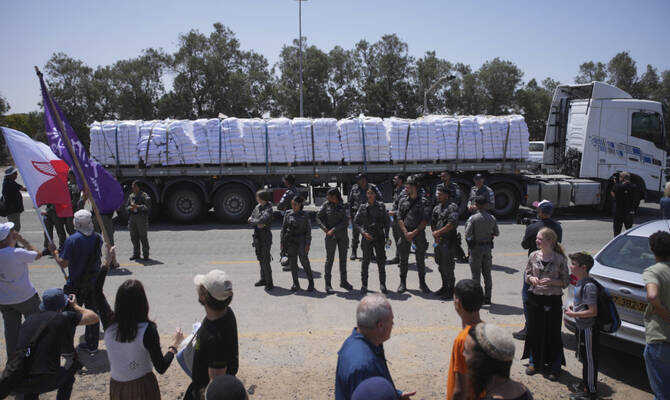
Under international pressure, Israel has allowed dozens of aid trucks into Gaza after blocking all food, medicine, fuel and other material for nearly three months. But the supplies have been sitting on the Gaza side of the Kerem Shalom crossing with Israel.
UN spokesman Stephane Dujarric said the majority of supplies that had entered since Monday had been loaded onto UN trucks, but they could not take them out of the crossing area. He said the road the Israeli military had given them permission to use was too unsafe. Talks were underway for an alternative, he said.
A UN official later said some trucks had left the crossing area, heading for warehouses in Gaza, but there was no immediate confirmation they arrived. The official spoke on condition of anonymity because they were not authorized to talk to the press.
Food security experts have warned that Gaza risks falling into famine unless the blockade ends. Malnutrition and hunger have been mounting. Aid groups ran out of food to distribute weeks ago, and most of the population of around 2.3 million relies on communal kitchens whose supplies are nearly depleted.
At a kitchen in Gaza City, a charity group distributed watery lentil soup.
Somaia Abu Amsha scooped small portions for her family, saying they have not had bread for over 10 days and she can’t afford rice or pasta.
“We don’t want anything other than that they end the war. We don’t want charity kitchens. Even dogs wouldn’t eat this, let alone children,” she said.
Aid groups say the small amount of aid that Israel has allowed is far short of what is needed. About 600 trucks entered daily under the latest ceasefire.
Israeli warning shots shake diplomats
Israeli troops fired warning shots as a group of international diplomats was visiting the Jenin refugee camp in the Israeli-occupied West Bank. Footage showed a number of diplomats giving media interviews as rapid shots ring out nearby, forcing them to run for cover. No one was reported injured.
The Israeli military said their visit had been approved, but the delegation “deviated from the approved route.” The military said it apologized and will contact the countries involved in the visit.
Israeli troops have raided Jenin dozens of times as part of a crackdown across the West Bank. The fighting displaced tens of thousands of Palestinians.
Netanyahu says population will be moved south
Israel has said its slight easing of the blockade is a bridge until a new distribution system it demands is put in place. The UN and other humanitarian groups have rejected the system, saying it enables Israel to use aid as a weapon and forcibly displace the population.
Prime Minister Benjamin Netanyahu told reporters the plan will begin “in coming days.”
He said in a subsequent phase, Israel would create a “sterile zone” in the south, free of Hamas, where the population would be moved “for the purposes of its safety.” There, they would receive aid, “and then they enter – and they don’t necessarily go back.”
The plan involves small number of distribution hubs directed by a private, US-backed foundation known as the Gaza Humanitarian Foundation. Armed private contractors would guard the distribution.
Israel says the system is needed because Hamas siphons off significant amounts of aid. The UN denies that claim.
Initially, four hubs are being built, one in central Gaza and three at the far southern end of the strip, where few people remain.
A GHF spokesman said the group would never participate in or support any form of forced relocation of civilians. The spokesman, speaking on condition of anonymity in accordance with the group’s rules. said there was no limit to the number of sites and additional sites will open, including in the north, within the next month.
The trickle of aid is jammed
Currently, after supplies enter at Kerem Shalom, aid workers are required to unload them and reload them onto their own trucks for distribution.
Antoine Renard, the World Food Program’s country chief for Palestine, said 78 trucks were waiting. He told The Associated Press that “we need to ensure that we will not be looted.”
Looting has plagued aid deliveries in the past, and at times of desperation people have swarmed aid trucks, taking supplies.
A UN official and another humanitarian worker said the Israeli military had designated a highly insecure route known to have looters. The military also set a short window for trucks to come to Kerem Shalom and rejected a number of individual truck drivers, forcing last-minute replacements, they said. Both spoke on condition of anonymity because they were not authorized to talk to the press.
COGAT, the Israeli defense body overseeing aid for Gaza, did not immediately respond when asked for comment.
Hospitals surrounded
Israeli strikes continued across Gaza. In the southern city of Khan Younis, where Israel recently ordered new evacuations pending an expanded offensive, 24 people were killed, 14 from the same family. A week-old infant was killed in central Gaza. In the evening, a strike hit a house in Jabaliya in northern Gaza, killing two children and their parents, according to hospital officials.
The Israeli military did not comment on the strikes. It says it targets Hamas infrastructure and accuses Hamas militants of operating from civilian areas.
Israeli troops also have surrounded two of northern Gaza’s last functioning hospitals, preventing anyone from leaving or entering the facilities, hospital staff and aid groups said this week.
The war in Gaza began when Hamas-led militants attacked southern Israel, killing some 1,200 people, mostly civilians, and abducting 251 others. The militants are still holding 58 captives, around a third believed to be alive, after most were returned in ceasefire agreements or other deals.
Israel’s retaliatory offensive has destroyed large swaths of Gaza and killed more than 53,000 Palestinians, mostly women and children, according to Gaza’s Health Ministry, which doesn’t differentiate between civilians and combatants in its count.