

Festival of fun: Riyadh expo highlights best in entertainment technology

1 / 4
With 350 exhibitors plus talks and discussions with industry leaders from around the world, the three-day Saudi Entertainment and Amusement Expo will conclude on May 22.(AN Photo by Rahaf Jambi)
2 / 4
With 350 exhibitors plus talks and discussions with industry leaders from around the world, the three-day Saudi Entertainment and Amusement Expo will conclude on May 22.(AN Photo by Rahaf Jambi)
3 / 4
With 350 exhibitors plus talks and discussions with industry leaders from around the world, the three-day Saudi Entertainment and Amusement Expo will conclude on May 22.(AN Photo by Rahaf Jambi)
4 / 4
With 350 exhibitors plus talks and discussions with industry leaders from around the world, the three-day Saudi Entertainment and Amusement Expo will conclude on May 22.(AN Photo by Rahaf Jambi)
Short Url
Updated 28 May 2025
Follow

Festival of fun: Riyadh expo highlights best in entertainment technology

  • Saudi Entertainment and Amusement Expo set to welcome 12,000 visitors over 3 days
  • Hologram zoo, inflatable monsters among attractions on show

Some of the weirdest and most wonderful innovations are on show at this year’s Saudi Entertainment and Amusement Expo in Riyadh.

With 350 exhibitors plus talks and discussions with industry leaders from around the world, the three-day event opened on Tuesday and is expected to attract about 12,000 visitors.

Among the products on show is a hologram zoo designed by Australian company Axiom Holographics, which was featured in Time magazine’s list of technologies of the year for 2023.

Brendan Hodgkins, global sales manager, said: “We package a full suite of hologram equipment that can be integrated into family entertainment centers, theme parks or shopping malls.

“During our trials, we attracted 25,000 people in just 42 days, generating over $550,000 in revenue.”

He said that the company had already sold more than 40 of its “zoos” around the world and was keen to expand into the Saudi market.

“We’re eager to bring this innovation to Saudi Arabia to help shape the future of entertainment in the Kingdom.”

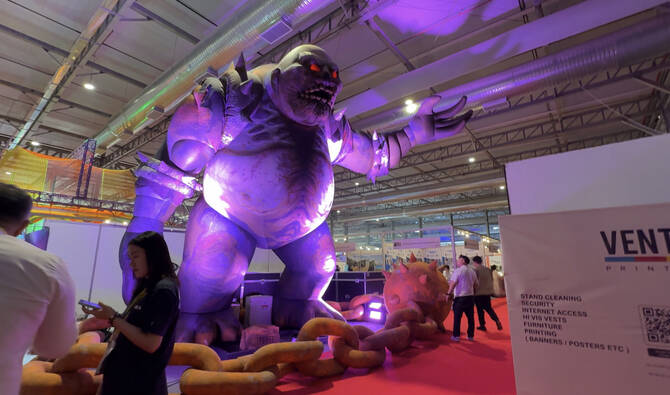
Another of the exhibits on show, and possibly the largest, is a 20-meter tall inflatable ogre, designed and built by Anka Inflatable Co. from Guangzhou in southern China.

A representative of the company, who gave his name only as John, said the product was ideal for larger venues, like amusement parks.

While the purple monster attracted plenty of visitors at the show, the technology can be adapted to suit the end-user’s needs, John said.

“(It) can be customized in many shapes and the skin can be changed after one, two, or three years. It’s also collapsible and easy to transport,” he said.

Anka was also keen to increase its profile in the region, he said.

“Many of my friends have built successful companies here. The relationship between China and Saudi Arabia is strong and this is a very good market for us.”

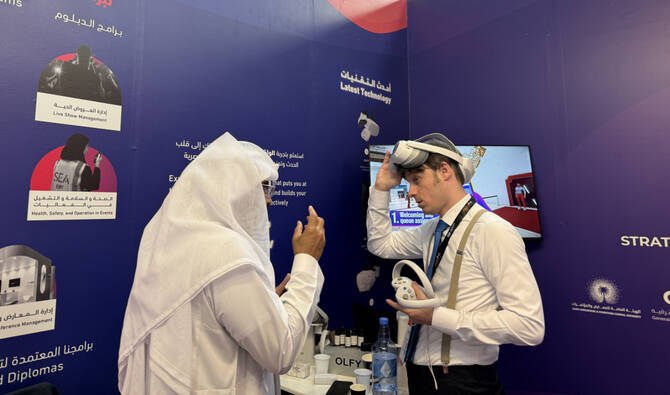
Besides the products on show, the expo is also being used to attract new people into the industry, with the Saudi Entertainment Academy promoting a series of training programs with links to future career opportunities.

“Our vision is to focus on professional training through diploma programs,” Sultan bin Jumaiah, a sales specialist with the academy, said.

“We aim to provide professional candidates for companies looking to hire. After completing our diploma, students will have the opportunity to join various companies in this sector.”

The initiative aligns with Saudi Vision 2030, which seeks to diversify the economy and create new job opportunities for Saudi citizens.


Riyadh emerges as Gulf evacuation hub for wealthy amid regional escalation

Updated 6 sec ago
Follow

Riyadh emerges as Gulf evacuation hub for wealthy amid regional escalation

  • Saudi capital’s King Khalid International Airport is among the few major airports in the region still operating normally after Iranian missile and drone strikes

RIYADH: Riyadh has become a principal evacuation hub for wealthy residents and senior executives seeking to leave the Gulf amid escalating regional tensions, according to a report by Semafor.

The Saudi capital’s King Khalid International Airport is among the few major airports in the region still operating normally after Iranian missile and drone strikes targeted cities including Dubai and Abu Dhabi over the weekend, as well as locations in Qatar and Bahrain.

With airspace closures elsewhere, stranded executives and high-net-worth individuals have been travelling overland to Riyadh, in some cases undertaking a roughly 10-hour journey from Dubai, in order to board private or commercial flights out of the region.

Citing people familiar with the arrangements, Semafor reported that private security firms have been hiring fleets of SUVs to transport clients to the Saudi capital before arranging chartered aircraft departures.

Those being evacuated include senior figures at global financial institutions as well as affluent individuals who had been in the Gulf for business or leisure.

The surge in demand has sharply increased costs.

Ameerh Naran, chief executive of private jet brokerage Vimana Private, told Semafor that Riyadh is currently “the only real option” for those seeking to exit the region, with private jet charters from the Saudi capital to Europe reaching as much as $350,000.

Alternative routes have narrowed. Security providers initially explored using Oman as an exit corridor, but that option became unviable after reported Iranian strikes on the country’s port infrastructure and a tanker, leaving Riyadh as the most accessible transit point, the report said.

Riyadh’s role marks a notable shift in regional risk perception. In previous years, security concerns — including cross-border Houthi attacks during the Yemen conflict and earlier periods of regional instability — had led many expatriates and business leaders to favour other Gulf cities as transit hubs.

However, Saudi Arabia’s more flexible visa regime, which now allows many nationalities to obtain visas on arrival, combined with the kingdom’s ability so far to keep its airspace open, has reinforced its position as a temporary gateway out of the region.

While some schools have moved to remote learning and certain companies have advised staff to work from home, Semafor reported that daily life in Riyadh has largely continued uninterrupted compared with other Gulf cities that have faced direct attacks.