

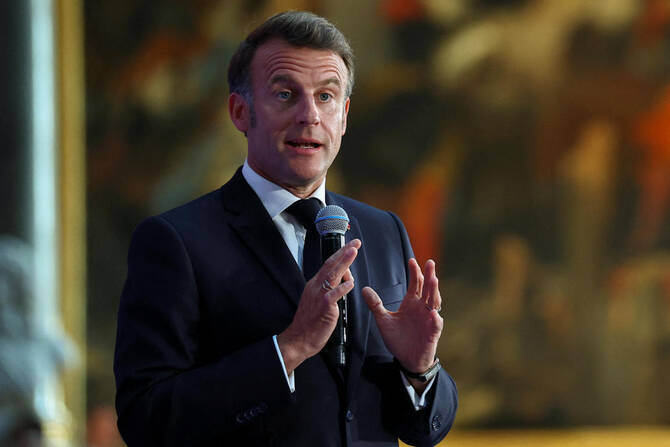

PARIS: President Emmanuel Macron on Wednesday ordered the government to draw up proposals to tackle the influence of the Muslim Brotherhood movement and the spread of political Islamism in France, the Elysee said.
The French presidency made the announcement after Macron chaired a security meeting to examine a report sounding the alarm about the Muslim Brotherhood and saying the movement poses “a threat to national cohesion” in France.
“Given the importance of the subject and the seriousness of the facts established, he has asked the government to draw up new proposals that will be examined at a forthcoming Defense Council meeting in early June,” the Elysee Palace said.
In a rare move, Macron has also decided to make the report public by the end of the week. AFP obtained a copy of the report on Tuesday.
The Elysee Palace has said that some measures will be announced, while others will be classified.
The report into the movement, which was founded in Egypt in 1928, was commissioned by the government and prepared by two senior civil servants.
It “clearly establishes the anti-republican and subversive nature of the Muslim Brotherhood” and “proposes ways to address this threat,” the presidency said ahead of the meeting.
France and Germany have the biggest Muslim populations among European Union countries.
Authorities are eager to prevent any spread of extremist Islamist ideas in a country that has been rocked by a string of deadly jihadist attacks.
Religious radicalization has become a hot-button issue as the far-right is becoming increasingly popular in France.
The report sparked heated reactions.
Far-right leader Marine Le Pen accused the government of inaction, saying on X that she has long proposed measures to “eradicate Islamist fundamentalism.”
Jordan Bardella, the leader of her National Rally party, said on France Inter radio: “If we come to power tomorrow, we will ban the Muslim Brotherhood.”
But critics have condemned what they call the rise of Islamophobia in France.
“Islamophobia has crossed a line,” hard-left firebrand Jean-Luc Melenchon said on X.
He accused officials of endorsing “the delusional theories” of Le Pen and France’s hard-line Interior Minister, Bruno Retailleau.
The report pointed to the spread of Islamism “from the bottom up,” adding the phenomenon constituted “a threat in the short to medium term.”
At the same time, the presidency stressed, “we are all perfectly aligned in saying that we must not lump all Muslims together.”
“We are fighting against Islamism and its radical excesses.”
The report zeroed in on the role of Muslims of France (Musulmans de France), which it identified as “the national branch of the Muslim Brotherhood in France.”
The Federation of Muslims of France denounced “unfounded accusations” and warned against “dangerous” conflation between Islam and radicalism.
“We firmly reject any allegation that attempts to associate us with a foreign political project or an ‘entryism’ strategy,” said Muslims of France, warning against “a stigmatization of Islam and Muslims.”
The “constant accusation shapes minds, fuels fears and, sadly, contributes to violent acts,” it added, pointing to the death of Aboubakar Cisse, a 22-year-old Malian who was stabbed dozens of times while praying in a mosque in southern France.
Conservative daily Le Figaro, which first published excerpts of the “shocking” report on Tuesday, said the Muslim Brotherhood “wants to introduce Sharia law in France.”
The report said however that “no recent document demonstrates the desire of Muslims in France to establish an Islamic state in France or to enforce Sharia law there.”
But the threat was real, the authors said.
“We are not dealing with aggressive separatism” but a “subtle... yet no less subversive aim for the institutions.”
Macron’s party proposed banning minors under 15 from wearing the Muslim headscarf in public spaces, saying the hijab “seriously undermines gender equality and the protection of children.”
The party also wants to introduce a “criminal offense for coercion against parents who force their underage daughters to wear the veil.”
In 2023, France banned pupils in public schools from wearing the abaya, a loose-fitting garment worn by Muslim women.


