

‘Heartbroken’ Malala calls on world leaders to end Israel’s ‘genocide’ in Gaza

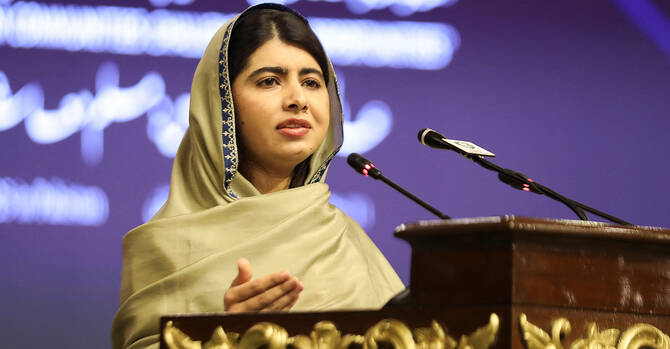
Nobel laureate Malala Yousafzai speaks during the "Girls' Education in Muslim Communities: Challenges and Opportunities" summit in Islamabad, Pakistan, on January 12, 2025. (REUTERS/File)
Short Url
Updated 21 May 2025
Follow

‘Heartbroken’ Malala calls on world leaders to end Israel’s ‘genocide’ in Gaza

  • Nobel Peace Prize winner draws attenion to starving children, demolished schools and hospitals, blocked humanitarian aid in Gaza
  • The war, now in its 20th month, has killed over 53,000, left Gaza in ruins and its population facing a worsening hunger crisis

KARACHI: Nobel Peace Prize winner Malala Yousafzai on Wednesday said she was “heartbroken” by starving children, demolished schools and hospitals, blocked humanitarian aid and displaced families in Gaza, calling on world leaders to push Israel to end its ‘genocide’ in the besieged enclave.

Israel’s ground and air offensive, launched in October 2023, has displaced nearly all of Gaza’s 2.3 million residents and killed more than 53,000, according to Gaza health authorities. Israeli strikes have killed more than 500 people in the past nine days alone as its military campaign has intensified, Gaza medics say.

The war, now in its 20th month, has left Gaza in ruins and its population facing a worsening hunger crisis. It has strained Israel’s relations with much of the world and those with its closest ally, the United States, now appear to be wavering.

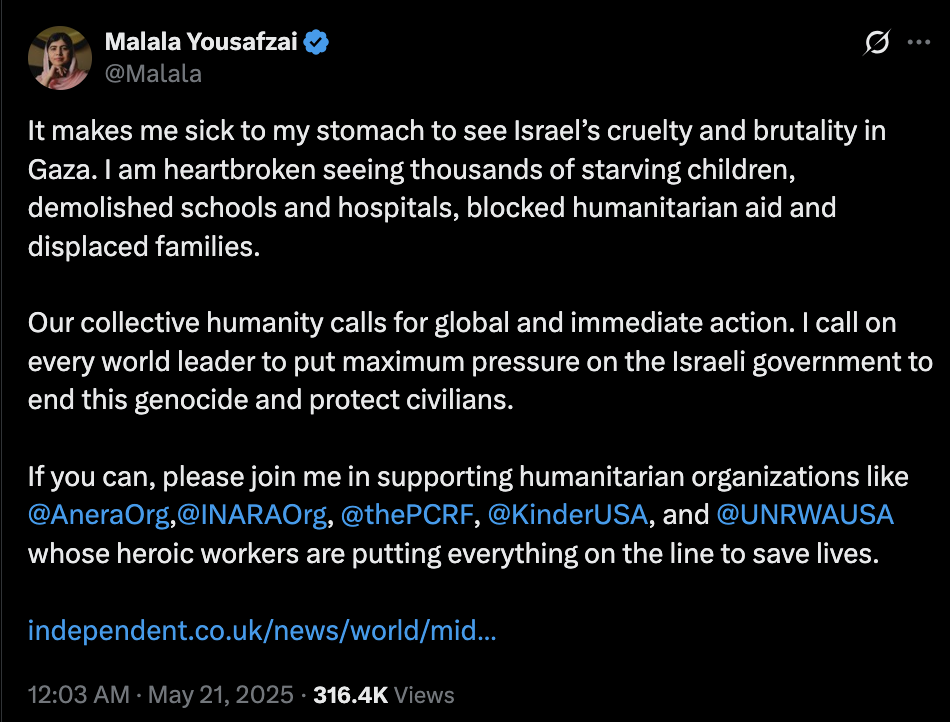
“It makes me sick to my stomach to see Israel’s cruelty and brutality in Gaza. I am heartbroken seeing thousands of starving children, demolished schools and hospitals, blocked humanitarian aid and displaced families,” Malala wrote on X.

“Our collective humanity calls for global and immediate action. I call on every world leader to put maximum pressure on the Israeli government to end this genocide and protect civilians.”
Malala’s statement came as Britain announced it was suspending trade talks with Israel and summoning its ambassador over “egregious policies” in the occupied West Bank and Gaza. 

British Prime Minister Keir Starmer told parliament he, along with the leaders of France and Canada, was “horrified” by Israel’s military escalation, repeating calls for a ceasefire.

The three nations had warned on Monday of “concrete actions” against Israel if it did not stop military operations in Gaza and lift restrictions on aid.

In addition to suspending trade talks, Britain announced sanctions against a number of individuals and groups in the Israeli-occupied West Bank over alleged violence against Palestinian residents.

European Union foreign policy chief Kaja Kallas has also asked for a review of the EU-Israel trade deal, according to Dutch news agency ANP.

EU sanctions on violent Israeli settlers have been prepared but have so far been blocked by one member state, Kallas said, without naming the country.

“External pressure will not divert Israel from its path in defending its existence and security against enemies who seek its destruction,” Israeli Foreign Ministry spokesperson Oren Marmorstein posted on X.

The United Nations said no humanitarian aid had been distributed yet in Gaza, although Israel eased its 11-week-old blockade on Monday.

“Israeli authorities are requiring us to offload supplies on the Palestinian side of Kerem Shalom crossing and reload them separately once they secure our team’s access from inside Gaza,” said UN spokesperson Stephane Dujarric.

He said four trucks of baby food were dropped off on the Palestinian side of the border on Monday, and that a few dozen trucks of flour, medicine, nutrition supplies and other basic items entered Gaza on Tuesday.

Israel’s military said 93 UN aid trucks entered Gaza on Tuesday via Kerem Shalom “after a thorough security inspection.”

– With inputs from Reuters


Punjab expands Pakistan-India Wagah border arena with museum, partition-themed park

Updated 4 sec ago
Follow

Punjab expands Pakistan-India Wagah border arena with museum, partition-themed park

  • The border crossing, near eastern city of Lahore, is the primary land route between Pakistan and India and one of the most recognizable symbols of their often-tense relations
  • The site is best known for its daily flag-lowering ceremony, a choreographed military ritual performed by border forces from both countries that draws thousands of spectators

ISLAMABAD: Maryam Nawaz, chief minister of Pakistan’s Punjab province, on Thursday inaugurated the newly constructed arena at Wagah border cross between Pakistan and India, which includes a museum and a partition themed park.

The Wagah border crossing, located near the eastern city of Lahore, is the primary land route between Pakistan and India and one of the most recognizable symbols of the often-tense relationship between the two neighbors. It serves as a key point for prisoner exchanges and limited movement of travelers, while remaining tightly regulated due to security considerations.

The site is best known for its daily flag-lowering ceremony, a choreographed military ritual performed by border forces from both countries that draws thousands of spectators. Over the years, the ceremony has evolved into a popular tourist attraction, blending displays of nationalism with public spectacle and making it one of Pakistan’s most visited landmarks, which connects with India’s Attari.

Flanked by military officials, CM Nawaz visited the crossing and inaugurated the new arena, with its seating capacity increased from 7,500 to 25,000 spectators, the state-run Radio Pakistan broadcaster reported. The chief minister also visited the martyrs’ monument and offered her respects.

“In addition to the arena’s expansion, several new constructions have been added at the Joint Check Post Wagah. These new developments include a theme park depicting the partition of the Subcontinent, featuring models of a railway station, military equipment and a Martyrs’ Memorial,” the broadcaster reported.

“A Pakistan Museum has also been established within the arena, showcasing the country’s history and culture from the Freedom Movement to the present day.”

In August 1947, Britain divided the Indian Sub-continent, its former colony, into two countries — Hindu-majority India and Muslim-majority Pakistan.

Excitement over independence was quickly overshadowed by some of the worst bloodletting that left up to 1 million people dead as gangs of Hindus and Muslims slaughtered each other.

Creating two independent nations also tore apart millions of Hindu and Muslim families in one of the world’s largest peacetime migrations, which displaced at least 15 million people.

The fate of Kashmir, then a princely state, was left undecided. The Himalayan territory continues to remain a flashpoint in relations between the neighbors, who have fought multiple wars over it.