

Pakistan reports two new polio cases, bringing 2025 tally to 10

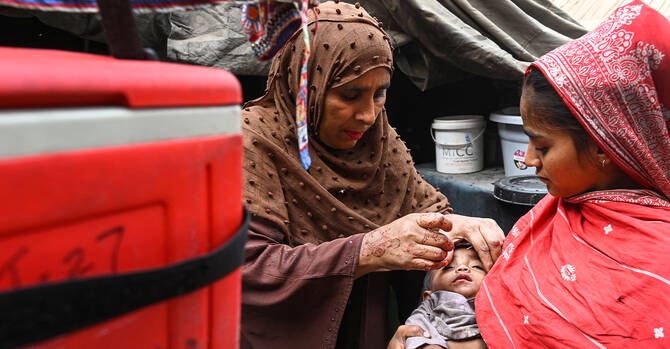
A health worker administers polio drops to a child during a door-to-door vaccination campaign in Lahore on October 28, 2024. (AFP/File)
Short Url
Updated 21 May 2025
Follow

Pakistan reports two new polio cases, bringing 2025 tally to 10

  • Pakistan, Afghanistan last two countries in the world where polio remains endemic
  • Pakistan reported 74 cases of polio in 2024, raising alarm bells over a fresh breakout 

KARACHI: Pakistan’s polio eradication program said on Wednesday two new cases of the wild poliovirus had been detected in the country’s northwestern Khyber Pakhtunkhwa province, bringing the tally of 2025 cases to 10.

The new cases have emerged ahead of the government launching a third nationwide campaign to vaccinate children under the age of five, scheduled from May 26 to June 1. The campaign will target over 45.4 million children across 159 districts, including high-risk areas of southern Khyber Pakhtunkhwa, where the new cases have been detected.

Polio is a paralyzing disease that has no cure. Multiple doses of the oral polio vaccine and completion of the routine vaccination schedule for all children under the age of 5 are essential to provide children high immunity against the disease.

“The Regional Reference Laboratory for Polio Eradication at the National Institute of Health has confirmed two new cases of wild poliovirus in District Lakki Marwat and District Bannu, South Khyber Pakhtunkhwa,” the body said in a statement. 

“With these latest detections, the total number of confirmed polio cases in Pakistan in 2025 has risen to 10, five from Khyber Pakhtunkhwa, four from Sindh, and one from Punjab.”

The statement said while polio vaccination campaigns continued nationwide, with two already held in 2025, certain areas, particularly in southern Khyber Pakhtunkhwa, faced challenges such as restricted access and difficulties in conducting house-to-house vaccination drives.

“These access and operational hurdles leave thousands of children, particularly in South KP, at risk of exposure to poliovirus as a result of missed opportunities for vaccination,” the statement said. 

Due to ongoing access constraints and community concerns, children in UC Bakhmal Ahmad Zai (Lakki Marwat) missed out on vaccination opportunities during the February and April 2025 immunization campaigns, resulting in immunity gaps. 

In UC Saintanga, Tehsil Wazir (Bannu), no comprehensive campaign had been implemented since October 2023. Limited access, shortage of female vaccinators, and gaps in monitoring had contributed to immunity gaps, leaving children at continued risk of poliovirus transmission.

“The Pakistan Polio Eradication Program is actively engaging with all stakeholders to address operational and access challenges and to enhance the effectiveness of vaccination campaigns in these high-risk areas. An intensified vaccination schedule is being implemented to interrupt virus transmission and protect children from lifelong paralysis,” the polio program added.

In the early 1990s, Pakistan reported around 20,000 polio cases annually but in 2018 the number dropped to eight cases. Six cases were reported in 2023 and only one in 2021. 

Pakistan and Afghanistan are the last two countries in the world where polio remains endemic.

Pakistan’s polio program began in 1994 but efforts to eradicate the virus have since been undermined by vaccine misinformation and opposition from some religious hard-liners who say immunization is a foreign ploy to sterilize Muslim children or a cover for Western spies. 

Militant groups also frequently attack and kill members of polio vaccine teams and security guards protecting them.



‘Fully stand with Bangladesh’: Pakistan PM backs decision to boycott India match

Updated 04 February 2026
Follow

‘Fully stand with Bangladesh’: Pakistan PM backs decision to boycott India match

  • Pakistan’s government have not allowed the national cricket team to play its World Cup match against India on Feb. 15
  • Pakistan has accused India of influencing ICC decisions, criticized global cricket body for replacing Bangladesh in World Cup

ISLAMABAD: Prime Minister Shehbaz Sharif on Wednesday backed his government’s decision to bar the national men’s cricket team from playing against India in the upcoming T20 World Cup tournament, reaffirming support for Bangladesh. 

Pakistan’s government announced on social media platform X last week that it has allowed its national team to travel to Sri Lanka for the World Cup. However, it said the Green Shirts will not take the field against India on their scheduled match on Feb. 15. 

Pakistan’s participation in the tournament was thrown into doubt after Pakistan Cricket Board (PCB) Chairman Mohsin Naqvi criticized the International Cricket Council (ICC) for replacing Bangladesh with Scotland. The decision was taken after Bangladesh said it would not let its team travel to India out of security concerns. 

During a meeting of the federal cabinet, Sharif highlighted that Pakistan has said that politics should be kept away from sports. 

“We have taken this stand after careful consideration and in this regard, we should stand fully with Bangladesh,” Sharif said in televised remarks. 

“And I believe this is a very reasonable decision.”

Pakistan has blamed India for influencing the ICC’s decisions. The global cricket governing body is currently led by Jay Shah, the head of the Board of Control for Cricket in India. Shah is the son of Indian Home Minister Amit Shah. 

Pakistan’s boycott announcement has triggered media frenzy worldwide, with several Indian cricket experts and analysts criticizing Islamabad for the decision. An India-Pakistan cricket contest is by far the most lucrative and eagerly watched match of any ICC tournament. 

The ICC has ensured that the two rivals and Asian cricket giants are always in the same group of any ICC event since 2012 to capitalize on the high-stakes game. 

The two teams have played each other at neutral venues over the past several years, as bilateral cricket remains suspended between them since 2013 due to political tensions. 

Those tensions have persisted since the two nuclear-armed nations engaged in the worst fighting between them since 1999 in May 2025, after India blamed Pakistan for an attack in Indian-administered Kashmir that killed tourists. 

Pakistan denied India’s allegations that it was involved in the attack, calling for a credible probe into the incident.