

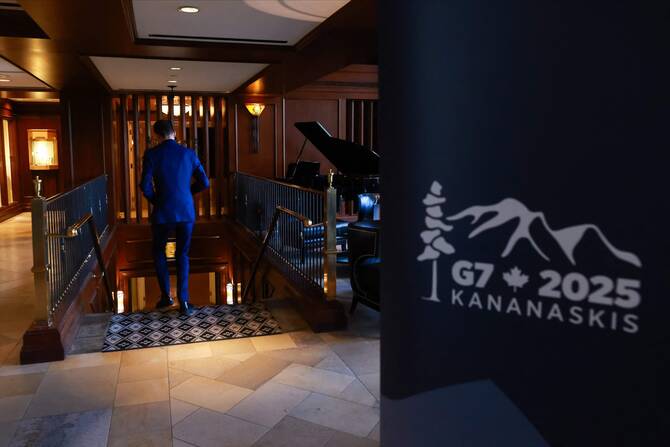
G7 finance chiefs gather with Trump tariffs, Ukraine war in focus

Economists warn tariffs could fuel inflation and weigh on growth, and the effects of US trade policy loom over Treasury Secretary Scott Bessent’s engagements. (AFP)
Short Url
Updated 21 May 2025
Follow

G7 finance chiefs gather with Trump tariffs, Ukraine war in focus

  • The talks take place amid an uncertain approach among the G7 democracies toward Ukraine following Trump’s return to power.

BANFF, Canada: Top finance leaders from the G7 group of nations gathered in Canada for talks beginning Tuesday, with the war in Ukraine and economic turmoil unleashed by US President Donald Trump’s tariffs at the top of minds.
In meetings through Thursday, leaders will discuss global economic conditions and seek a common position on Ukraine, whose representatives have been invited to attend.
Ukraine’s presence “sends a strong message to the world” that members are recommitting to support the country against Russia’s invasion, Canadian Finance Minister Francois-Philippe Champagne told reporters Tuesday.
“We’re also going to talk about what we’re going to be doing in terms of reconstruction,” he said in a joint press conference with Ukrainian counterpart Sergii Marchenko.
The talks in Canada’s western province of Alberta come amid an uncertain approach among the G7 democracies toward Ukraine following Trump’s return to power.
Once broadly unified, the G7 — Britain, Canada, France, Germany, Italy, Japan and the United States — has been rattled by Trump, who reached out to Russia and slapped tariffs on both allies and competitors.
Marchenko said he would seek during the meetings to reiterate Ukraine’s position on the need for more pressure on Russia.


While Trump’s levies are not formally on the agenda, a Canadian official told reporters that “trade and tariffs will be embedded in the discussion on the global economy.”
Economists warn tariffs could fuel inflation and weigh on growth, and the effects of US trade policy loom over Treasury Secretary Scott Bessent’s engagements.
Asked about talks with Bessent, Champagne said Tuesday that despite tension around tariffs, both sides are looking to coordinate actions and tackle concerns including excess industrial capacity, non-market practices and financial crimes.
“The spirit around the table is constructive,” he said.
A source briefed on US participation expects China’s excess industrial capacity to be discussed, with members sharing concerns on the issue.
A Japanese official told AFP its finance minister plans for a meeting with Bessent, seeking to address topics like foreign exchange.
While the grouping discusses policies and solutions to issues like trade, security and climate change, analysts warned of unpredictability this time amid internal tensions.


The gathering in picturesque Banff will be “a test or signal” of the G7’s ability to agree on a final statement,” a French finance ministry official told reporters Tuesday.
Although Canada’s presidency hopes to issue a communique, this outcome must reflect “a shared understanding of the global economic situation and common goals in addressing the challenges,” the official said.
“We will not be able to accept language that is completely watered down.”
The source briefed on US participation said Washington is not inclined to “do a communique just for the sake of doing a communique,” noting a consensus should align with Trump administration priorities too.
German Finance Minister Lars Klingbeil warned Tuesday that trade disputes with the United States should be resolved as soon as possible.
In comments before meeting his counterparts, Klingbeil said tariffs and uncertainties are a burden on the economy and job security.
Trump has slapped a blanket 10 percent tariff on most US trading partners, threatening higher rates on economies including the European Union and sending jitters through the world economy.
Officials told AFP they are not expecting trade agreements this week, but said the gathering is another chance to find common ground.
But the issue of sanctions on Russia remains uncertain.
Trump said Russia and Ukraine would start peace talks after he spoke Monday with Russian President Vladimir Putin, while the EU formally adopted a new round of Russia sanctions Tuesday.
A source briefed on US participation maintained that all options remain regarding sanctions, but these should be aimed at outcomes like the peace process


India rolls out strictest anti-pollution curbs as toxic smog engulfs Delhi

Demonstrator wearing an oxygen mask and holding oxygen tanks takes part in protest.
Updated 14 December 2025
Follow

India rolls out strictest anti-pollution curbs as toxic smog engulfs Delhi

  • Private monitors in several parts of northern Delhi recorded AQI spikes between 550 and 700s
  • Authorities invoked stage four of the capital region’s emergency pollution-control framework

NEW DELHI: India’s capital choked under a thick blanket of smog on Sunday, with the government imposing anti-pollution curbs after monitoring stations in some areas recorded extremely hazardous air quality.

Home to 30 million people, Delhi has not recorded a single “clean air” day in 2025, with Air Quality Index readings hitting high above the 50 score throughout the year.

On the AQI scale from 0 to 500, good air quality is represented by levels below 50, while levels above 300 are dangerous.

Worsening since late October, official records over the weekend were in the severe to severe-plus range of 400–500, but as 24-hour averages, they did not capture the peaks. Private monitors in several parts of North and North West Delhi recorded AQI spikes above 550 and even into the 700s in real-time.

On Saturday evening, the Ministry of Environment’s Commission for Air Quality Management invoked stage four — the highest level — of the Graded Response Action Plan for Delhi and surrounding areas.

To “prevent further deterioration of air quality in the region,” the commission suspended all non-essential construction, shut stone crushers and mining operations, stopped entry of trucks into the capital region, and ordered schools to shift to hybrid classes or online, where possible.

While authorities blamed the pollution on “adverse meteorological conditions,” residents have been demanding more government action.

“The situation is so bad in Delhi that we don’t have any option but to force kids to do online classes. The government has failed us; it has not done anything to address the issue,” said Nabanita Nayak, who decided for her teenage children to attend school online only, despite concerns over their screen addiction.

“If the kids are too much in front of laptops, that’s also an issue. As a mother, I am worried.” 

Delhi’s pollution has been worsening since Diwali in late October, when the average AQI has been above 370, or “very poor.” Since mid-November, it has been over 400, which means “severe” air quality, with certain areas recording 500 and above, which is classified as a “hazardous” level.

“I don’t feel proud living in Delhi. It’s the capital city of the country … We talk about being a developed nation by 2047 — we have deadlines,” said Jagriti Arora, who is keeping her 7-year-old daughter at home to prevent allergy flare-ups caused by air pollution.

“The government has to do something … China had a big problem with pollution, but now they’ve managed to bring it down.”

Delhi’s air quality deteriorates in winter due to local emissions and seasonal weather conditions. Cold temperatures and low wind speeds result in a temperature inversion, which traps pollutants close to the ground instead of letting them disperse. This allows emissions from millions of vehicles, ongoing construction, and nearby industrial activity to accumulate in the air. Urban waste burning and dust from construction sites further add to it.

“This is not a new thing. This has been happening now for over 10 years,” Arora said. “You can see it. You don’t need to actually look at an AQI meter to see how bad the pollution is these days.”