Rubio says Syria could be weeks away from ‘full-scale civil war’

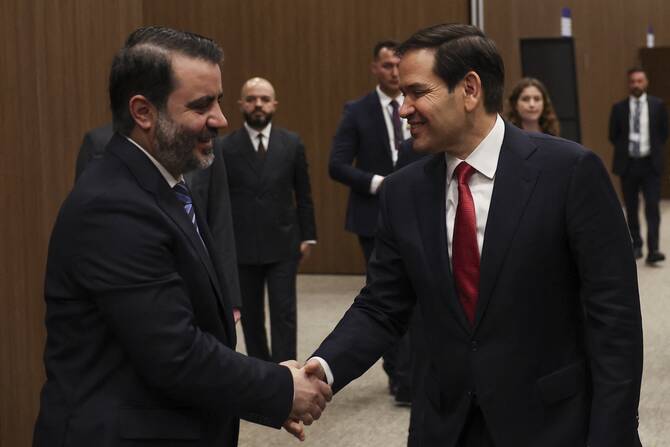
Syrian Foreign Minister Asaad Hassan al-Shibani (L) shakes hands with U.S. Secretary of State Marco Rubio at the NEST International Convention Center, in Antalya, May 15, 2025. (AFP)
Short Url
Updated 20 May 2025
Follow

Rubio says Syria could be weeks away from ‘full-scale civil war’

  • US Secretary of State says Syria is weeks away from a potential collapse and splitting up

WASHINGTON: US Secretary of State Marco Rubio warned Tuesday that Syria could be weeks away from a fresh civil war of “epic proportions,” as he called for support to the transitional leadership.
“It is our assessment that, frankly, the transitional authority, given the challenges they’re facing, are maybe weeks — not many months — away from potential collapse and a full-scale civil war of epic proportions, basically the country splitting up,” Rubio told a US Senate hearing.
The top US diplomat spoke after a series of bloody attacks on the Alawite and Druze minorities in Syria, where Islamist-led fighters in December toppled Bashar Assad in a lightning offensive after a brutal civil war that began in 2011.
US President Donald Trump last week on a visit to Saudi Arabia announced a lifting of Assad-era sanctions and met with the guerrilla leader who is now Syria’s transitional president, Ahmed Al-Sharaa.
Sharaa, clad in a suit and complimented by Trump as a “young, attractive guy,” was until recently on a US wanted list over jihadist connections.
Rubio quipped: “The transitional authority figures, they didn’t pass their background check with the FBI.”
But he added: “If we engage them, it may work out, it may not work out. If we did not engage them, it was guaranteed to not work out.”
Rubio, who also met with Syria’s foreign minister in Turkiye on Thursday, blamed the renewed violence on the legacy of Assad, a largely secular leader who hailed from the Alawite sect.
“They are dealing with deep internal distrust in that country, because Assad deliberately pitted these groups against each other,” Rubio said.


Pakistan PM orders strategy to improve project execution as multilateral lenders propose reforms

Updated 8 sec ago
Follow

Pakistan PM orders strategy to improve project execution as multilateral lenders propose reforms

  • Shehbaz Sharif says he will personally lead a steering committee to speed up priority projects
  • Four working groups proposed to streamline approvals, procurement, land issues and staffing

ISLAMABAD: Prime Minister Shehbaz Sharif on Monday directed officials to draw up a detailed strategy to improve the planning and execution of development projects, saying he would personally chair a steering committee aimed at ensuring timely and transparent completion of priority schemes.

The move came during a meeting where the World Bank and Asian Development Bank presented recommendations to the government on strengthening project implementation.

According to the prime minister’s office, participants received a briefing that said project approvals involve multiple steps and need simplification, while timely procurement and better readiness tools could also help accelerate implementation.

“National projects of critical importance must be completed transparently and on time,” Sharif told officials, according to the statement. “This is our priority.”

He said the federal and provincial steering committee on development-sector reforms would be headed by him.

The statement said four working groups were also proposed during the meeting: one to review approval and preparation processes, a second to modernize procurement, a third to address land acquisition and resettlement challenges, and a fourth to focus on human-resource alignment and staff deployment for development schemes.

Sharif thanked the World Bank and Asian Development Bank for their support and said development projects must be aligned with the objectives of Pakistan’s Public Sector Development Program (PSDP) and provincial Annual Development Plans (ADPs).

The meeting was attended by senior federal ministers, provincial representatives, senior civil servants and the country directors of both multilateral lenders.