

Pakistan, China to continue ‘cooperation for regional peace’ after India conflict

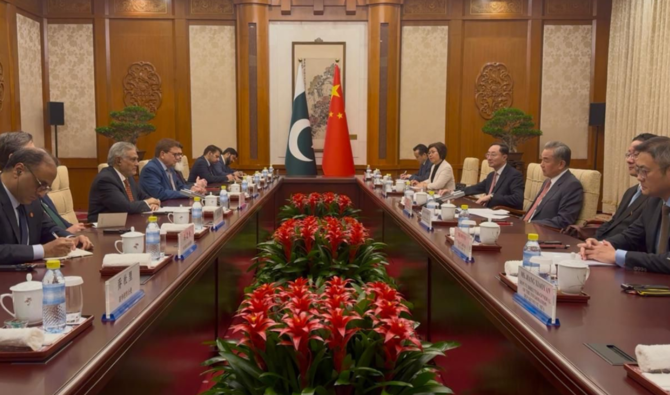
Pakistan Deputy Prime Minister Ishaq Dar and Chinese Foreign Minister Wang Yi hold in-depth consultations on May 20, 2025, in Beijing, China. (Photo courtesy: foreign office)
Short Url
Updated 20 May 2025
Follow

Pakistan, China to continue ‘cooperation for regional peace’ after India conflict

  • The statement comes after Pakistan declared its victory in a military standoff with India that saw Islamabad use China’s J-10Cs
  • India and China, two South Asian giants and nuclear powers, are widely seen as competitors and long-term strategic rivals

ISLAMABAD: Pakistan and China have resolved to continue “bilateral cooperation for regional peace, development and stability,” the Pakistani foreign office said on Tuesday, following a four-day military conflict between Pakistan and India.

The statement came during Pakistan Deputy Prime Minister Ishaq Dar’s three-day visit to Beijing after Pakistan and India exchanged missiles, drones and artillery fire until the United States brokered a ceasefire on May 10.

Pakistan declared a victory in the standoff, saying its air force used Chinese J-10C aircraft to shoot down six Indian fighter jets, including three French Rafales, and the army targeted several Indian military installations during the recent flare-up.

Dar on Tuesday held in-depth consultations with the Chinese Foreign Minister Wang Yi on the evolving situation in South Asia and the future trajectory of Pakistan-China partnership, according to the Pakistani foreign office.

“Both leaders expressed satisfaction at the commonality of views on all issues of mutual interest and expressed their firm resolve to continue bilateral cooperation for regional peace, development and stability,” it said in a statement.

For China, Pakistan is a strategic and economic ally. Beijing is investing over $60 billion to build infrastructure, energy and other projects in Pakistan as part of its China-Pakistan Economic Corridor.

India and China, on the other hand, are competing regional giants and nuclear powers and widely seen as long-term strategic rivals, sharing a 3,800 Himalayan border that has been disputed since the 1950s and sparked a brief war in 1962.

The most recent standoff — that started in 2020 — thawed in October as the two sides struck a patrolling agreement.

Dar, who is also the foreign minister of Pakistan, earlier began his day with a meeting with Liu Jianchao, Minister of the International Department of the Communist Party of China (IDCPC), who reiterated that “China will continue to prioritize its relations with Pakistan as an All-Weather Strategic Cooperative Partner and ironclad friend.”

Pakistan’s foreign office said in an earlier statement that Dar would discuss with Chinese leaders “the evolving regional situation in South Asia and its implications for peace and stability.”

“The two sides will also review the entire spectrum of Pakistan-China bilateral relations and exchange views on regional and global developments of mutual interest,” the statement added.

The conflict between India and Pakistan has offered the world a first real glimpse into how advanced Chinese military technology performs against proven Western hardware and Chinese defense stocks have already been surging as a result.

A rising military superpower, China hasn’t fought a major war in more than four decades but has raced under President Xi Jinping to modernize its armed forces, pouring resources into developing sophisticated weaponry and cutting-edge technologies.

It has also extended that modernization drive to Pakistan, long hailed by Beijing as its “ironclad brother.”

Over the past five years, China has supplied 81 percent of Pakistan’s imported weapons, according to data from the Stockholm International Peace Research Institute (SIPRI). Those exports include advanced fighter jets, missiles, radars and air-defense systems. Some Pakistan-made weapons have also been co-developed with Chinese firms or built with Chinese technology and expertise.


Curfew extended in Gilgit-Baltistan, probe ordered after deadly Khamenei protests

Updated 03 March 2026
Follow

Curfew extended in Gilgit-Baltistan, probe ordered after deadly Khamenei protests

  • At least 15 people were killed in clashes with law enforcement agencies over the weekend in Gilgit-Baltistan
  • Government also announces a de-weaponization campaign, crackdown on hate speech and cybercrime in region

ISLAMABAD: The government in Pakistan’s Gilgit-Baltistan (GB) region on Tuesday extended a curfew in Gilgit district and ordered a judicial probe into violent protests over the killing of Iranian Supreme Leader Ali Khamenei in US-Israeli strikes last week, an official said.

At least 15 people were killed in clashes with law enforcement agencies over the weekend in GB, where protesters torched and vandalized several buildings, including United Nations regional offices, an army-run school, software technology park and a local charity building.

The violence prompted regional authorities to impose curfew in Gilgit and Skardu districts on March 2-4 as officials urged people to stay indoors and cooperate with law enforcers, amid widespread anger in Pakistan, particularly among members of the Shiite minority, over Khamenei’s killing.

On Tuesday, the GB government convened to review the situation and announced the extension of curfew in Gilgit among a number of security measures as well as ordered the establishment of a judicial commission to investigate the weekend violence in the region.

“The government has made it clear that the law will strictly take its course against elements involved in vandalism at government institutions, private properties and incidents of vandalism in Gilgit and Skardu and no kind of mischief will be tolerated,” Shabbir Mir, a GB government spokesperson, said in a statement.

“In view of the security situation, curfew will remain in force in Gilgit, while the decision to extend the curfew in Skardu will be taken keeping the ground realities and the changing situation in view.”

The statement did not specify how long the curfew will remain in place in Gilgit.

Besides the formation of the judicial commission to investigate the violent clashes, the government also decided to launch a large-scale de-weaponization campaign in the entire Gilgit district, for which relevant institutions have been directed to immediately complete all necessary arrangements, according to Mir.

In addition, a crackdown has been ordered on hate speech, spread of fake news and cybercrime.

“The aim of these decisions is to ensure the rule of law, protect the lives and property of citizens and crack down on miscreants,” he said. “Approval has also been given to immediately survey the affected infrastructure and start their restoration work on priority basis.”

Demonstrators in Pakistan’s southern port city of Karachi also stormed the US Consulate on Sunday, smashing windows and attempting to burn the building. Police responded with batons, tear gas, and gunfire, leaving 10 people dead and more than 50 injured.

Pakistani authorities have since beefed up security at US diplomatic missions across the country, including around the US consulate building in Peshawar, to avoid any further violence.