PARIS: Breaking with tradition at the Tour de France is stirring controversy.
Since race organizers announced plans last week to climb the iconic Montmartre hill in Paris during the final stage in July, the cycling world has been abuzz. Could the climb actually decide the Tour winner? Or disrupt the final sprint by injecting tactical uncertainty into what is usually a celebratory day?
Well, that remains to be seen. But one thing seems certain: The stage will be a spectacle.
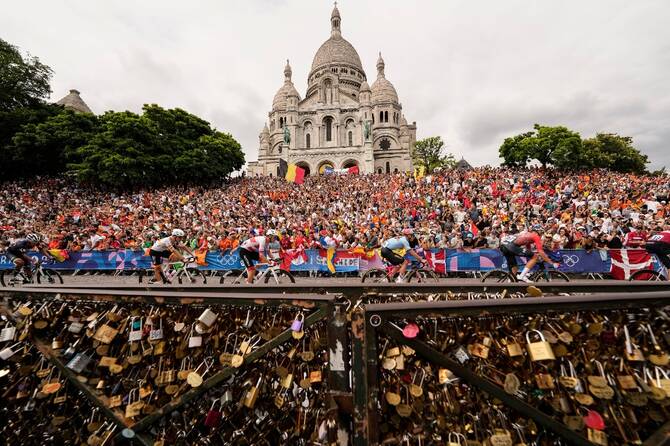
At last year’s Olympics, massive crowds lined the streets of Montmartre — the area in the northern part of Paris that is popular among artists and offers grand vistas of the city — to cheer on riders.
Inspired by the frenetic atmosphere and willing to build on the momentum, Tour organizers said this month that riders competing in cycling’s biggest race this summer would climb the Montmartre hill and pass beneath the Sacré-Coeur basilica before “battling it out on a stage that may break from the traditions established over the past 50 years in the heart of the capital.”
Traditionally, the Tour final stage is largely processional until a sprint decides the day’s winner on the Champs-Élysées. Last year’s final stage was held outside Paris for the first time since 1905 because of a clash with the Olympics, moving instead to Nice. The world famous avenue is back on the program this year for the conclusion of the 3,320-kilometer (2,060-mile) race.
The inclusion of the steep Montmartre climb could dramatically change the dynamics of the stage. If the hill features just a few kilometers from the finish line, or is climbed several times, pure sprinters will likely be dropped before they can compete for the stage win. And if the general classification remains tight ahead of the final stage, the yellow jersey itself could be decided in Paris.
Riders not happy
Full details of the route will be presented at a news conference on Wednesday. With a peloton roughly twice as big as it was at the Olympics, organizers are working with Paris authorities and the Prefecture of police to ensure the security of the race on the narrow and cobbled streets of the area. But some top riders have already expressed their lack of enthusiasm about the addition.
“Montmartre was nice to do in the Olympics, it seemed good, a lot of people, a really good atmosphere,” two-time Tour champion Jonas Vingegaard told reporters this week. “But when they came to the Montmartre, there was only 15 riders left in the bunch. And when we do the Tour de France, there will be 150 guys fighting for positions on a very narrow climb. It could end up being more stress than they want to have.”
Even Remco Evenepoel, who won the Olympic men’s road race in Paris last year and the gold medal in the time trial, is also opposed to the idea.
“There will be enough battle for positioning in the first week of the Tour,” he told sports media Sporza. “With Montmartre added, that would mean we have to do the same on the last day. We will be tired enough by then.”
Evenepoel also lamented the fact that sprinters would be robbed of a rare chance to claim a prestigious win on the world famous avenue.
“They get a big chance every year to sprint for a stage win on the Champs-Elysées,” he said. “That chance is then taken away from them. In my opinion, Montmartre is an unnecessary obstacle.”
Marc Madiot, who manages the Groupama-FDJ team, said bad weather on the final day could make the stage more treacherous.
“Imagine a slight rain in Paris; it’s not going to be easy for the riders,” he told RMC Radio. “Do we want a show? Do we want to visit Paris? Do we want to commemorate the Olympics? If we expect a real race, we could be disappointed. And if we do get a real race, we put everything that has happened in the last three weeks in jeopardy.”
The Tour starts from the northern city of Lille on July 5, and the women’s race kicks off on July 26 from the Brittany town of Vannes.

Tour de France’s new Montmartre climb could be a game changer. It sparks controversy
https://arab.news/6tbzg
Tour de France’s new Montmartre climb could be a game changer. It sparks controversy
FIFA accused of ‘monumental betrayal’ over latest World Cup ticket prices
- Fan organization Football Supporters Europe (FSE) described the current prices as “extortionate”
- The FSE called on FIFA to immediately halt ticket sales via national associations “until a solution that respects the tradition, universality, and cultural significance of the World Cup is found”
BERLIN: Soccer fans have accused FIFA of a “monumental betrayal” after latest prices for World Cup tickets began to circulate on Thursday.
The governing body allocates 8 percent of tickets to national associations for games involving their team to sell to the most loyal fans.
And a list published by the German soccer federation revealed prices ranged from $180-$700 for varying group stage games. The lowest price for the final was $4,185 and the highest was $8,680.
Those group-stage prices are very different from FIFA’s claims of $60 tickets being available, while the target from United States soccer officials when bidding for the tournament seven years ago was to offer hundreds of thousands of $21 seats across the opening phase of games.
Fan organization Football Supporters Europe (FSE) described the current prices as “extortionate.”
“This is a monumental betrayal of the tradition of the World Cup, ignoring the contribution of supporters to the spectacle it is,” it said in a statement.
The English Football Association shared pricing information with the England Supporters Travel Club (ESTC) on Thursday evening, which showed that if a fan bought a ticket for every game through to the final it would cost just over $7,000.
FIFA said in September that tickets released through its website would initially range from $60 for group-stage matches to $6,730 for the final. But those prices are subject to change as it adopts dynamic pricing for the first time at the World Cup.
FIFA tickets are available in four categories, with the best seats in Category 1.
In the price list published by the German federation, there were only three categories.
The lowest priced ticket was $180 for Germany’s opening group game against Curacao in Houston. The lowest price for the semifinal was $920 rising to $1,125.
The FSE called on FIFA to immediately halt ticket sales via national associations “until a solution that respects the tradition, universality, and cultural significance of the World Cup is found.”
The Associated Press approached FIFA for comment.
Latest phase
FIFA launched its third phase of widespread ticket sales Thursday, with fans now able to apply for specific matches for the first time through its “Random Selection Draw.”
Following last week’s draw for the 2026 tournament, which will be co-hosted by the United States, Canada and Mexico, an updated schedule has been published.
That means fans know when and where the likes of Lionel Messi and Argentina will play. Previous ticket ballots were blind as the qualification period had not even been completed and the draw was yet to take place.
Now participating nations have been placed in groups, with their paths through the tournament determined. For instance, Messi and Cristiano Ronaldo could go on to meet in the quarterfinals in Kansas City if both Argentina and Portugal top their respective groups.
Not that fans are guaranteed to get tickets to the games they apply for.
The draw opened Dec. 11 at 11 a.m. ET (1600 GMT) and closes Jan. 13, 2026.
FIFA says ticket applications can be made at any point during this window and the timing of entry will not impact the chances of success. Fans can apply via FIFA’s website for a maximum of four tickets per household per match and a maximum of 40 tickets throughout the tournament.
Fans will need a FIFA ID to apply for tickets and can pick which matches and which pricing category they want to apply for.
Successful applicants will be notified by email in February and charged automatically.
Prices
The last time the US hosted the World Cup in 1994 prices ranged from $25 to $475. In Qatar in 2022 prices ranged from around $70 to $1,600 when ticket details were announced.
Tickets for the final at MetLife Stadium on July 19 are already going for in excess of $11,000 on secondary resale sites.
For this tournament FIFA has also set up its own resale platform where it charges a 15 percent fee based on the total resale price.
FIFA said that closer to the tournament any remaining tickets will go on general sale on a first-come, first-served basis.
It did not reveal a time frame for the release of those remaining tickets.