

Pakistan textiles body says over 900 mills shut due to exports scheme

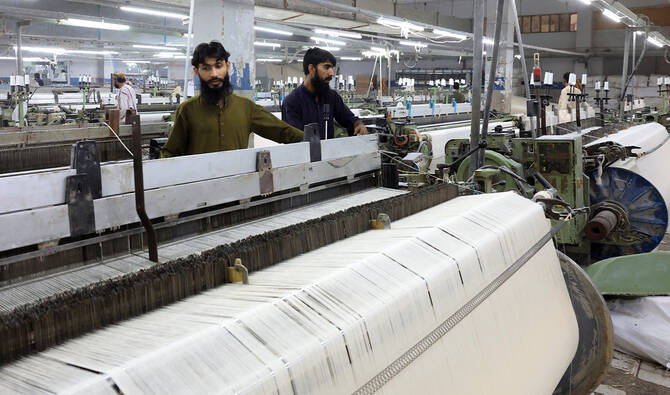
Economy Workers inspect loom machines, weaving fabric at a textiles manufacturer in Karachi, Pakistan, on April 3, 2025. (REUTERS/File)
Short Url
Updated 20 May 2025
Follow

Pakistan textiles body says over 900 mills shut due to exports scheme

  • Under Export Facilitation Scheme, exporters can import raw materials and inputs at 0 percent sales tax
  • However, an 18 percent tax on the same inputs has to be paid if they are produced locally in Pakistan

KARACHI: Pakistan’s textiles body said this week over 900 factories, including ginning and spinning mills, had been shut down due to a government export scheme that had disrupted operations and strained finances.

The Export Facilitation Scheme was launched in 2021, with the aim of simplifying the import of raw materials, machinery and input goods for exporters by offering minimal duties and taxes. Under the scheme, exporters can import raw materials and inputs at 0 percent sales tax. However, an 18 percent tax on the same inputs has to be paid if they are produced locally in Pakistan.

The textile industry is a major player in the country’s economy, contributing significantly to exports and employment. It’s one of the largest manufacturing sectors, employing about 45 percent of the industrial workforce and accounting for a substantial portion of Pakistan’s total exports. 

The industry is known for its cotton production, spinning capacity, and exports of various textile products. 

“Over 800 ginning factories and 120 spinning mills have shut down and millions of livelihoods lost,” All Pakistan Textile Mills Association Chairman Kamran Arshad said on Monday in a statement, urging the government to amend the Export Facilitation Scheme. 

“The crisis has reached the weaving sector, with looms shutting down and workers protesting on the streets.”

He urged the government to remove yarn and fabric from the exports scheme to halt the textile industry’s downfall. 

“It’s an irrational, self-destructive policy that punishes domestic production and rewards imports,” the statement said.

Pakistani cotton was taxed at 18 percent while imported cotton enjoyed sales tax exemption through the export scheme, the statement said, adding that sales tax refunds could only be filed after a six to 10 months cycle after the product was manufactured and exported.

“Only partial refunds of 60-70 percent are issued once a month,” it added. “The remaining amount is deferred for manual processing where there is already a backlog of over $392 million and no progress on clearing it over the last four to five years.”

As the eighth largest exporter of textile commodities in Asia, the textile industry contributes 8.5 percent to Pakistan’s gross domestic product.


JazzCash signs deal with Binance in UAE to explore regulated crypto adoption in Pakistan

Updated 24 min 59 sec ago
Follow

JazzCash signs deal with Binance in UAE to explore regulated crypto adoption in Pakistan

  • MoU focuses on awareness and development of compliant virtual-asset solutions in Pakistan
  • Pakistan introducing licensing regime for crypto firms as it formalizes digital-asset oversight

ISLAMABAD: Pakistani financial-technology platform JazzCash has signed a memorandum of understanding with global cryptocurrency exchange Binance in the United Arab Emirates to explore cooperation on virtual-asset use and education in Pakistan, the company said on Wednesday.

The agreement sets a framework for discussions on awareness campaigns and future digital-asset products that would comply with Pakistan’s emerging crypto regulations. The move signals growing engagement between global blockchain companies and Pakistani fintechs as authorities shift toward formal licensing of the sector.

Pakistan has spent the past year drafting rules to regulate the fast-expanding market for digital coins and tokens, requiring virtual-asset service providers to obtain government approval. Officials say the transition is aimed at curbing money-laundering and terror financing risks, boosting transparency and encouraging responsible innovation.

“JazzCash has always championed technologies that expand financial access while promoting secure and inclusive participation in the digital economy," JazzCash Chief Executive Officer Murtaza Ali said. 

“By entering into this exploratory MoU with Binance, we are advancing our efforts to understand how global digital-asset trends can support Pakistan’s evolving regulatory landscape. We aim to engage responsibly, support regulatory progress, and advance opportunities that build trust, transparency and innovation for our customers.”

The MoU does not establish a commercial partnership, but marks one of the most high-profile engagements between Pakistan’s fintech sector and a global crypto exchange as the country moves toward regulated digital-asset adoption.

Binance welcomed the cooperation, framing it as part of Pakistan’s shift toward regulated digital-asset activity.

"With regulatory frameworks like [Pakistan Virtual Assets Regulatory Authority] PVARA paving the way, this collaboration represents a significant step toward expanding financial inclusion and empowering more people to access the benefits of blockchain technology in a secure and compliant environment," Binance Chief Marketing Officer Rachel Conlan said.

Earlier this month, Binance executives met Pakistani finance officials to discuss digital-payments reform, blockchain-skills training and the potential for Web3-linked jobs. Pakistan also set up the Pakistan Crypto Council and formed PVARA this year to license and supervise crypto-asset service providers.