

Pakistan textiles body says over 900 mills shut due to exports scheme

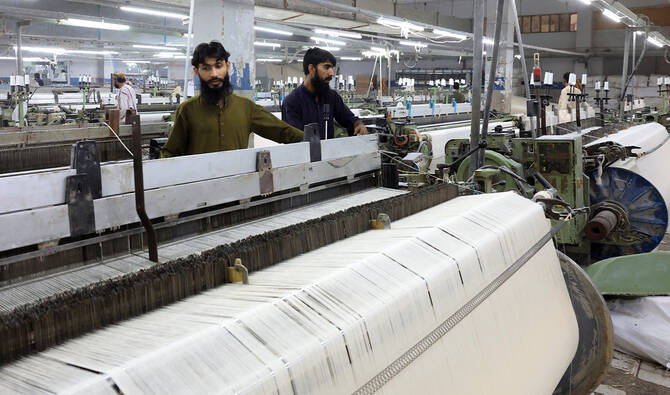
Economy Workers inspect loom machines, weaving fabric at a textiles manufacturer in Karachi, Pakistan, on April 3, 2025. (REUTERS/File)
Short Url
Updated 20 May 2025
Follow

Pakistan textiles body says over 900 mills shut due to exports scheme

  • Under Export Facilitation Scheme, exporters can import raw materials and inputs at 0 percent sales tax
  • However, an 18 percent tax on the same inputs has to be paid if they are produced locally in Pakistan

KARACHI: Pakistan’s textiles body said this week over 900 factories, including ginning and spinning mills, had been shut down due to a government export scheme that had disrupted operations and strained finances.

The Export Facilitation Scheme was launched in 2021, with the aim of simplifying the import of raw materials, machinery and input goods for exporters by offering minimal duties and taxes. Under the scheme, exporters can import raw materials and inputs at 0 percent sales tax. However, an 18 percent tax on the same inputs has to be paid if they are produced locally in Pakistan.

The textile industry is a major player in the country’s economy, contributing significantly to exports and employment. It’s one of the largest manufacturing sectors, employing about 45 percent of the industrial workforce and accounting for a substantial portion of Pakistan’s total exports. 

The industry is known for its cotton production, spinning capacity, and exports of various textile products. 

“Over 800 ginning factories and 120 spinning mills have shut down and millions of livelihoods lost,” All Pakistan Textile Mills Association Chairman Kamran Arshad said on Monday in a statement, urging the government to amend the Export Facilitation Scheme. 

“The crisis has reached the weaving sector, with looms shutting down and workers protesting on the streets.”

He urged the government to remove yarn and fabric from the exports scheme to halt the textile industry’s downfall. 

“It’s an irrational, self-destructive policy that punishes domestic production and rewards imports,” the statement said.

Pakistani cotton was taxed at 18 percent while imported cotton enjoyed sales tax exemption through the export scheme, the statement said, adding that sales tax refunds could only be filed after a six to 10 months cycle after the product was manufactured and exported.

“Only partial refunds of 60-70 percent are issued once a month,” it added. “The remaining amount is deferred for manual processing where there is already a backlog of over $392 million and no progress on clearing it over the last four to five years.”

As the eighth largest exporter of textile commodities in Asia, the textile industry contributes 8.5 percent to Pakistan’s gross domestic product.


Security forces kill nine Pakistani Taliban militants in restive northwest, military says

Updated 7 sec ago
Follow

Security forces kill nine Pakistani Taliban militants in restive northwest, military says

  • The militants were killed in separate operations in Khyber Pakhtunkhwa's Dera Ismail Khan and Bannu districts
  • Pakistan this week summoned Afghanistan’s deputy head of mission to demand action against the Pakistani Taliban

ISLAMABAD: Pakistan security forces have killed nine Pakistani Taliban militants in two separate engagements in the northwestern Khyber Pakhtunkhwa (KP) province, the military said on Sunday, amid a surge in militancy in the region bordering Afghanistan.

Four militants were killed in an intelligence-based operation in KP's Dera Ismail Khan, while five other Pakistani Taliban members were gunned in an exchange of fire with security forces in the Bannu district, according to the Inter-Services Public Relations (ISPR), the military's media wing.

Weapons and ammunition were also recovered from the deceased "Indian-sponsored" militants, who remained actively involved in numerous activities against security forces and law enforcement agencies and target killing of civilians. There was no immediate response from India to the statement.

"Sanitization operations are being conducted to eliminate any other Indian sponsored kharja [militant] found in the area," the ISPR said in a statement. "Pakistan will continue at full pace to wipe out menace of foreign sponsored and supported terrorism from the country."

KP has seen a surge in militancy in recent years, with the Pakistani Taliban, or the Tehreek-e-Taliban Pakistan (TTP), and other militant groups frequently targeting security forces convoys and check-posts, besides targeted killings and kidnappings of law enforcers and government officials.

Pakistan this week summoned Afghanistan’s deputy head of mission and demanded “decisive action” against the TTP after four Pakistani soldiers were killed in an attack on a military camp in KP’s North Waziristan district that also killed four assailants, according to the Pakistani foreign office.

Islamabad has long accused Kabul of allowing its soil and India of backing militant groups, including the TTP, for attacks against Pakistan. Kabul and New Delhi have consistently denied this.

The uptick in militant violence triggered fierce clashes between Pakistan and Afghanistan in Oct. The two countries agreed to a ceasefire in Doha on Oct. 19, but tensions remain high between the neighbors.