ISLAMABAD: Pakistan’s Deputy Prime Minister Ishaq Dar began meetings today, Tuesday, with Chinese officials during a three-day visit to Beijing to discuss “the evolving regional situation in South Asia and its implications for peace and stability,” the foreign office said.
The Beijing visit comes as the Pakistan Air Force (PAF) has hailed the use of Chinese J-10Cs to shoot down six Indian fighter jets, including three French Rafales, during a flare-up in hostilities that saw the nuclear-armed neighbors pound each other with missiles, drones and artillery for four days until the United States brokered a ceasefire earlier this month.
For China, Pakistan is a strategic and economic ally. It is investing over $60 billion to build infrastructure, energy and other projects in Pakistan as part of its China-Pakistan Economic Corridor.
India and China, on the other hand, are competing regional giants and nuclear powers and widely seen as long-term strategic rivals, sharing a 3,800 Himalayan border that has been disputed since the 1950s and sparked a brief war in 1962. The most recent standoff — that started in 2020 — thawed in October as the two sides struck a patrolling agreement.
Starting a day of meetings on Tuesday, Dar, who is also the foreign minister of Pakistan, met with the Minister of International Department of the Communist Party of China (IDCPC), Liu Jianchao.
“The DPM/FM appreciated China’s firm support to Pakistan’s sovereignty and territorial integrity, and issues of its core interest,” the foreign office said in a statement.
“Liu reiterated that as All-Weather Strategic Cooperative Partner and ironclad friend, China would continue to prioritize its relations with Pakistan.”
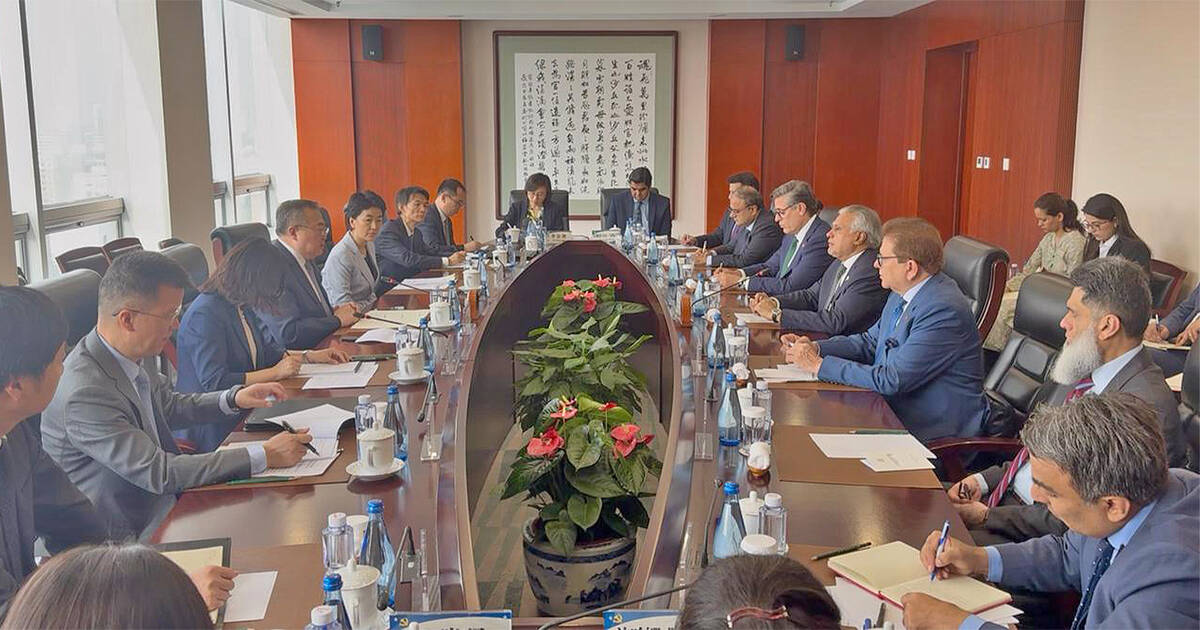
Pakistan’s Deputy Prime Minister Ishaq Dar (fouth from right) meets with the Minister of International Department of the Communist Party of China (IDCPC), Liu Jianchao, in Beijing on May 19, 2025. (Government of Pakistan)
In an earlier statement, the foreign office in Islamabad said Dar would discuss with Chinese leaders “the evolving regional situation in South Asia and its implications for peace and stability.”
“The two sides will also review the entire spectrum of Pakistan-China bilateral relations and exchange views on regional and global developments of mutual interest,” the statement added.
The conflict between India and Pakistan has offered the world a first real glimpse into how advanced Chinese military technology performs against proven Western hardware and Chinese defense stocks have already been surging as a result.
A rising military superpower, China hasn’t fought a major war in more than four decades but has raced under President Xi Jinping to modernize its armed forces, pouring resources into developing sophisticated weaponry and cutting-edge technologies.
It has also extended that modernization drive to Pakistan, long hailed by Beijing as its “ironclad brother.”
Over the past five years, China has supplied 81 percent of Pakistan’s imported weapons, according to data from the Stockholm International Peace Research Institute (SIPRI).
Those exports include advanced fighter jets, missiles, radars and air-defense systems. Some Pakistan-made weapons have also been co-developed with Chinese firms or built with Chinese technology and expertise.