TRIPOLI: At least 58 unidentified corpses were found on Monday in a hospital in Tripoli that was under the control of a militia whose leader was killed last week, the interior ministry said.
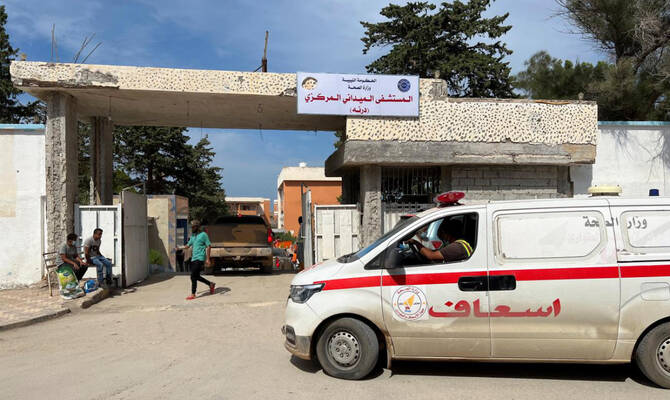
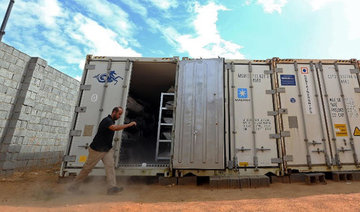
The corpses were found in a morgue refrigerator in Abu Salim Accidents Hospital in the densely populated Abu Salim neighborhood, following a report from the hospital, the ministry said in a statement.
Pictures of corpses with numbers and censored faces were posted by the ministry, showing remains in various states of decomposition on steel carriers and beds. Some of the remains were burnt. An investigation was underway to establish the identities of the deceased.
“So far, 23 corpses have been examined, and all necessary legal procedures have been taken, including documenting data and collecting samples,” the ministry said.
Abu Salim was home to a militia known as the Stabilization Support Apparatus, whose chief, Abdulghani Kikli, widely known as Ghaniwa, was killed in unconfirmed circumstances last Monday.
Kikli’s killing led to the sudden defeat of the SSA by factions aligned to internationally recognized Prime Minister Abdulhamid Al-Dbeibah of the Government of National Unity (GNU).
On Tuesday, Dbeibah ordered armed groups to be dismantled, triggering the fiercest clashes Tripoli had seen in years between two armed groups. The clashes killed at least eight civilians, according to the United Nations.
The corpses found on Monday are the second set of unidentified remains discovered in recent days. On Saturday, officials said nine corpses had been found in a morgue refrigerator in Al-Khadra hospital, another SSA-controlled hospital in the Abu Salim neighborhood.
The militia had not reported the corpses to the relevant authorities, the interior ministry said.
Dbeibah said on Saturday that eliminating militias was an “ongoing project,” as a ceasefire after last week’s clashes remained in place.
The GNU posted a video on Monday showing bulldozers demolishing the so-called 77 camp, one of the biggest facilities that was under control of SSA. The camp is to be turned into a national park.
Libya has had little stability since a 2011 NATO-backed uprising ousted longtime autocrat Muammar Qaddafi. The country split in 2014 between rival eastern and western factions, though an outbreak of major warfare paused with a truce in 2020.


![]()

At least 58 corpses found in Libyan hospital, ministry says
Short Url
https://arab.news/pbdsw
At least 58 corpses found in Libyan hospital, ministry says
- The corpses found on Monday are the second set of unidentified remains discovered in recent days

Latest updates


© 2026 SAUDI RESEARCH & PUBLISHING COMPANY, All Rights Reserved And subject to Terms of Use Agreement.