LONDON/BRUSSELS: Britain agreed the most significant reset of defense and trade ties with the European Union since Brexit on Monday after US President Donald Trump’s upending of the global order pushed the two sides to move on from their acrimonious divorce.
Nearly nine years after it voted to leave the bloc, Britain reached a wide-ranging deal with the EU including a security and defense pact, fewer restrictions on British food exporters and visitors, and a contentious new fishing agreement.
Trump’s tariffs, alongside warnings that Europe should do more to protect itself, forced governments around the world to rethink trade, defense and security ties, bringing British Prime Minister Keir Starmer closer to European leaders.
Starmer, who backed remaining in the EU in the Brexit referendum, also bet that offering benefits to Britons such as the use of faster e-gates at EU airports will drown out the cries of “betrayal” from Brexit campaigner Nigel Farage.
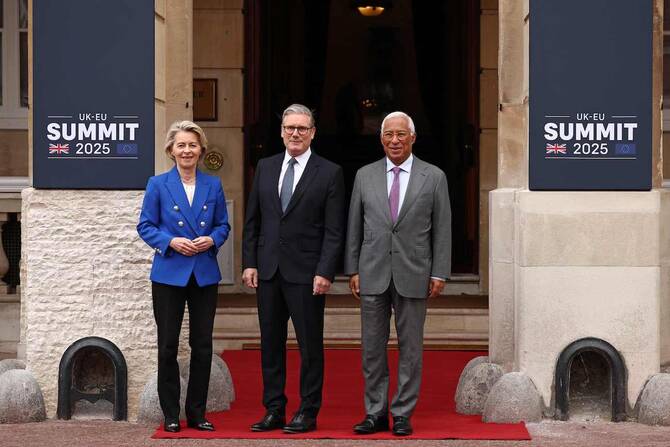
Flanked by EU Commission President Ursula von der Leyen and European Council President Antonio Costa at London’s Lancaster House, Starmer said the deal marked “a new era in our relationship.”
Von der Leyen said it sent a message: “At a time of global instability, and when our continent faces the greatest threat it has for generations, we in Europe stick together.”
Britain said the reset with its biggest trading partner would reduce red tape for agricultural producers — making food cheaper — improve energy security and, by 2040, add nearly 9 billion pounds ($12.1 billion) to the economy, which is about 2.6 trillion pounds in size.
It is the third deal Britain has struck this month, after agreements with India and the US, and while it is unlikely to lead to an immediate economic boost, it could lift business confidence, drawing much-needed investment.
At the heart of the reset is a defense and security pact that will let Britain be part of any joint procurement and pave the way for British companies including BAE, Rolls-Royce and Babcock to take part in a 150 billion euro ($167 billion) program to rearm Europe.
On fishing, British and EU vessels will have access to each other’s waters for 12 years — removing one of the UK’s strongest hands in any future talks — in return for a permanent reduction in paperwork and border checks that had prevented small food producers from exporting to Europe.
In return, Britain has agreed to the outline of a limited scheme to let young EU and British people live and work in each others’ territories for periods, with the details to be hammered out in future, and it is discussing participation in the Erasmus+ student exchange program.
The agreement was denounced by the opposition Conservative Party — which was in power when Britain left the bloc and spent years negotiating the original divorce deal — who said Britain will now have to accept EU rules.
Nigel Farage, head of the right-wing, pro-Brexit Reform UK party, called the deal an “abject surrender — the end of the fishing industry.” The Scottish Fishermen’s Federation called it a “horror show” because EU fishermen will be able to access British waters for far longer than had been expected.
Improving relations
Chris Curtis, a Labour member of parliament, said the deal would correct some of the problems created by the Conservatives’ original deal agreed after Brexit and said he believed most people wanted improved relations.
“It is very easy to pretend that there are no tradeoffs, that you can get everything you want, and you don’t have to give anything away, but that is clearly baloney,” he told Reuters.
Britain’s vote to leave the EU in a historic referendum in 2016 revealed a country that was badly divided over everything from migration and sovereignty of power to culture and trade.
It helped trigger one of the most tumultuous periods in British political history, with five prime ministers in office before Starmer arrived last July, and poisoned relations with Brussels.
Polls show a majority of Britons now regret the vote although they do not want to rejoin. Farage, who campaigned for Brexit for decades, now leads in opinion polls in Britain, giving Starmer limited room for maneuver.
But collaboration between Britain and European powers over Ukraine and Trump has rebuilt trust.
Rather than seek a full return to a pillar of the EU such as the single market, for fear of angering Brexit voters, Starmer sought to negotiate better market access in some areas — a move that is often rejected by the EU as “cherry picking” of EU benefits without the obligations of membership.
Removing red tape on food trade required Britain to accept EU oversight on standards, but Starmer will argue that it is worth it to grow the economy and cut food prices. Trade experts said breaking the taboo of EU oversight for something that would benefit small companies and farmers was good politics.
Despite the agreement, Britain’s economy will remain significantly different from before it left the bloc. Brexit cost London’s financial center thousands of jobs, has weighed on the sector’s output and reduced its tax contributions, studies show.

UK strikes EU trade and defense reset in ‘new era’ for relations
Short Url
https://arab.news/pnbxd
UK strikes EU trade and defense reset in ‘new era’ for relations
- Britain said the reset with its biggest trading partner would reduce red tape for agricultural producers and improve energy security
Thai villagers stay behind to guard empty homes as border clashes force mass evacuations
SURIN: Fighting that has flared along the Thai-Cambodian border has sent hundreds of thousands of Thai villagers fleeing from their homes close to the frontier since Monday. Their once-bustling communities have fallen largely silent except for the distant rumble of firing across the fields.
Yet in several of these villages, where normally a few hundred people live, a few dozen residents have chosen to stay behind despite the constant sounds of danger.
In a village in Buriram province, about 6 miles (10 kilometers) from the border, Somjai Kraiprakon and roughly 20 of her neighbors gathered around a roadside house, keeping watch over nearby homes. Appointed by the local administration as Village Security Volunteers, they guarded the empty homes after many residents were forced to flee and with fewer security officials stationed nearby than usual.
The latest large-scale fighting derailed a ceasefire pushed by US President Donald Trump, which halted five days of clashes in July triggered by longstanding territorial disputes. As of Saturday, around two dozen people had been reported killed in the renewed violence.
At a house on the village’s main intersection, now a meeting point, kitchen and sleeping area, explosions were a regular backdrop, with the constant risk of stray ammunition landing nearby. Somjai rarely flinched, but when the blasts came too close, she would sprint to a makeshift bunker beside the house, built on an empty plot from large precast concrete drainage pipes reinforced with dirt, sandbags and car tires.
She volunteered shortly after the July fighting. The 52-year-old completed a three-day training course with the district administration that included gun training and patrol techniques before she was appointed in November. The volunteer village guards are permitted to carry firearms provided by relevant authorities.
The army has emphasized the importance of volunteers like Somjai in this new phase of fighting, saying they help “provide the highest possible confidence and safety for the public.”
According to the army, volunteers “conduct patrols, establish checkpoints, stand guard inside villages, protect the property of local people, and monitor suspicious individuals who may attempt to infiltrate the area to gather intelligence.”
Somjai said the volunteer team performs all these duties, keeping close watch on strangers and patrolling at night to discourage thieves from entering abandoned homes. Her main responsibility, however, is not monitoring threats but caring for about 70 dogs left behind in the community.
“This is my priority. The other things I let the men take care of them. I’m not good at going out patrolling at night. Fortunately I’m good with dogs,” she said, adding that she first fed a few using her own money, but as donations began coming in, she was able to expand her feeding efforts.
In a nearby village, chief Praden Prajuabsook sat with about a dozen members of his village security team along a roadside in front of a local school. Around there, most shops were already closed and few cars could be seen passing once in a while.
Wearing navy blue uniforms and striped purple and blue scarves, the men and women chatted casually while keeping shotguns close and watching strangers carefully. Praden said the team stationed at different spots during the day, then started patrolling when night fell.
He noted that their guard duty is around the clock, and it comes with no compensation and relies entirely on volunteers. “We do it with our own will, for the brothers and sisters in our village,” he said.
Beyond guarding empty homes, Praden’s team, like Somjai, also ensures pets, cattle and other animals are fed. During the day, some members ride motorbikes from house to house to feed pigs, chickens and dogs left behind by their owners.
Although his village is close to the battlegrounds, Praden said he is not afraid of the sounds of fighting.
“We want our people to be safe… we are willing to safeguard the village for the people who have evacuated,” he said.
Yet in several of these villages, where normally a few hundred people live, a few dozen residents have chosen to stay behind despite the constant sounds of danger.
In a village in Buriram province, about 6 miles (10 kilometers) from the border, Somjai Kraiprakon and roughly 20 of her neighbors gathered around a roadside house, keeping watch over nearby homes. Appointed by the local administration as Village Security Volunteers, they guarded the empty homes after many residents were forced to flee and with fewer security officials stationed nearby than usual.
The latest large-scale fighting derailed a ceasefire pushed by US President Donald Trump, which halted five days of clashes in July triggered by longstanding territorial disputes. As of Saturday, around two dozen people had been reported killed in the renewed violence.
At a house on the village’s main intersection, now a meeting point, kitchen and sleeping area, explosions were a regular backdrop, with the constant risk of stray ammunition landing nearby. Somjai rarely flinched, but when the blasts came too close, she would sprint to a makeshift bunker beside the house, built on an empty plot from large precast concrete drainage pipes reinforced with dirt, sandbags and car tires.
She volunteered shortly after the July fighting. The 52-year-old completed a three-day training course with the district administration that included gun training and patrol techniques before she was appointed in November. The volunteer village guards are permitted to carry firearms provided by relevant authorities.
The army has emphasized the importance of volunteers like Somjai in this new phase of fighting, saying they help “provide the highest possible confidence and safety for the public.”
According to the army, volunteers “conduct patrols, establish checkpoints, stand guard inside villages, protect the property of local people, and monitor suspicious individuals who may attempt to infiltrate the area to gather intelligence.”
Somjai said the volunteer team performs all these duties, keeping close watch on strangers and patrolling at night to discourage thieves from entering abandoned homes. Her main responsibility, however, is not monitoring threats but caring for about 70 dogs left behind in the community.
“This is my priority. The other things I let the men take care of them. I’m not good at going out patrolling at night. Fortunately I’m good with dogs,” she said, adding that she first fed a few using her own money, but as donations began coming in, she was able to expand her feeding efforts.
In a nearby village, chief Praden Prajuabsook sat with about a dozen members of his village security team along a roadside in front of a local school. Around there, most shops were already closed and few cars could be seen passing once in a while.
Wearing navy blue uniforms and striped purple and blue scarves, the men and women chatted casually while keeping shotguns close and watching strangers carefully. Praden said the team stationed at different spots during the day, then started patrolling when night fell.
He noted that their guard duty is around the clock, and it comes with no compensation and relies entirely on volunteers. “We do it with our own will, for the brothers and sisters in our village,” he said.
Beyond guarding empty homes, Praden’s team, like Somjai, also ensures pets, cattle and other animals are fed. During the day, some members ride motorbikes from house to house to feed pigs, chickens and dogs left behind by their owners.
Although his village is close to the battlegrounds, Praden said he is not afraid of the sounds of fighting.
“We want our people to be safe… we are willing to safeguard the village for the people who have evacuated,” he said.
© 2025 SAUDI RESEARCH & PUBLISHING COMPANY, All Rights Reserved And subject to Terms of Use Agreement.