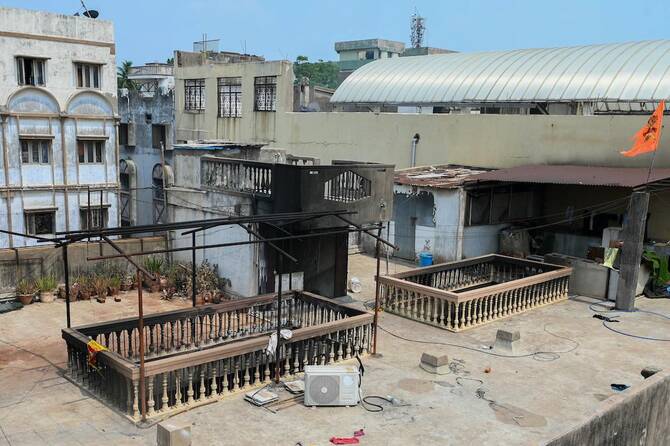
HYDERABAD, India: At least 17 people were killed and several injured in a fire that broke out at a building near the historic Charminar monument in southern Hyderabad city, officials said Sunday.
Several people were found unconscious and rushed to various hospitals, according to local media. They said the building housed a jewelry store at ground level and residential space above.
“The accident happened due to a short circuit and many people have died,” federal minister and Bharatiya Janata Party leader G Kishan Reddy told reporters at the site of the accident.
Director general of Telangana fire services Y Nagi Reddy told reporters that 21 people were in the three-story building when the fire started on the ground floor early on Sunday.
“17 people, who were shifted to the hospital in an unconscious state, could not survive. The staircase was very narrow, which made escape difficult. There was only one exit, and the fire had blocked it,” he said.
The fire was brought under control.
Prime minister Narendra Modi announced financial compensation for the victims’ families and said in a post on X that he was “deeply anguished by the loss of lives.”
Fires are common in India, where building laws and safety norms are often flouted by builders and residents.


![]()


Building fire kills 17, injures others in southern India
Short Url
https://arab.news/w52yu
Building fire kills 17, injures others in southern India
- Fires are common in India, where building laws and safety norms are often flouted by builders and residents


Polls open in Nepal’s first election after last year’s youth-led protests toppled the government
KATMANDU: Polls opened across Nepal on Thursday in the first nationwide election since last year’s violent, youth-led uprising forced the government from power.
Security forces patrolled streets and guarded polling stations across the Himalayan nation of about 30 million people as voters lined up to cast their ballots. Counting of votes will begin later Thursday, with results expected over the weekend.
Authorities banned vehicles from the streets and prohibited political rallies and public gatherings. All forms of campaigning are barred on election day.
Nearly 19 million people are eligible to vote, according to the Election Commission.
Voters are directly electing 165 members to the House of Representatives, the lower chamber of Parliament. The remaining 110 seats in the 275-member body will be allocated through a proportional representation system, under which political parties nominate lawmakers based on their share of the vote.
The election is widely seen as a three-way contest, shaped by voter frustration over widespread corruption and demands for greater government accountability.
The National Independent Party, founded in 2022, is considered the front-runner, posing a strong challenge to two long-dominant parties — the Nepali Congress and the Communist Party of Nepal (Unified Marxist–Leninist).
The new party’s prime ministerial candidate is rapper-turned politician Balendra Shah, who won the 2022 Katmandu mayoral race and emerged as a leading figure in the 2025 uprising that ousted former Prime Minister Khadga Prasad Oli.
Shah, 35, has rode a wave of public anger toward traditional political parties. He highlighted health and education for poor Nepalis as a key focus during his campaign.
The youth-led protests against corruption and poor governance were triggered by a social media ban before snowballing into a popular revolt against the government. Dozens were killed and hundreds injured when protesters attacked government buildings and police opened fire on them.
While the Congress and the Communists retain loyal voter bases, Shah’s party has drawn larger crowds on the campaign trail, highlighting its growing appeal among younger voters seeking an alternative.
The next administration is expected to inherit daunting challenges. It must deliver on changes demanded by last year’s protests, tackle entrenched corruption and carefully manage ties with its powerful neighbors, India and China.
Security forces patrolled streets and guarded polling stations across the Himalayan nation of about 30 million people as voters lined up to cast their ballots. Counting of votes will begin later Thursday, with results expected over the weekend.
Authorities banned vehicles from the streets and prohibited political rallies and public gatherings. All forms of campaigning are barred on election day.
Nearly 19 million people are eligible to vote, according to the Election Commission.
Voters are directly electing 165 members to the House of Representatives, the lower chamber of Parliament. The remaining 110 seats in the 275-member body will be allocated through a proportional representation system, under which political parties nominate lawmakers based on their share of the vote.
The election is widely seen as a three-way contest, shaped by voter frustration over widespread corruption and demands for greater government accountability.
The National Independent Party, founded in 2022, is considered the front-runner, posing a strong challenge to two long-dominant parties — the Nepali Congress and the Communist Party of Nepal (Unified Marxist–Leninist).
The new party’s prime ministerial candidate is rapper-turned politician Balendra Shah, who won the 2022 Katmandu mayoral race and emerged as a leading figure in the 2025 uprising that ousted former Prime Minister Khadga Prasad Oli.
Shah, 35, has rode a wave of public anger toward traditional political parties. He highlighted health and education for poor Nepalis as a key focus during his campaign.
The youth-led protests against corruption and poor governance were triggered by a social media ban before snowballing into a popular revolt against the government. Dozens were killed and hundreds injured when protesters attacked government buildings and police opened fire on them.
While the Congress and the Communists retain loyal voter bases, Shah’s party has drawn larger crowds on the campaign trail, highlighting its growing appeal among younger voters seeking an alternative.
The next administration is expected to inherit daunting challenges. It must deliver on changes demanded by last year’s protests, tackle entrenched corruption and carefully manage ties with its powerful neighbors, India and China.
Latest updates


© 2026 SAUDI RESEARCH & PUBLISHING COMPANY, All Rights Reserved And subject to Terms of Use Agreement.