Pakistan, Iran agree to enhance trade and security cooperation

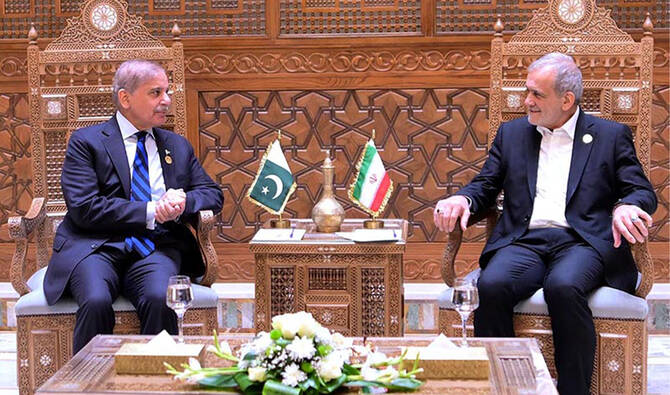
Pakistan Prime Minister Shehbaz Sharif meets Iranian President, Masoud Pezeshkian, on the sidelines of the 11th D-8 Summit in Cairo, Egypt, on December 19, 2024. (APP/File)
Short Url
Updated 18 May 2025
Follow

Pakistan, Iran agree to enhance trade and security cooperation

  • Prime Minister Shehbaz Sharif, Iranian President Masoud Pezeshkian discuss bilateral cooperation over phone 
  • Sharif thanks Iranian president for Tehran’s role in defusing South Asia tensions between India and Pakistan 

ISLAMABAD: Pakistan Prime Minister Shehbaz Sharif and Iranian President Masoud Pezeshkian this week agreed to enhance cooperation in trade, security and connectivity between the two countries, a statement from Sharif’s office said. 

Pakistan and Iran have had a history of rocky relations despite several commercial pacts, with Islamabad being historically closer to Saudi Arabia and the United States.

Their highest profile agreement is a stalled gas supply deal signed in 2010 to build a pipeline from Iran’s South Fars gas field to Pakistan’s southern provinces of Balochistan and Sindh. Pakistan and Iran are also often at odds over instability on their shared porous border, with both countries routinely trading blame for not rooting out militancy.

“They agreed to enhance cooperation in all areas of shared interest, especially trade, connectivity, security and people-to-people contacts,” the Pakistani Prime Minister’s Office (PMO) said regarding a phone call between Sharif and Pezeshkian on Saturday. 

It said the Iranian president invited Sharif to undertake an official visit to Tehran, which the Pakistani premier accepted. 

The two officials also discussed Pakistan’s recent conflict with India, which saw at least 70 killed on both sides last week. India and Pakistan attacked each other with drones, missiles, artillery fire and fighter jets before Washington brokered a ceasefire between the two countries on May 10. 

Sharif thanked Pezeshkian for Iran’s “sincere and brotherly diplomatic efforts” to defuse tensions in South Asia. He reaffirmed Pakistan’s “firm resolve” to defend its sovereignty and territorial integrity at all costs.

“The Prime Minister emphasized that Jammu and Kashmir dispute remained the root cause of instability in South Asia. He called for its just resolution, in accordance with the UN Security Council’s resolutions and the aspirations of the Kashmiri people, as key to enduring peace in the region,” the statement said. 


Pakistan hikes prices of petrol by Rs5, diesel by Rs7.32 per liter for next fortnight

Updated 10 sec ago
Follow

Pakistan hikes prices of petrol by Rs5, diesel by Rs7.32 per liter for next fortnight

  • After latest increase, new price of petrol is RsRs258.17 per liter while that of diesel is Rs275.70 per liter
  • Fuel prices in Pakistan are reviewed fortnightly, influenced by global oil prices, exchange rate movements, taxes

ISLAMABAD: Pakistan’s government has increased the price of petrol by Rs5 per liter and that of high-speed diesel (HSD) by Rs5 per liter and Rs7.32 per liter, respectively, an official notification by the Ministry of Energy said on Sunday. 

After the fresh increase, the new price of petrol is Rs258.17 per liter from the previous Rs253.17 per liter. Meanwhile, the new price of HSD is Rs275.70 per liter, up from the previous Rs268.38 per liter. 

“The government has raised the prices of petroleum products based on recommendations of OGRA [Oil and Gas Regulatory Authority],” a notification by the Ministry of Energy said on Sunday. 

Fuel prices in Pakistan are reviewed fortnightly and are influenced by global oil prices, exchange rate movements and domestic taxes. The pricing mechanism passes changes in import costs on to consumers.

The government kept the price of petrol unchanged on Feb. 1, increasing that of HSD by Rs11.30 per lite. 

Petrol is mainly used in private transport, motorcycles and rickshaws, while diesel fuels heavy transport and agricultural machinery and is considered a key driver of inflation in the South Asian country.

Financial analysts warn constant increases in prices of petroleum products stoke inflation, inflicting a heavy burden on consumers.