

Pakistan detains four deportees linked to human smuggling after UAE convictions

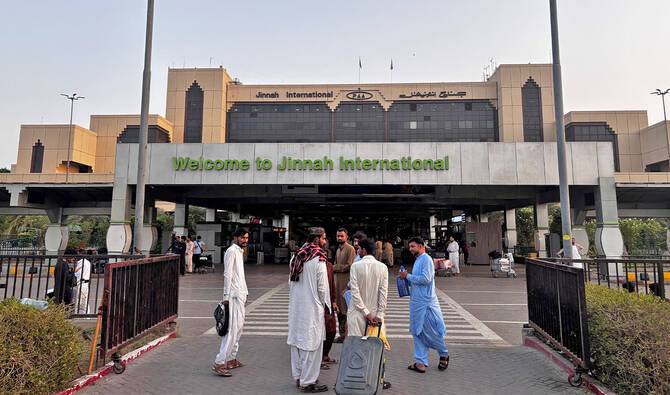
Passengers wait outside at Jinnah International airport after all domestic and international flights were canceled in Karachi on May 7, 2025. (AFP/File)
Short Url
Updated 17 May 2025
Follow

Pakistan detains four deportees linked to human smuggling after UAE convictions

  • The suspects arrived in Pakistan on emergency travel documents after serving their sentences in the UAE
  • Pakistan has intensified its crackdown on human smuggling networks following migrant boat tragedies

KARACHI: The Federal Investigation Agency (FIA) on Saturday detained four men deported from the United Arab Emirates (UAE) for their alleged involvement in human smuggling and prostitution, as Pakistan intensifies its crackdown on such networks following a series of deadly migrant boat tragedies.

The suspects were arrested upon arrival at Karachi’s Jinnah International Airport, according to an FIA statement, after being convicted in the UAE for participating in illegal activities. After serving their sentences, they were deported to Pakistan on emergency travel documents.

“FIA Immigration carries out a major operation,” the statement said. “Four suspects arriving from the UAE have been taken into custody. The suspects were involved in illegal activities in the UAE.”

“The suspects have been transferred to the Anti-Human Trafficking Circle in Karachi for further legal action,” it added.

The arrests come amid Pakistan’s broader campaign against human smuggling, which has gained urgency following multiple migrant boat disasters involving Pakistani nationals.

Earlier this year, over 40 Pakistanis were feared drowned near Morocco’s coast while in 2023 more than 200 Pakistanis were presumed dead in a shipwreck off Greece.

Prime Minister Shehbaz Sharif has vowed to dismantle human smuggling networks that lure citizens into perilous journeys with false promises of better lives abroad.

“Global cooperation is essential to combat prostitution carried out under the guise of human smuggling,” the FIA said.

“All available resources are being utilized to eliminate human smuggling,” it added.


Pakistan, China to sign multiple MoUs at major agriculture investment conference today

Updated 59 min 10 sec ago
Follow

Pakistan, China to sign multiple MoUs at major agriculture investment conference today

  • Hundreds of Chinese and Pakistani firms to attend Islamabad event
  • Conference seen as part of expanding CPEC ties into agriculture, trade

KARACHI: Islamabad and Beijing are set to sign multiple memorandums of understanding (MoUs) to boost agricultural investment and cooperation at a major conference taking place in the capital today, Monday, with hundreds of Chinese and Pakistani companies expected to participate.

The conference is being billed by Pakistan’s Ministry of National Food Security and Research as a platform for deepening bilateral agricultural ties and supporting broader economic engagement between the two countries.

“Multiple memorandums of understanding will be signed at the Pakistan–China Agricultural Conference,” the Ministry of National Food Security said in a statement. “115 Chinese and 165 Pakistani companies will participate.”

The conference reflects a growing emphasis on expanding Pakistan-China economic cooperation beyond the transport and energy foundations of the flagship China-Pakistan Economic Corridor (CPEC) into agriculture, industry and technology.

Under its first phase launched in 2015, CPEC, a core component of China’s Belt and Road Initiative, focused primarily on transportation infrastructure, energy generation and connectivity projects linking western China to the Arabian Sea via Pakistan. That phase included motorways, power plants and the development of the Gwadar Port in the country's southwest, aimed at helping Pakistan address chronic power shortages and enhance transport connectivity.

In recent years, both governments have formally moved toward a “CPEC 2.0” phase aimed at diversifying the corridor’s impact into areas such as special economic zones, innovation, digital cooperation and agriculture. Second-phase discussions have highlighted Pakistan’s goal of modernizing its agricultural sector, attracting Chinese technology and investment, and boosting export potential, with high-level talks taking place between planning officials and investors in Beijing.

Agri-sector cooperation has also seen practical collaboration, with joint initiatives examining technology transfer, export protocols and value-chain development, including partnerships in livestock, mechanization and horticulture.

Organizers say the Islamabad conference will bring together government policymakers, private sector investors, industry associations and multinational agribusiness firms from both nations. Discussions will center on investment opportunities, technology adoption, export expansion and building linkages with global buyers within the framework of Pakistan-China economic cooperation.