

Gaza, Sudan most at risk as global starvation approaches 300m: Report

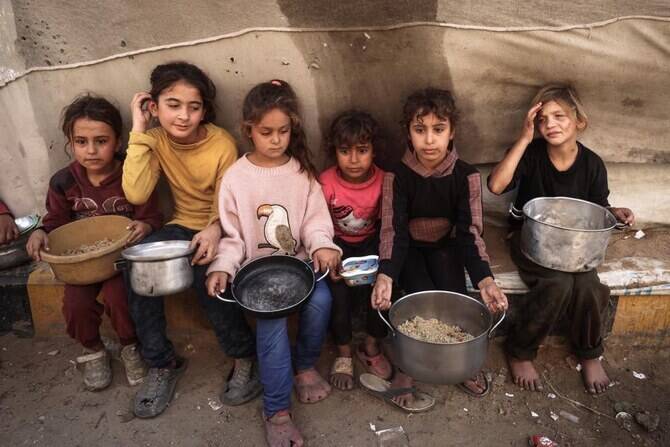
Almost 300 million people face death from starvation, with the most at risk in war-torn Gaza and Sudan, the latest Global Report on Food Crises has warned. (AFP/File)
Short Url
Updated 16 May 2025
Follow

Gaza, Sudan most at risk as global starvation approaches 300m: Report

  • Populations of both face ‘starvation, death, destitution and high rates of acute malnutrition’
  • War, aid cuts, climate among issues causing food shortages in Yemen, Afghanistan, Pakistan, Somalia

LONDON: Almost 300 million people face death from starvation, with the most at risk in war-torn Gaza and Sudan, the latest Global Report on Food Crises has warned.

The report said 295.3 million people have been identified as facing “high levels of acute food insecurity” after a sixth consecutive year of the global number growing, with people in South Sudan, Yemen, Somalia, Afghanistan and Pakistan also noted as being at particular risk.

Cuts to humanitarian aid budgets and escalating conflicts were highlighted as having pushed as many as 13.7 million people into chronic food insecurity over the past 12 months.

The report noted that the number of people most at risk of food shortages as defined by the UN-backed Integrated Food Security Phase Classification had more than doubled in that period, and that 95 percent of those were in Gaza and Sudan.

It added that the populations of both face “starvation, death, destitution and high rates of acute malnutrition.”

More than half of Gaza’s approximately 2.1 million people face “catastrophe,” while Sudan has as many as 24 million people suffering food insecurity. Famine has been officially declared in the African country.

“Intensifying conflict, increasing geopolitical tensions, global economic uncertainty and profound funding cuts are deepening acute food insecurity,” the GRFC said.

“Following the closure of all crossings into the Gaza Strip in early March, and the collapse of the two-month ceasefire, food access has been severely restricted.”

The GRFC said 19 other countries are suffering from worsening food security “aggravated” by drought, highlighting Somalia, Afghanistan, Pakistan, Ethiopia and Kenya.

War is also increasing several other countries’ food security, especially Nigeria and Myanmar.


Amnesty says Algeria unlawfully returned Tunisia asylum seeker

Updated 4 sec ago
Follow

Amnesty says Algeria unlawfully returned Tunisia asylum seeker

  • Amnesty International said Makhlouf was handed over to Tunisian police on January 18 without prior notice to him or his lawyers, in a move the group called “unlawful refoulement”

TUNIS: Global rights group Amnesty accused Algerian authorities on Monday of breaching international law by forcibly returning a political dissident to Tunisia, even though he was a registered asylum seeker.
Seifeddine Makhlouf, a former parliamentarian and critic of Tunisian President Kais Saied, was reportedly sentenced to prison for “plotting against state security” before his return to the North African country.
Makhlouf, who is the leader of the Al Karama party, sought asylum in Algeria in July 2024 after facing detention in Tunisia, and registered as an asylum seeker with the UN refugee agency UNHCR.
Amnesty International said Makhlouf was handed over to Tunisian police on January 18 without prior notice to him or his lawyers, in a move the group called “unlawful refoulement.”
“Makhlouf’s forced return is a violation of the principle of non-refoulement,” Amnesty’s MENA deputy chief Sara Hashash said in a statement published by the group.
“By handing him over to Tunisian authorities without allowing him any opportunity to contest the decision or assessing the risks he faces in Tunisia... Algeria has breached its obligations under international human rights law, including the Refugee Convention,” she added.
Saied froze parliament in July 2021 and seized far-reaching executive powers in what critics have called a “coup.”
Since then, local and international NGOs have denounced a regression of rights and freedoms in Tunisia.
Amnesty said Makhlouf was later imprisoned in Algeria for irregular entry and placed in administrative detention, during which he was denied access to the UN refugee agency.
The rights group said Makhlouf was arrested upon his arrival in Tunisia to serve sentences handed down in his absence.
Reports said a Tunisian court sentenced Makhlouf on January 13 to five years in prison for “plotting against state security.”
The Amnesty statement called for “verdicts rendered in absentia to be quashed and for a new and fair trial to be held before an independent and impartial court.”
Hashash warned that Makhlouf’s case reflects wider regional repression, calling his extradition “particularly alarming given the escalating crackdown on dissent in Tunisia, where the judiciary has been increasingly weaponized to silence political opposition.”
She said that Algeria’s actions “set a dangerous precedent,” adding that “bilateral cooperation now takes precedence over the most fundamental principles of international human rights and refugee law.”