Trump says urged Apple to manufacture in US not India

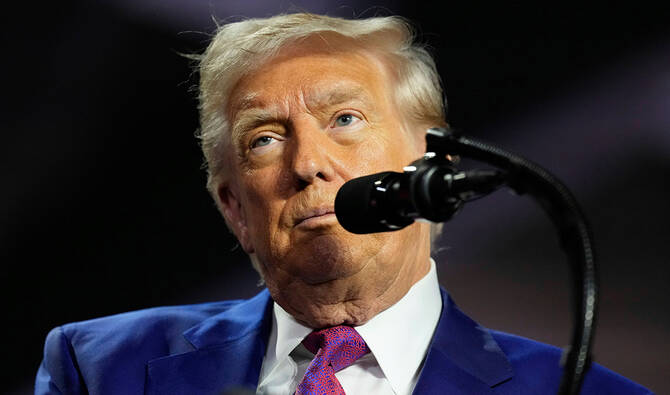
President Donald Trump speaks at the Al Udeid Air Base in Doha, Qatar on May 15, 2025. (AP)
Short Url
Updated 15 May 2025
Follow

Trump says urged Apple to manufacture in US not India

  • Apple CEO said in May majority of iPhones in sold in US would have India as country of origin
  • India, hit by US tariffs, has threatened to retaliate response to increased duties on steel, aluminum

DOHA: US President Donald Trump said Thursday he urged Apple to manufacture its products in the United States instead of India, where the US tech giant has said it would be shifting production after US tariffs on China.

“I had a little problem with Tim Cook,” Trump said, referring to Apple’s CEO, during a multi-day tour of the Gulf. “I said, Tim, we treated you really good. We put up with all the plants that you built in China for years now.”

The president said he told Cook: “We’re not interested in you building in India... we want you to build here and they’re going to be upping their production in the United States.”

On Monday, the US and China announced an agreement to suspend tit-for-tat tariffs for 90 days, de-escalating a trade war that has spooked financial markets and raised fears of a global economic downturn.

Prior to the agreement between Beijing and Washington, Cook said Apple was “not able to precisely estimate the impact of tariffs.”

When presenting the tech company’s first-quarter profits in early May, Cook said he expected “a majority of iPhones sold in the US will have India as their country of origin.”

He warned of the uncertain impact of the 145 percent US tariffs on products from China — the company’s long-time manufacturing hub — despite a temporary reprieve for high-end tech goods such as smartphones and computers.

Although completed smartphones are exempted from Trump’s tariffs for now, not all components that go into Apple devices are spared.

Apple expects US tariffs to cost $900 million in the current quarter, even though their impact was “limited” at the start of this year, according to Cook.

India, also hit by US tariffs, threatened on Tuesday to take retaliatory measures in response to the increased duties on steel and aluminum.

India’s Foreign Minister Subrahmanyam Jaishankar said on Thursday trade negotiations between India and the United States are ongoing, and any agreement should be mutually beneficial.

Apple announced in February it would invest more than $500 billion in the United States over the next four years and promised to hire 20,000 people in the country.

“Apple’s already in for 500 billion but they’re going to be upping their production, so it’ll be great,” Trump said in Qatar.


China FM tells EU diplomats not to blame Beijing for bloc’s problems

Updated 1 sec ago
Follow

China FM tells EU diplomats not to blame Beijing for bloc’s problems

BEIJING: China’s foreign minister told his French and German counterparts that Beijing was not to blame for Europe’s economic and security problems as he pushed for more cooperation at a summit in Munich, a foreign ministry statement said Saturday.
Wang Yi made the comments at a meeting with France’s Jean-Noel Barrot and Germany’s Johann Wadephul on the sidelines of the Munich Security Conference on Friday.
He sought to promote China as a reliable partner of the European Union at a time when the bloc is trying to reduce its dependence on both Beijing and an increasingly unpredictable Washington.
“China’s development is an opportunity for Europe, and Europe’s challenges do not come from China,” Wang said, according to the statement.
Warning that “unilateralism, protectionism, and power politics” were on the rise globally, he said he hoped Europe would “pursue a rational and pragmatic policy toward China.”
“The two sides are partners, not adversaries; interdependence is not a risk; intertwined interests are not a threat; and open cooperation will not harm security.”
The meeting came against the backdrop of trade tensions between the two giant economies and disputes over what the EU sees as China’s support for Russia’s war in Ukraine.
The EU is seeking to cut its reliance on China for strategic goods like rare earths while also rebalancing a trade relationship that sees it run a large deficit with the world’s second-largest economy.
In recent years, the two sides have clashed over Chinese electric-vehicle exports, which threaten Europe’s car industry and which Brussels argues are based on unfair subsidies, and Chinese tariffs on EU goods ranging from cheese to cognac.
Wang urged Germany and France to help “give a clear direction for the development of China-Europe relations.”
In a separate meeting with Wadephul — also on Friday — Wang touted economic and trade cooperation as “the cornerstone of China-Germany ties,” according to a foreign ministry readout.
Wang also met Britain’s foreign minister Yvette Cooper, telling her that Beijing and London should “explore more potential for cooperation,” while the two sides also discussed Ukraine and Iran.