

Australia forges closer defense ties with Indonesia as PM visits Jakarta 

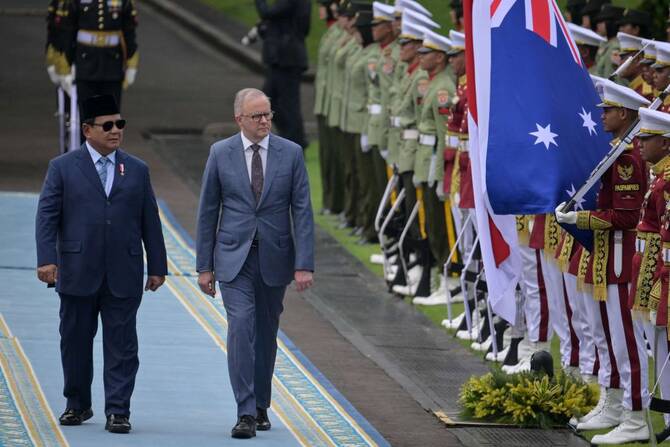
Indonesian President Prabowo Subianto and Australian Prime Minister Anthony Albanese inspect the presidential honor guard at the Presidential Palace in Jakarta on May 15, 2025. (AFP)
Short Url
Updated 15 May 2025
Follow

Australia forges closer defense ties with Indonesia as PM visits Jakarta 

  • Indonesia, Australia signed a landmark defense pact last August 
  • Australia’s Albanese has visited Indonesia four times since becoming PM in 2022

JAKARTA: Australia’s Prime Minister Anthony Albanese held defense talks with Indonesian President Prabowo Subianto on Thursday, as he visited Jakarta on his first international visit since re-election.

Albanese arrived in the Indonesian capital on Wednesday evening, a day after his new government was sworn in, as the two countries seek to further strengthen their strategic ties. 

The trip comes less than a year after Indonesia and Australia cemented a landmark defense pact last August, which includes provisions that allow their forces to operate from each other’s countries. 

“This treaty-level agreement, underpinned by the Lombok treaty, will enable new cooperation in maritime security, counterterrorism as well as humanitarian and disaster relief,” Albanese said during a joint press conference at the Presidential Palace. 

The 2006 Lombok Treaty, which entered into force two years later, included agreements on joint military exercises, maritime security and military training.

Albanese said the August deal was “the most significant step” in Australia and Indonesia’s security partnership for three decades. 

“Let me be very clear, I do not see this agreement though as the last step, just the next step. I want us to aim high, go further, and work even more closely together.” 

Indonesia and Australia held their largest-ever joint military exercise last November, with around 2,000 troops training in air, maritime, amphibious and land operations. 

“I’m here in Indonesia because no relationship is more important to Australia than this one,” Albanese said. “And no nation is more important to the prosperity, security and stability of the Indo-Pacific than Indonesia.” 

Albanese has visited Indonesia four times since becoming Australia’s premier in 2022. 

Newly elected Australian prime ministers typically make their first bilateral visit to Asia, usually Indonesia.

Prabowo said the two countries were committed to “complete the ratification process” of their latest defense agreement.

“We will continue discussing other possibilities to improve and increase cooperation in defense,” he added.   

During their meeting, Albanese and Prabowo also discussed cooperation in trade, food security, energy transition, critical minerals and people-to-people relations.


Bangladesh mourns Khaleda Zia, its first woman prime minister

Updated 30 December 2025
Follow

Bangladesh mourns Khaleda Zia, its first woman prime minister

  • Ousted ex-premier Sheikh Hasina, who imprisoned Zia in 2018, offers condolences on her death
  • Zia’s rivalry with Hasina, both multiple-term PMs, shaped Bangladeshi politics for a generation

DHAKA: Bangladesh declared three days of state mourning on Tuesday for Khaleda Zia, its first female prime minister and one of the key figures on the county’s political scene over the past four decades.

Zia entered public life as Bangladesh’s first lady when her husband, Ziaur Rahman, a 1971 Liberation War hero, became president in 1977.

Four years later, when her husband was assassinated, she took over the helm of his Bangladesh Nationalist Party and, following the 1982 military coup led by Hussain Muhammad Ershad, was at the forefront of the pro-democracy movement.

Arrested several times during protests against Ershad’s rule, she first rose to power following the victory of the BNP in the 1991 general election, becoming the second woman prime minister of a predominantly Muslim nation, after Pakistan’s Benazir Bhutto.

Zia also served as a prime minister of a short-lived government of 1996 and came to power again for a full five-year term in 2001.

She passed away at the age of 80 on Tuesday morning at a hospital in Dhaka after a long illness.

She was a “symbol of the democratic movement” and with her death “the nation has lost a great guardian,” Bangladesh’s interim leader Muhammad Yunus said in a condolence statement, as the government announced the mourning period.

“Khaleda Zia was the three-time prime minister of Bangladesh and the country’s first female prime minister. ... Her role against President Ershad, an army chief who assumed the presidency through a coup, also made her a significant figure in the country’s politics,” Prof. Amena Mohsin, a political scientist, told Arab News.

“She was a housewife when she came into politics. At that time, she just lost her husband, but it’s not that she began politics under the shadow of her husband, president Ziaur Rahman. She outgrew her husband and built her own position.”

For a generation, Bangladeshi politics was shaped by Zia’s rivalry with Sheikh Hasina, who has served as prime minister for four terms.

Both carried the legacy of the Liberation War — Zia through her husband, and Hasina through her father, Sheikh Mujibur Rahman, widely known as the “Father of the Nation,” who served as the country’s first president until his assassination in 1975.

During Hasina’s rule, Zia was convicted in corruption cases and imprisoned in 2018. From 2020, she was placed under house arrest and freed only last year, after a mass student-led uprising, known as the July Revolution, ousted Hasina, who fled to India.

In November, Hasina was sentenced to death in absentia for her deadly crackdown on student protesters and remains in self-exile.

Unlike Hasina, Zia never left Bangladesh.

“She never left the country and countrymen, and she said that Bangladesh was her only address. Ultimately, it proved true,” Mohsin said.

“Many people admire Khaleda Zia for her uncompromising stance in politics. It’s true that she was uncompromising.”

On the social media of Hasina’s Awami League party, the ousted leader also offered condolences to Zia’s family, saying that her death has caused an “irreparable loss to the current politics of Bangladesh” and the BNP leadership.

The party’s chairmanship was assumed by Zia’s eldest son, Tarique Rahman, who returned to Dhaka just last week after more than 17 years in exile.

He had been living in London since 2008, when he faced multiple convictions, including an alleged plot to assassinate Hasina. Bangladeshi courts acquitted him only recently, following Hasina’s removal from office, making his return legally possible.

He is currently a leading contender for prime minister in February’s general elections.

“We knew it for many years that Tarique Rahman would assume his current position at some point,” Mohsin said.

“He should uphold the spirit of the July Revolution of 2024, including the right to freedom of expression, a free and fair environment for democratic practices, and more.”