

Pakistan and Kuwait review trade, investment cooperation during bilateral consultations 

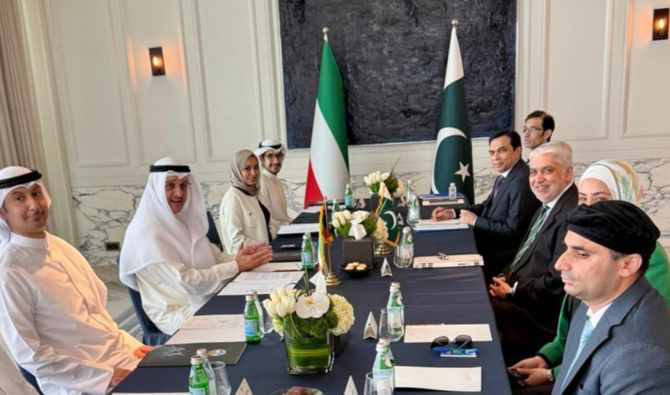
The delegation of Pakistan and Kuwait photo graphed during the fourth round of their Bilateral Political Consultations (BPC) in Kuwait on Wednesday. (Photo courtesy: @ForeignOfficePk/ X)
Short Url
Updated 15 May 2025
Follow

Pakistan and Kuwait review trade, investment cooperation during bilateral consultations 

  • Fourth round of Pakistan-Kuwait Bilateral Political Consultations held in Kuwait, says Islamabad 
  • Pakistan has increasingly eyed trade, investment to ensure consistent, sustainable economic growth 

ISLAMABAD: Pakistani and Kuwaiti officials reviewed their countries’ cooperation in trade, investment, human resource collaboration and other economic spheres, the Pakistani foreign ministry said on Wednesday, as the two sides held their bilateral political consultations. 

Pakistan and Kuwait held the fourth round of their Bilateral Political Consultations (BPC) in Kuwait on Wednesday. The Kuwaiti delegation was led by Sameeh Essa Johar Hayat, the Gulf country’s assistant foreign minister (Asia Affairs) while Additional Foreign Secretary (Middle East) Shehryar Akbar Khan led the Pakistani side. 

“The two sides reviewed the entire spectrum of bilateral relations including trade, investment, human resource collaboration, consular and people-to-people contacts with a view to further enhance bilateral cooperation,” the statement said on Wednesday. 

It added that the two delegations also exchanged views on regional and international issues, and reaffirmed their commitment to continued cooperation and consultation.

“While expressing satisfaction over the upward trajectory in bilateral relations and the momentum of high-level interactions and exchanges, both sides agreed to further deepen engagement in diverse areas of mutual interest,” the Pakistani foreign ministry said. 
It said that the next round of the BPC between the two sides will take place in Islamabad on mutually agreed dates.
Since narrowly escaping a default in 2023, Pakistan has eyed increasing foreign trade and investment with regional allies, especially Gulf countries. 
Islamabad formed the Special Investment Facilitation Council (SIFC), a hybrid civil-military government body, tasked with attracting international investment in key economic sectors such as tourism, agriculture, livestock, mines and minerals and others. 


Pakistan to begin first phase of Hajj 2026 trainings from today

Updated 31 December 2025
Follow

Pakistan to begin first phase of Hajj 2026 trainings from today

  • Training programs to be held in phases across Pakistan till February, says religion ministry
  • Saudi Arabia allocated Pakistan a total quota of 179,210 pilgrims for Hajj 2026

ISLAMABAD: Pakistan’s religious affairs ministry has said that it will begin the first phase of mandatory Hajj 2026 training for pilgrims intending to perform the pilgrimage from today, Thursday.

The one-day Hajj training programs will be held in phases across the country at the tehsil level until February. The ministry directed intending pilgrims to bring their original identity cards and the computerized receipt of their Hajj application to attend the training sessions.

“Pilgrims should attend the one-day training program according to their scheduled date,” Pakistan’s Ministry of Religious Affairs (MoRA) said in a statement.

The ministry said training schedules are being shared through the government’s Pak Hajj 2026 mobile application as well as via SMS. It added that details of the schedule are also available on its website.

According to the ministry, training programs will be held in Abbottabad on Jan. 2; Ghotki, Thatta and Kotli on Jan. 3; and Tando Muhammad Khan and Khairpur on Jan. 4.

Hajj training sessions will be held in Rawalakot, Badin and Naushahro Feroze on Jan. 5, while pilgrims in Fateh Jang, Dadu and Tharparkar will receive the training on Jan. 6.

The ministry said training programs will be conducted in Umerkot and Larkana on Jan. 7, followed by sessions in Mirpurkhas, Shahdadkot and Mansehra on Jan. 8.

Pakistan’s religious affairs ministry has previously said these trainings will be conducted by experienced trainers and scholars using multimedia.

It said the training has been made mandatory to ensure that intending pilgrims are fully aware of Hajj rituals and administrative procedures.

Saudi Arabia has allocated Pakistan a quota of 179,210 pilgrims for Hajj 2026, of which around 118,000 seats have been reserved under the government scheme, while the remainder will be allocated to private tour operators.

Under Pakistan’s Hajj scheme, the estimated cost of the government package ranges from Rs1,150,000 to Rs1,250,000 ($4,049.93 to $4,236), subject to final agreements with service providers.