

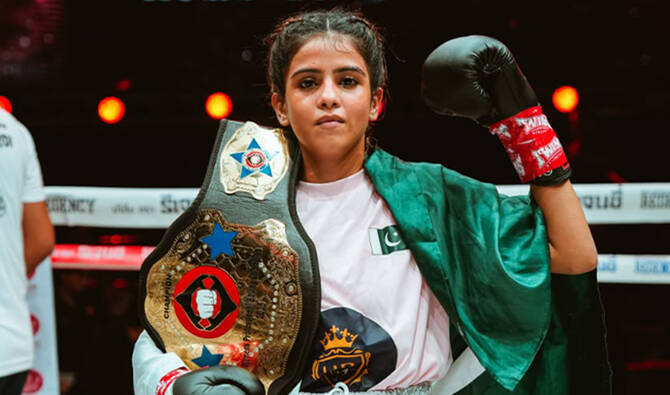

KARACHI: In a powerful display of grit and determination, 19-year-old Aliya Soomro punched her way to international recognition, knocking out Thailand’s Suthida Ganyanooch in the first round of “The Fighter: World Boxing” match in Bangkok on May 3.
Yet, for the teenage fighter from Karachi’s gritty Lyari neighborhood, the real battle was fought long before she entered the ring, as she braved relentless criticism and deeply ingrained gender norms back home.
In a country where many women still struggle to pursue their ambitions, especially in fields traditionally considered the preserve of men, Soomro said her victory was about more than just boxing as it challenged the limits others had set for women like her.
“They ended up motivating me,” she told Arab News at her modest residence, referring to all those who questioned her passion. “People thought they were demotivating me, but what they didn’t realize was that their negativity was actually turning into my motivation.”
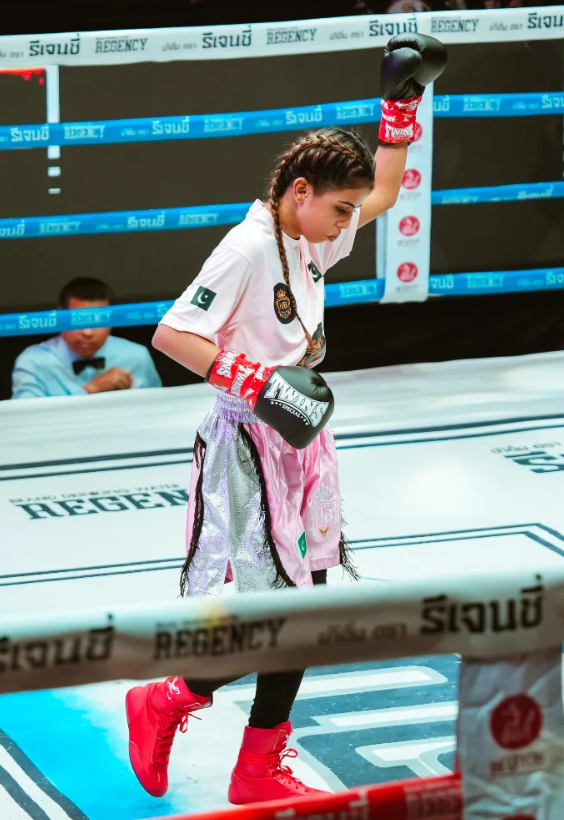
Boxer Aliya Soomro celebrates after beating Thailand's Suthida Ganyanooch in “The Fighter: World Boxing” match in Bangkok, Thailand, in a picture uploaded on May 3, 2025. (Aliya Soomro Boxer/X)
“People gossiped about me, saying things like, ‘Make her quit, she can’t do it, this is beyond her,’” she said, recounting how many of them whispered such comments in her parents’ ears.
Born and raised in Lyari, an area long associated with poverty and gang violence, Soomro grew up hearing doubts about girls’ capabilities and endured years of neglect.
“You know, people still follow old-fashioned thinking that girls can’t do anything, that it’s not in their capacity and that they should just stay at home and tend to the stove,” she said.
But she was not just disappointed in people but also the sports authorities since even after being repeatedly shortlisted for Pakistan’s national boxing team, she was dropped without explanation.
“I was told, ‘Be ready, you’ll get your ticket in the morning.’ But when I got ready and sat waiting in the morning, I found out someone else had taken my place.”
Soomro’s father, Muhammad Hanif Soomro, a laborer and former footballer, said he made it his life’s mission to help his daughter, eldest of his four children, succeed.
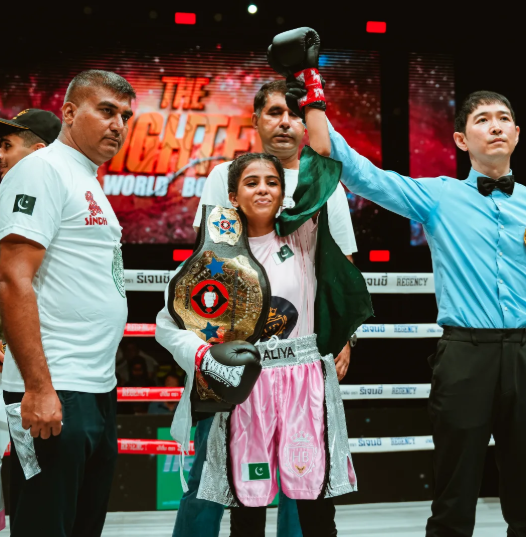
In a picture shared by boxer Aliya Soomro, a referee holds her hand in the air, declaring her victory in the first round of “The Fighter: World Boxing” match in Bangkok on May 3. (Aliya Soomro Boxer/X)
“I am very happy as what has happened with me is not happened with my daughter,” he said, recalling how his poverty and lack of support deprived him of making his dream of playing football for his country come true.
He said he just unheard criticism of his daughter.
“If we had listened to the criticism, this would not have been possible,” he maintained. “The answer to criticism is hard work, dedication and she proved it. That’s her response.”
Without sponsors or institutional backing, Soomro said she walked from company to company during Ramadan, seeking help.
“Even during Ramadan, while fasting, I would go around to companies asking for sponsorship,” she said. “No one supported me.”
Eventually, help came from unexpected place, with Muhammad Hussain Bhatti, a leader from the fishermen’s community, getting her visa and tickets.
“After that, he took full responsibility for my sponsorship,” she added.
The victory in Bangkok has changed how Soomro is seen. Upon her return, she was applauded by Sindh Chief Minister Murad Ali Shah who awarded her a shield and Rs1 million ($3,553) cash prize.
“Now, after returning with a victory, the situation has changed,” she said. “The chief minister is giving me great support.”
She’s also been offered a sports scholarship and professional coaching support ahead of her upcoming fight against an Indian opponent in Dubai.
But for Soomro, the transformation is deeply personal.

Boxer Aliya Soomro in a boxing match with Thailand's Suthida Ganyanooch during “The Fighter: World Boxing” match in Bangkok, Thailand, in a picture uploaded on May 3, 2025. (Aliya Soomro Boxer/X)
“The same ground where people once gossiped about me, I was later invited there as a chief guest, and they said, ‘She is our daughter.’ That was a moment of pride for me,” she said.
Soomro hopes her success will inspire other girls in Lyari and across Pakistan to pursue their dreams, regardless of societal pressures.
“I would just say this,” she said. “Don’t confine girls within four walls. Let them live freely. Just as you consider boys to be strong, know that women’s strength is even more important in your life... Women are powerful.”
She informed that boxing ran in her blood, with her maternal grand grandfather being a boxer.
“There was this one story. A cow had broken free. My great grandfather stood in a specific stance and threw a counter right, and it hit so hard that one of the cow’s horns broke off,” she said, smiling.
Despite being a third-year BBA student at a local university, Soomro balances her studies, training and coaching.
“Boxing isn’t just a sport for me,” she said. “Boxing is my life.”
Recalling her fight in Bangkok, Soomro said when she stepped into the ring, she just wanted to win. She knocked her opponent out in just 45 seconds.
When her Thai rival stood up, she hugged Soomro, saying: “Your punch is very hard.”


