Islamic Development Bank supports Pakistani project to reactivate out-of-work women doctors 

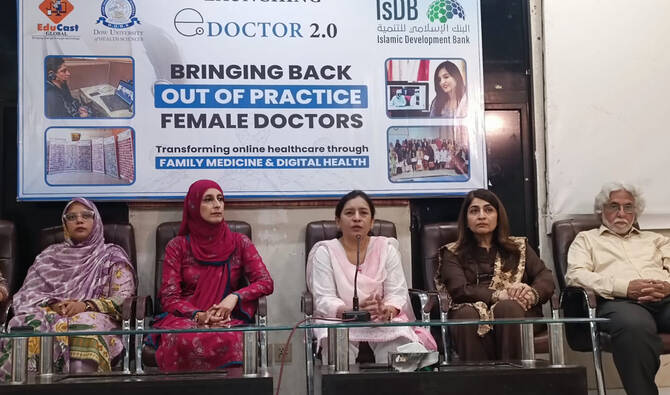
Dr. Jehan Ara Hassan, interim vice chancellor of Dow University of Health Sciences, speaks during the launching of “Doctor 2.0” program at the Karachi Press Club Auditorium in Karachi on May 14, 2025. (Photo courtesy: Handout/Educast)
Short Url
Updated 14 May 2025
Follow

Islamic Development Bank supports Pakistani project to reactivate out-of-work women doctors 

  • Originally launched in 2018, eDoctor program was born out of national need to bring licensed but inactive doctors back to work
  • As many as 35 percent of female medical doctors are unemployed in Pakistan, according to 2023 Gallup Pakistan survey

KARACHI: Pakistan’s Dow University of Health Sciences (DUHS) and health and education tech platform EDUCAST on Wednesday launched a telemedicine initiative aimed at reviving the careers of out-of-practice Pakistani women doctors in a project funded by the Islamic Development Bank.

Originally launched in 2018, the eDoctor program was born out of a national need to reclaim licensed but inactive female doctors who had exited the medical field due to social, familial, or logistical barriers, resulting in estimated Rs. 35 billion losses to the public exchequer. As many as 35 percent of female medical doctors are unemployed in Pakistan, according to a Gallup Pakistan survey in 2023.

The first phase of the project successfully trained and reactivated over 1,500 female doctors across 27 countries through a self-paced, digitally-enabled certification program in partnership with Germany’s Lecturio and Standford University’s Digital Medic platform.

The second phase of the project, Doctor 2.0, launched this week will offer advanced online certification in clinical practice and telemedicine, hands-on clinical observation opportunities at partner clinics, access to Al-powered virtual clinics via smartphones and integration into national initiatives such as ElderCare, polio eradication, MCH support, and rural telehealth.

“This is more than a training program, this is a movement to empower Pakistani women doctors through technology, purpose and dignity,” said Prof. Dr. Jehan Ara Hassan, Acting Vice Chancellor of DUHS. “With Doctor 2.0, we’re giving them a toolkit to reclaim their profession and serve their people.”

She added that Doctor 2.0 was positioned to become a “global model” for female-led, Al-powered, digital health, with plans to export the model to conflict-affected and underserved countries through partnerships with humanitarian agencies.

“This program embodies what modern, resilient, and inclusive health care should look like,” EDUCAST CEO Abdullah Butt said. “We’re proud to be the digital backbone of this transformative initiative.”

Past work of the eDoctor project include managing over 500,000 patients through EDUCAST’s COVID home care program in Sindh during the coronavirus pandemic.

In Afghanistan, the program provided teleconsultation services across 20 Afghan provinces, enabling cancer care, maternal health, and urgent second opinions, while in Yemen, through partnerships with NGOs like INSAN, it offered digital support in areas with no access to on-ground health services.

The program was also used to mobilize tele-triage and digital support during emergencies such as floods in Pakistan and is the backbone of Pakistan’s first elderly home health care platform, BRIDGE, supporting hundreds of senior citizens remotely.



Pakistan urges ‘time-bound and irreversible’ path to Palestinian statehood at UN

Updated 5 sec ago
Follow

Pakistan urges ‘time-bound and irreversible’ path to Palestinian statehood at UN

  • Pakistan warns the Security Council Israeli settlement expansion has reached its highest level in the West Bank
  • It says Islamabad backs sustained ceasefire, expanded humanitarian access, protection of UNRWA’s role in Gaza

ISLAMABAD: Pakistan on Tuesday called for a time-bound and irreversible political process leading to the establishment of a sovereign Palestinian state, urging the international community to move beyond declarations and turn long-standing commitments into concrete action.

Addressing a Security Council briefing on the Middle East, Pakistan’s ambassador to the United Nations said repeated diplomatic initiatives had underscored that the status quo was untenable and that only a credible political horizon, grounded in international law, could deliver durable peace.

His remarks came as the Security Council reviewed the implementation of Resolution 2334, which calls on Israel to halt settlement activity in occupied Palestinian territory.

Pakistan said recent diplomatic efforts — including a high-level conference in July and the General Assembly’s endorsement of the New York Declaration reaffirming the two-state framework — had sought to preserve the possibility of a negotiated settlement between Israelis and Palestinians.

It said follow-up meetings at Sharm El-Sheikh, along with US-led initiatives under President Donald Trump aimed at halting the fighting, were intended to reopen a political process toward Palestinian statehood.

“A time-bound and irreversible political process, anchored in relevant UN resolutions must lead to the establishment of a sovereign, independent and contiguous State of Palestine on the basis of pre-1967 borders, with Al-Quds Al-Sharif as its capital,” Pakistan’s Permanent Representative Asim Iftikhar Ahmad told the council.

“It is high time to turn promises into action and speed up this process,” he added.

Ahmad said Pakistan backed Security Council Resolution 2803, which calls for efforts to sustain the ceasefire, expand aid access and restart a political track toward Palestinian statehood.

He said settlement activity in the occupied West Bank, including East Jerusalem, had reached its highest levels since the United Nations began systematic monitoring, citing UN findings that more than 6,300 housing units were advanced during the reporting period.

Such actions, he said, had “no legal validity” under international law but continued to undermine the viability of the two-state solution.

Pakistan also defended the role of the UN Relief and Works Agency (UNRWA), saying it remained indispensable for Palestinian refugees and must not be weakened by what it called unfounded criticism.

Ahmad condemned the storming of UNRWA’s headquarters in East Jerusalem earlier this month, calling it a violation of international law and the inviolability of UN premises, and urged full, safe and unimpeded humanitarian access to Gaza, along with the immediate start of reconstruction without annexation or forced displacement.