

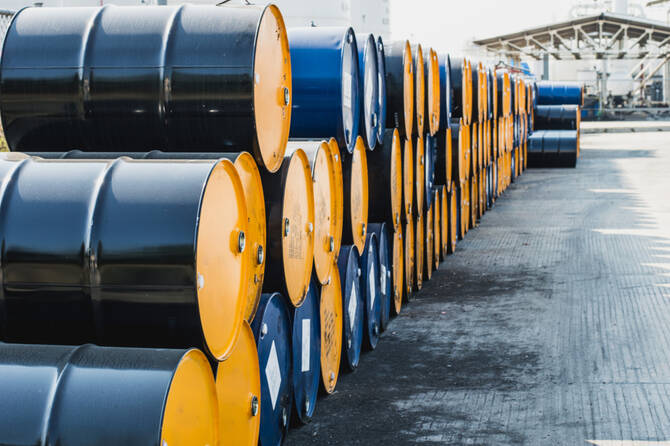
Oil Updates — prices dip as traders watch for jump in US crude stockpiles

Brent crude futures fell 32 cents, or 0.5 percent, to $66.31 a barrel by 10:00 a.m. Saudi time. Shutterstock
Short Url
Updated 14 May 2025
Follow

Oil Updates — prices dip as traders watch for jump in US crude stockpiles

SINGAPORE: Oil prices retreated on Wednesday as traders eyed a potential jump in US crude inventories, though prices held near two-week highs amid relief after the United States and China agreed to temporarily lower their reciprocal tariffs.

Brent crude futures fell 32 cents, or 0.5 percent, to $66.31 a barrel by 10:00 a.m. Saudi time. US West Texas Intermediate crude slipped 32 cents, or 0.5 percent, to $63.35. Both benchmarks had climbed more than 2.5 percent in the previous session.

The two largest economies agreed on Monday to pause their trade war for at least 90 days, with the US cutting tariffs to 30 percent from 145 percent and China slashing duties on US imports to 10 percent from 125 percent.

“The US-China economic pause might have crafted a narrative that could invigorate demand amidst a backdrop of cautious optimism,” said Priyanka Sachdeva, senior market analyst at Phillip Nova.

However, expectations of a staggering jump in US oil inventories capped optimism for now, Sachdeva added.

“This sharp contrast to last week’s substantial draw signals that the demand side is still grappling with significant challenges, leaving market watchers on edge and wondering where the next twist will come from,” she said.

Crude stocks were up by 4.3 million barrels in the week ended May 9, market sources said, citing American Petroleum Institute figures on Tuesday.

Official weekly inventory data from the US Energy Information Administration is due on Wednesday at 5:30 p.m. Saudi time.

Investors remain watchful of demand signals. Rystad energy analysts said in a note the agreement had “eroded some demand side pessimism,” while cautioning against any lingering impact of the tariffs despite the rollbacks.

The market is also watching US President Donald Trump’s Gulf trip, begun on Tuesday with an appearance at an investment forum in Riyadh, where he said the US would lift longstanding sanctions on Syria and secured a $600-billion pledge of Saudi investment.

Rystad Energy’s global head of commodity markets Mukesh Sahdev said preventing oil price spikes over the summer travel season will be a key part of the president’s agenda on the trip.

The US could take advantage of lower prices to buy more Middle East crude for its Strategic Petroleum Reserve, he added.

“The big unknown for the market is how US actions related to Iran, Russia and Venezuela will result in supply disruptions or additions,” Sahdev said.

On Tuesday, the US slapped fresh sanctions on about 20 companies it said were helping Iran’s Armed Forces General Staff and its front company, Sepehr Energy, send Iranian oil to China.

The sanctions follow a fourth round of US-Iran talks in Oman to tackle disputes over Iran’s nuclear program. 


Industry leaders highlight Riyadh’s Metro, infrastructure as investment catalysts

Updated 29 December 2025
Follow

Industry leaders highlight Riyadh’s Metro, infrastructure as investment catalysts

RIYADH: Saudi Arabia’s capital, Riyadh, is experiencing a transformative phase in its real estate sector, with the construction market projected to reach approximately $100 billion in 2025, accompanied by an anticipated annual growth rate of 5.4 percent through 2029.

The Kingdom is simultaneously advancing its data center capacity at an accelerated pace, with an impressive 2.7 GW currently in the pipeline. This expansion underscores the critical role of strategic land and power planning in establishing national infrastructure as a cornerstone of economic growth.

These insights were shared by leading industry experts during JLL’s recent client event in Riyadh, which focused on the city’s macroeconomic landscape and emerging trends across office, residential, retail, hospitality, and pioneering sectors, including AI infrastructure and Transit-Oriented Development.

Saud Al-Sulaimani, Country Lead and Head of Capital Markets at JLL Saudi Arabia, commented: “Riyadh is positioned at the forefront of Saudi Arabia’s Vision 2030, offering unparalleled opportunities for both investors and developers. National priorities are continuously recalibrated to ensure strategic alignment of projects and foster deeper collaboration with the private sector.”

He added: “Recent regulatory developments, including the introduction of the White Land Tax and the rent freeze, are designed to stabilize the market and are expected to drive renewed focus on delivering premium-quality assets. This dynamic environment, coupled with evolving construction cost considerations in select segments, is fundamentally reshaping the market landscape while accelerating progress toward our national objectives.”

The event further underscored the transformative impact of infrastructure initiatives. Mireille Azzam Vidjen, Head of Consulting for the Middle East and Africa at JLL, highlighted Riyadh’s transit revolution. She detailed the Riyadh Metro, a $22.5 billion investment encompassing 176 kilometers, six lines, and 84 stations, providing extensive geographic coverage, with a depth of 9.8 km per 100 sq. km. This strategic development generates significant TOD opportunities, with properties in proximity potentially commanding a 20-30 percent premium. JLL emphasized the importance of implementing climate-responsive last-mile solutions to enhance mobility and accessibility, particularly given Riyadh’s extreme temperatures.

Gaurav Mathur, Head of Data Centers at JLL, emphasized the rapid expansion of the Kingdom’s AI infrastructure, signaling a critical area for technological investment and innovation.

Focusing on the construction sector, Maroun Deeb, Head of Projects and Development Services, KSA at JLL, explained that the industry is actively navigating complexities such as skilled labor availability, material costs, and supply chain dynamics.

He highlighted the adoption of Building Information Modeling as a key driver for enhancing operational efficiency and project delivery.