

Trump calls for deeper India-Pakistan engagement, hails US role in ceasefire at Riyadh forum

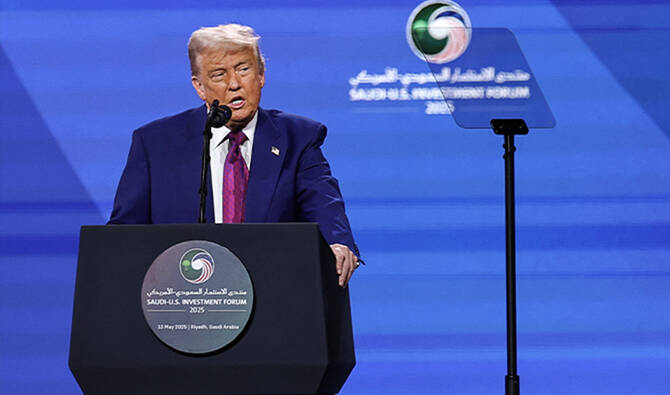
US President Donald Trump speaks at the Saudi-US Investment Forum, in Riyadh, Saudi Arabia on May 13, 2025. (Reuters)
Short Url
Updated 14 May 2025
Follow

Trump calls for deeper India-Pakistan engagement, hails US role in ceasefire at Riyadh forum

  • The US president says he used trade as leverage to secure the ceasefire, a claim India denies
  • He asks Marco Rubio to help leaders of both countries ‘go out and have a nice dinner together’

ISLAMABAD: United States President Donald Trump on Tuesday reiterated he had brokered a “historic ceasefire” between India and Pakistan using trade as leverage, while urging his administration to help build diplomatic ties strong enough for the nuclear-armed rivals to someday “go out and have a nice dinner together.”

The statement came days after a major standoff between the two South Asian neighbors, which saw both sides exchange missile and drone attacks as well as artillery fire across the Line of Control in Kashmir.

Trump, who announced the ceasefire on Saturday, said it followed a night of intense diplomatic activity. Subsequently, US Secretary of State Marco Rubio informed the two countries had agreed to hold talks at a neutral venue to discuss a broad range of outstanding issues.

Trump made the remarks about the ceasefire during his address to the Saudi-US Investment Forum in Riyadh, shortly after arriving in the Kingdom where he met Crown Prince Mohammed bin Salman and senior Saudi officials. 

The visit also saw the signing of more than $300 billion in defense and economic deals.

“Just days ago, my administration successfully brokered a historic ceasefire to stop the escalating violence between India and Pakistan,” he said. “And I used trade to a large extent to do it and I said, ‘Fellas, come on, let’s make a deal. Let’s do some trading. Let’s not trade nuclear missiles. Let’s trade the things that you make so beautifully.’”

Trump praised the efforts of his top aides, including Vice President JD Vance and Rubio, and called the leadership in both India and Pakistan “strong and smart.”

“Maybe we can even get them together a little bit, Marco, where they go out and have a nice dinner together,” he added. “Wouldn’t that be nice?”

He warned that the recent crisis, which he said “started off small,” had the potential to spiral into a broader conflict with devastating consequences.

“Millions of people could have died,” he said.

India, however, negated shortly before Trump’s speech that trade was a factor in the US-mediated truce.

Randhir Jaiswal, spokesperson for India’s Ministry of External Affairs, confirmed that top leaders in New Delhi and Washington remained in close contact during the standoff, but denied that trade was discussed.

“The issue of trade didn’t come up in any of these discussions,” he said, referring to calls between Vance and Prime Minister Narendra Modi, as well as between Rubio and External Affairs Minister Subrahmanyam Jaishankar.

With input from AP


Pakistan high court pauses tree-cutting in Islamabad until Feb. 2

Updated 10 sec ago
Follow

Pakistan high court pauses tree-cutting in Islamabad until Feb. 2

  • Islamabad High Court asks CDA to ‘explain and justify’ tree-cutting at next hearing
  • CDA officials say 29,000 trees were cut due to allergies, deny felling in green belts

ISLAMABAD: The Islamabad High Court has ordered an immediate halt to tree-cutting in the federal capital until Feb. 2, seeking justification from civic authorities over the legality of a large-scale felling drive that has seen thousands of trees removed in recent months.

The interim order, issued by a single-judge bench led by Justice Khadim Hussain Soomro, came during proceedings on a petition challenging the Capital Development Authority’s (CDA) tree-cutting operations in Islamabad’s Shakarparian area and H-8 sector.

At the outset of the hearing, the petitioner’s counsel argued that trees were being felled in violation of the Pakistan Environmental Protection Act 1997, the Islamabad Wildlife Ordinance 1979 and the city’s master plan.

“Respondents shall not cut trees till the next date of hearing,” Justice Soomro said in the court order released on Friday while referring to CDA officials.

“Respondents are directed to come fully prepared and to file paragraph-wise comments before the next date of hearing, along with a comprehensive report explaining the justification and legal basis for the cutting of trees,” he added.

According to the court order, the petitioner maintained that the CDA had not made any public disclosure regarding the legal basis for the operation and that the felling was causing environmental harm.

The petition sought access to the official record of tree-cutting activities and called for the penalization of CDA officials responsible for the act under relevant criminal and environmental laws.

It also urged the court to impose a moratorium on infrastructure projects in Islamabad, order large-scale replanting as compensation and constitute a judicial commission headed by a retired Supreme Court judge to probe the alleged violations.

CDA officials acknowledge around 29,000 paper mulberry trees have been cut in the capital in recent months, arguing that the species triggers seasonal allergies such as sneezing, itchy eyes and nasal congestion.

They also maintain that no trees have been removed from designated green belts and that the number of replacement trees planted exceeds those felled.

Designed in the 1960s by Greek architect Constantinos Doxiadis, Islamabad was conceived as a low-density city with green belts and protected natural zones at its core.

Critics, however, say the recent felling has extended beyond paper mulberry trees and question whether authorities are adhering to the city’s master plan and the legal protections governing forested and green areas.

The court has adjourned its hearing until Feb. 2, 2026.