

Iran says it’s open to temporary uranium enrichment limits

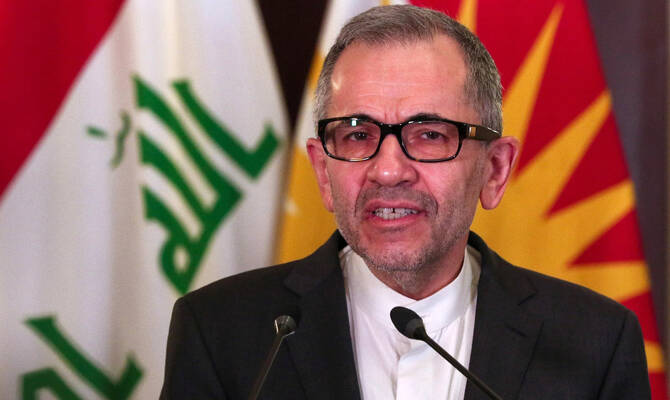
Iran is open to accepting temporary limits on its uranium enrichment, its deputy foreign minister Majid Takht-Ravanchi said Tuesday. (AFP/File)
Short Url
Updated 13 May 2025
Follow

Iran says it’s open to temporary uranium enrichment limits

  • Iran described Sunday’s talks as “difficult but useful” while a senior US official said Washington was “encouraged” and both sides confirmed plans for future negotiations

TEHRAN: Iran is open to accepting temporary limits on its uranium enrichment, its deputy foreign minister said Tuesday, while adding that talks with the US have yet to address such specifics.

Tehran and Washington on Sunday held their fourth round of nuclear talks, which kicked off last month, marking their highest-level contact since the US in 2018 pulled out of the 2015 nuclear deal.

“For a limited period of time, we can accept a series of restrictions on the level and volume of enrichment,” said Deputy Foreign Minister Majid Takht-Ravanchi.

“We have not yet gone into details about the level and volume of enrichment,” he said, quoted by Tasnim news agency.

Iran currently enriches uranium to 60 percent purity — far above the 3.67 percent limit set in the 2015 deal but below the 90 percent needed for weapons-grade material.

US Secretary of State Marco Rubio said Monday that Iran was the only country in the world without nuclear weapons that enriches uranium to that level.

Iranian Foreign Minister Abbas Araghchi said at the latest talks that the right to enrich uranium was “non-negotiable,” while US chief negotiator Steve Witkoff called it a “red line.”

The Islamic republic began rolling back its commitments to the deal a year after the US withdrawal.

Since returning to office in January, Trump has revived his “maximum pressure” approach against Tehran. While backing nuclear diplomacy, he also warned of potential military action if it fails.

Iran described Sunday’s talks as “difficult but useful” while a senior US official said Washington was “encouraged” and both sides confirmed plans for future negotiations.

The talks are being held in “full coordination” with the supreme leader, Iranian President Masoud Pezeshkian said, according to a presidency statement on Tuesday.

“In the negotiations, we will not retreat from our principles in any way, but at the same time, we do not want tensions,” he added.

Also on Tuesday, Iran’s atomic energy agency chief, Mohammad Eslami, described the country’s nuclear industry as its “wealth and strength,” according to ISNA news agency.

Despite the talks, Washington has continued to impose sanctions targeting Iran’s nuclear program and oil industry, with the latest announced on Monday.

“There is no doubt that there is a lot of pressure on us,” said Ali Larijani, a close adviser to Iran’s supreme leader, while noting that not all of Iran’s problems were due to the sanctions.


UN chief condemns Israeli law blocking electricity, water for UNRWA facilities

Updated 01 January 2026
Follow

UN chief condemns Israeli law blocking electricity, water for UNRWA facilities

  • The agency provides education, health and aid to millions of Palestinians in Gaza, the West Bank, Jordan, Lebanon and Syria

United Nations Secretary General Antonio Guterres condemned on Wednesday a move by Israel to ban electricity or water to facilities owned by the UN Palestinian refugee agency, ​a UN spokesperson said.
The spokesperson said the move would “further impede” the agency’s ability to operate and carry out activities.
“The Convention on the Privileges and Immunities of the United Nations remains applicable to UNRWA (United Nations Relief and Works Agency for Palestine Refugees in the Near East), its property and assets, and to its officials and other personnel. Property used ‌by UNRWA ‌is inviolable,” Stephane Dujarric, spokesman for the ‌secretary-general, ⁠said ​while ‌adding that UNRWA is an “integral” part of the world body.
UNRWA Commissioner General Phillipe Lazzarini also condemned the move, saying that it was part of an ongoing “ systematic campaign to discredit  UNRWA and thereby obstruct” the role it plays in providing assistance to Palestinian refugees.
In 2024, the Israeli parliament passed a law banning the agency from operating in ⁠the country and prohibiting officials from having contact with the agency.
As a ‌result, UNRWA operates in East Jerusalem, ‍which the UN considers territory occupied ‍by Israel. Israel considers all Jerusalem to be part ‍of the country.
The agency provides education, health and aid to millions of Palestinians in Gaza, the West Bank, Jordan, Lebanon and Syria. It has long had tense relations with Israel but ties have deteriorated ​sharply since the start of the war in Gaza and Israel has called repeatedly for UNRWA to ⁠be disbanded, with its responsibilities transferred to other UN agencies.
The prohibition of basic utilities to the UN agency came as Israel also suspended of dozens of international non-governmental organizations working in Gaza due to a failure to meet new rules to vet those groups.
In a joint statement, Canada, Denmark, Finland, France, Iceland, Japan, Norway, Sweden, Switzerland and the United Kingdom said on Tuesday such a move would have a severe impact on the access of essential services, including health care. They said one in ‌three health care facilities in Gaza would close if international NGO operations stopped.