

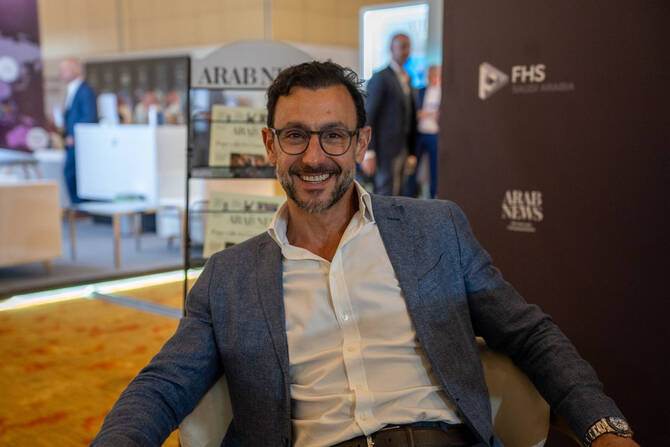

RIYADH: Saudi Arabia now accounts for half of Radisson Hotel Group’s Middle East portfolio, as the Kingdom cements its role as a global priority for the hospitality giant.
The company currently has 100 hotels either open or under development across the region, with 50 of them located in Saudi Arabia, revealed Radisson’s top executive in an interview with Arab News on the sidelines of the Future Hospitality Summit in Riyadh.
The expansion aligns with Saudi Arabia’s fast-growing hotel sector, as the Kingdom plans to add more than 362,000 new hotel rooms by 2030, backed by a $110 billion investment.
Elie Younes, executive vice president and global chief development officer at Radisson, said: “Saudi Arabia sits in one of the top five countries for us globally.”
He said that of the 50 hotels in Saudi Arabia, 30 are open and 20 are under construction.
Providing details and a timeframe for their planned 20 hotels in Saudi Arabia, Younes said the projects will be rolled out over the next three to four years, with an additional 30 hotels expected to open in the following three to four years.
The new wave of properties will translate into approximately 4,000 to 5,000 rooms. “If you multiply 20 by 200 to 250, you will get 4,000 to 5,000 rooms currently planned under construction in Saudi Arabia, which will eventually also make an economic impact because that will create job opportunities for approximately 5,000 people,” said Younes.
Radisson is also ramping up its presence in the capital. The company recently opened Radisson Blu Minhal in Riyadh and plans to launch its third Radisson Collection hotel in the city soon.
The Mansard Hotel, part of its urban portfolio, was noted as the brand’s first resort in Riyadh. Service apartments under the Radisson Collection brand are expected to open in the next four months.
The group sees strong potential across multiple segments. “There is room for another 10 to 15 Radisson Blu hotels. As for Radisson Collection, which is our entry-level luxury brand, there will be fewer opportunities to grow it because of its luxury nature — maybe four or five more hotels. We already have three in Riyadh alone,” he said.
Younes highlighted the scalability of the core four-star Radisson brand, particularly in smaller Saudi cities.
“We recently opened three of them here in Riyadh alone, and I think we could open at least or sign another 20 or 30 of them in the Kingdom across the next four to five years, focusing on places like Riyadh, Jeddah, Makkah, and Madinah… to some extent, and specifically, after that, in some of the secondary regional cities, where we also see opportunities for business development,” he explained.
Commenting on global tariffs, Younes said it is difficult to assess the impact of what he described as a “semi-political, semi-non-political” decision.
“We don’t see that to have a direct impact in Saudi Arabia because — you have to remember that — over 50 percent of the travel industry in Saudi Arabia is domesticated in terms of traveling, and over 90 percent of investments in Saudi Arabia comes from Saudi Arabia,” he added.
Younes also spoke about broader trends in the hospitality industry, including growing traveler volumes and a heightened focus on sustainability. “I think we are very lucky and should be grateful to work in this industry because it is one of those ever-growing industries,” he said.
He noted shifts in travel behavior as business and leisure increasingly merge: “People going for a long business trip but integrating into that trip a little bit of fun, bringing the wife, bringing the kids, spending the extra day. Wanting to have fun.”
The executive noted that operational challenges are mounting, driven by rising costs and technological disruption. “The cost of labor going up. Inflation going up. The influence of artificial intelligence. All of these elements will push us and will result in us becoming more efficient,” he said.
While artificial intelligence will likely shape back-end operations, Younes emphasized the enduring value of human service: “The human touch will never go away. We all know that.”
Looking ahead, he sees the convergence of hospitality and residential real estate as a key evolution in the sector.
“I see more integration and fusion between the conventional hospitality and residential real estate as we move forward to try and achieve all of these efficiencies and economies,” he concluded.


