

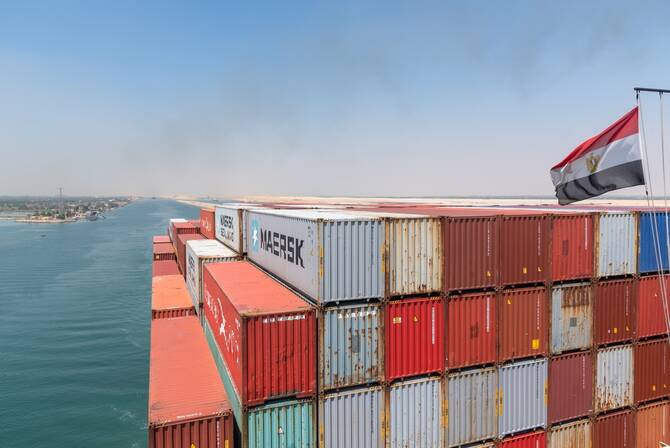
Egypt’s exports surge by 24% in February amid trade shifts

The latest monthly trade report released by the Central Agency for Public Mobilization and Statistics, known as CAPMAS, explained that the growth in exports was driven by an increase in ready-made garments. Shutterstock
Short Url
Updated 13 May 2025
Follow

Egypt’s exports surge by 24% in February amid trade shifts

RIYADH: Egypt’s exports rose by 24.1 percent year on year in February to reach $4.43 billion, driven by increased shipments of key commodities.

The surge comes amid other economic indicators improving, highlighting the country’s developing financial landscape.

The latest monthly trade report released by the Central Agency for Public Mobilization and Statistics, known as CAPMAS, explained that the growth in exports was driven by an increase in ready-made garments, which rose by 30.6 percent, and petroleum products, which increased by 12.2 percent. 

Moreover, processed foods grew by 9.3 percent, and primary plastic products saw a 3.4 percent rise.

Egypt’s export growth comes as the Middle East and North Africa region navigates shifting global trade dynamics in 2025, with the impact of recent tariff measures and geopolitical tensions reshaping commercial flows worldwide. 

Egypt’s overall trade balance recorded a deficit of $2.33 billion, marking a 29.1 percent decline from February 2024, when the deficit stood at $3.28 billion. 

In the second month of this year, imports saw a 1.4 percent decline to $6.67 billion, down from $6.85 billion in the same period of 2024, due to the rise in prices of some imported goods.

Sector highlights

While some goods, including fresh fruits, fertilizers, potatoes, and iron products, saw declines, the surge in manufactured and petroleum goods bolstered the overall export figures.

Reduced purchases of wheat, raw iron and steel materials, pharmaceuticals, and primary plastics contributed to the import decline. Conversely, imports of petroleum products, natural gas, corn, and soybeans rose sharply. 

Adding to the economic momentum, remittances from Egyptians working abroad surged to a record $32.6 billion in the 12 months through February, marking a 72.4 percent increase from the previous year.

The North African country’s net foreign assets also rose by $1.48 billion in February, reaching $10.18 billion, supported by increased foreign investment in treasury bills. 

In a meeting with the National Press Authority in January, Rania Al-Mashat, the minister of planning and economic development, said that the economy is projected to grow by 4 percent this fiscal year, bolstered by structural reforms and a record $46.1 billion in foreign direct investment in 2023/2024.

The government is pursuing $4.2 billion in macroeconomic support from global partners, with negotiations underway for an additional $4.10 billion in EU budget aid.


Closing Bell: Saudi benchmark index closes lower at 10,540 

Updated 24 December 2025
Follow

Closing Bell: Saudi benchmark index closes lower at 10,540 

RIYADH: Saudi equities ended Wednesday’s session lower, with the Tadawul All Share Index falling 55.13 points, or 0.52 percent, to close at 10,540.72. 

The sell-off was mirrored across other indices, with the MSCI Tadawul 30 Index retreating 5.79 points, or 0.41 percent, to close at 1,393.32, while the parallel market Nomu slipped 74.56 points, or 0.32 percent, to 23,193.21.  

Market breadth remained firmly negative, as decliners outpaced advancers, with 207 stocks ending the session lower against just 51 gainers on the main market. 

Trading activity moderated compared to recent sessions, with volumes reaching 123.5 million shares, while total traded value stood at SR2.72 billion ($725.2 million). 

On the sectoral and stock level, Al Moammar Information Systems Co. led the gainers after surging 9.96 percent to close at SR172.30, extending its rally following a series of contract announcements tied to data center and IT infrastructure projects.  

Al Masar Al Shamil Education Co. climbed 4.89 percent to SR27.48, while Naqi Water Co. advanced 3.36 percent to SR58.50. Al Yamamah Steel Industries Co. and Al-Jouf Agricultural Development Co. also posted solid gains, rising 3 percent and 2.86 percent, respectively. 

Losses, however, were concentrated in industrial names. Saudi Kayan Petrochemical Co. fell 3.67 percent to SR4.73, while Makkah Construction and Development Co. slid 3.44 percent to SR80.  

Saudi Tadawul Group Holding Co. retreated 3.28 percent to SR147.50, weighed down by broader market weakness, and Saudi Cable Co. declined 3.18 percent to SR143.  

Alkhaleej Training and Education Co. rounded out the top losers, shedding just over 3 percent. 

On the announcement front, BinDawood Holding announced the signing of a share purchase agreement to acquire 51 percent of Wonder Bakery LLC in the UAE for 96.9 million dirhams, marking a strategic expansion of its food manufacturing footprint beyond Saudi Arabia.   

The acquisition, which remains subject to regulatory approvals, is expected to support the group’s regional growth ambitions and strengthen supply chain integration.  

BinDawood shares closed at SR4.68, up 0.43 percent, reflecting a positive market reaction to the overseas expansion move.  

Meanwhile, Al Moammar Information Systems disclosed the contract sign-off for the renewal of IT systems support licenses with the Saudi Central Bank, valued at SR114.4 million, inclusive of VAT.   

The 36-month contract is expected to have a positive financial impact starting from fourth quarter of 2025, reinforcing MIS’s position as a key technology partner for critical government institutions. The stock surged to the session’s limit making it the top gainer. 

In a separate disclosure, Maharah Human Resources confirmed the completion of the sale of its entire stake in Care Shield Holding Co. through its subsidiary, Growth Avenue Investments, for a total consideration of SR434.3 million.  

The transaction involved the transfer of 41.36 percent of Care Shield’s share capital to Dallah Healthcare, with Maharah receiving the full cash proceeds.  

Despite the strategic divestment, Maharah shares closed lower, ending the session at SR6.12, down 1.29 percent.