

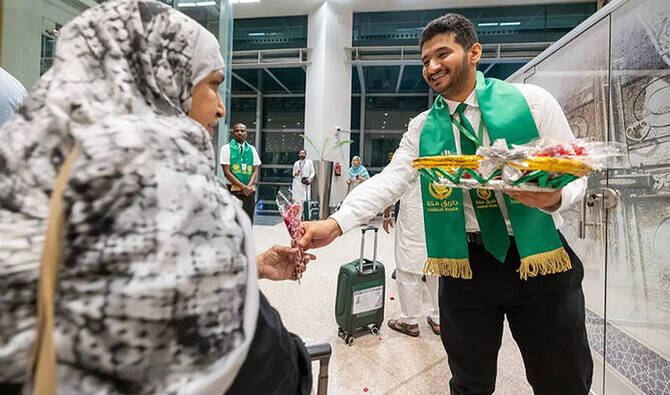
Pakistan says has introduced ‘historic’ new facilities for Hajj pilgrims

Saudi official gives flower to a Pakistani pilgrim departing from Islamabad International Airport in Islamabad, Pakistan, on April 29, 2025 for this year's Hajj. (Saudi Press Agency)
Short Url
Updated 13 May 2025
Follow

Pakistan says has introduced ‘historic’ new facilities for Hajj pilgrims

  • For the first time, Hajj pilgrims will have access to fully air-conditioned camps in Mina
  • New facilities part of effort to ensure smoother, more comfortable Hajj experience

ISLAMABAD: Director Hajj in Makkah, Azizullah Khan, said on Tuesday Pakistani pilgrims will this year enjoy “historic facilities” in Mashair, sacred sites used during the Hajj pilgrimage, including fully air-conditioned camps in Mina with sofa-cum-beds, and improved accommodation in Makkah.

Over the last few years, Saudi Arabia has launched mobile apps like Nusuk, Hajj Navigator, Tawakkalna and Asefny to streamline services, with the aim to make the Hajj experience smoother by offering real-time guidance and ensuring pilgrim safety.

For the first time, Pakistani Hajj pilgrims will have access to fully air-conditioned camps in Mina and be accommodated in top-of-the-line hotels and buildings in the Azizia and Batha Quraish neighborhoods.

Pilgrims will receive a specially designed bag containing the Pakistani flag, a QR code for identification, and relevant information. A mobile app will provide access to Hajj group information, training schedules, flight details, accommodation details, and live maps and locations during the pilgrimage.

“For the first time in history, Hujjaj will have sofa-cum-beds instead of mattresses while tents are upgraded with gypsum board walls and air coolers have been replaced with air conditioners,” Khan told Radio Pakistan, adding that elevated luggage storage racks had also been introduced to enhance comfort.

“Dedicated sections are overseeing food, health and transport related arrangements round the clock for maximum facilitation of the pilgrims,” he said, adding that 99 percent of pilgrims who had arrived in Saudi Arabia had received Nusuk cards.

The cards are an essential Hajj permit, not just an ID, for pilgrims traveling to Makkah and the holy sites. It facilitates movement and ensures the well-being of Hajj pilgrims by managing logistics and administration. The card also allows pilgrims to access information about their Hajj mission, schedules, and allows for communication with their mission. Additionally, it enables receiving alerts, evaluating services, and filing observations.

Compulsory Hajj training has been made available for all pilgrims in Pakistan, starting from Jan. 18, 2025, with details accessible through the “Pak Hajj 2025 Mobile App.” 

For the government Hajj scheme, the option of three easy installments has been introduced for the first time. 

All Hajj-related financial transactions have also been digitized, ensuring transparency and accountability. 

Pakistan’s Hajj medical mission includes a hospital each in Makkah and Madinah, along with two dispensaries in Madinah and nine in Makkah, all fully functional. 

A Monitoring Cell has been established to address potential issues faced by private pilgrims and provide support to them. Various specialized units, including a Wheelchair Desk, have been set up to cater to the needs of different groups of pilgrims. 


UK says Pakistan regulatory overhaul to yield £1 billion a year as Islamabad launches reform drive

Updated 13 December 2025
Follow

UK says Pakistan regulatory overhaul to yield £1 billion a year as Islamabad launches reform drive

  • Britain says it worked with Pakistan on 472 proposed reforms to streamline business rules across key sectors
  • PM Shehbaz Sharif says Pakistan has stabilized economy and now aims to attract investment by cutting red tape

ISLAMABAD: Britain’s development minister Jenny Chapman said on Saturday Pakistan’s sweeping new regulatory overhaul could generate economic gains of nearly £1 billion a year, as Islamabad formally launched the reform package aimed at cutting red tape and attracting foreign investment.

The initiative, driven by Prime Minister Shehbaz Sharif’s government and the Board of Investment, aims to introduce legislative changes and procedural reforms designed to streamline approvals, digitize documentation and remove outdated business regulations.

Chapman said the UK had worked with Pakistan on 472 reform proposals as part of its support to help the country shift from economic stabilization to sustained growth.

“These reforms will break down barriers to investment, eliminate more than 600,000 paper documents, and save over 23,000 hours of labor every year for commercial approvals,” Chapman said at the launch ceremony in the presence of Sharif and his team. “The first two packages alone could have an economic impact of up to 300 billion Pakistani rupees annually — nearly one billion pounds — with more benefits to come.”

Addressing the ceremony, the prime minister said the reforms were central to Pakistan’s effort to rebuild investor confidence after the country narrowly avoided financial default in recent years.

“Our economy was in a very difficult situation when we took office,” he said. “But we did not lose hope, and today Pakistan is economically out of the woods. Now we are focused on growing our economy and attracting foreign investment.”

He described the new regulatory framework as a “quantum jump” that would reduce corruption, speed up approvals and remove longstanding procedural hurdles that have discouraged businesses.

Chapman told the audience that more than 200 British companies operate in Pakistan, with the largest six contributing around one percent of Pakistan’s GDP.

She said the UK saw Pakistan as a partner rather than a recipient of aid.

“Modern partners work together not as donors but as investors, bringing all our strengths to the table,” she said, adding that the reforms would make Pakistani exports more competitive and encourage UK firms to expand their footprint.

Sharif highlighted the role of the British Pakistani diaspora and said Pakistan hoped to unlock more private capital by engaging diaspora entrepreneurs and financial institutions in the UK.