


BERLIN: German authorities on Tuesday banned an extremist group called the "Kingdom of Germany", raided multiple locations nationwide and arrested four of its leading members.
The group is part of a right-wing conspiracy theorist movement known as the "Citizens of the Reich" ("Reichsbuerger"), which rejects the legitimacy of the modern German republic.
Among those detained was the group's self-proclaimed "king" Peter Fitzek, 59, a former chef and karate instructor.
He founded the organisation, which has claimed to have about 6,000 members.
Long dismissed as malcontents and oddballs, the Reichsbuerger have become increasingly radicalised and are considered a security threat by German authorities.
Hundreds of security forces searched properties in seven states linked to the group, known in German as "Koenigreich Deutschland".
The interior ministry said that over the past 10 years, the group had established "pseudo-state structures and institutions", issuing its own currency and identity papers and running an insurance scheme for its members.
The ministry declared the dissolution of the group, which it accused of "attacking the liberal democratic order" of the federal Republic of Germany.
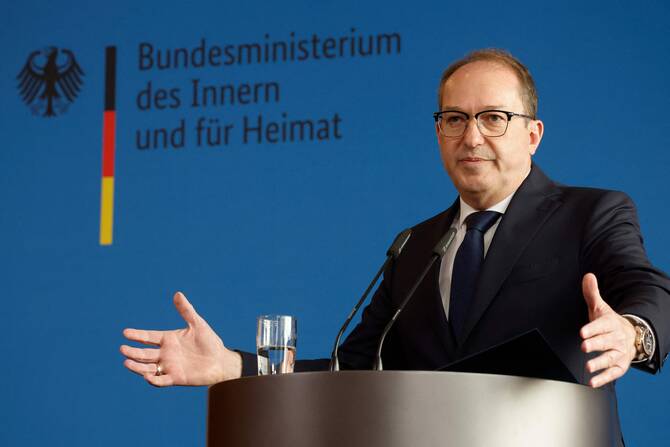
Interior Minister Alexander Dobrindt said that the members of the group had "created a 'counter-state' in our country and built up economic criminal structures".
"In this way, they persistently undermine the legal system and the Federal Republic's monopoly on the use of force."
Authorities said the association had financed itself primarily through prohibited banking and insurance transactions for its members as well as donations.
The Federal Prosecutor's Office in Karlsruhe said Fitzek was arrested along with three other suspected ringleaders of the group, which was classified as a criminal organisation.
As the "so-called supreme sovereign," Fitzek had "control and decision-making power in all key areas", the Prosecutor's Office said.
"The Kingdom of Germany considers itself a sovereign state within the meaning of international law and strives to extend its claimed 'national territory' to the borders of the German Empire of 1871," it added in a statement.
Fitzek, who once ran unsuccessfully to enter parliament, anointed himself as "king" in 2012 in an elaborate ceremony complete with a crown and sceptre.
He told AFP in an interview in 2023 that founding the organisation was the only answer to the "mass manipulation" he saw in German society.
His followers tend to be people with a "pioneering spirit" who "want to make a positive change in this world", Fitzek told AFP in Wittenberg, the group's original base in eastern Germany.
In Tuesday's raids, police searched locations in the states of Baden-Wuerttemberg, Lower Saxony, North Rhine-Westphalia, Rhineland-Palatinate, Saxony, Saxony-Anhalt and Thuringia.
There were around 23,000 members of the Reichsbuerger movement in 2022, according to Germany's domestic intelligence agency.
More than 2,000 of them were considered potentially violent.
While Reichsbuerger members subscribe to an ideology similar to that of the Kingdom of Germany, the Reichsbuerger movement is made up of many disparate groups.
In 2022, members of a group including an ex-MP and former soldiers were arrested over a plot to attack parliament, overthrow the government and install aristocrat and businessman Prince Heinrich XIII Reuss as head of state.
Another high-profile case saw a group of Reichsbuerger members charged with plotting to kidnap the then health minister, Karl Lauterbach, in protest at Covid-19 restrictions.


