

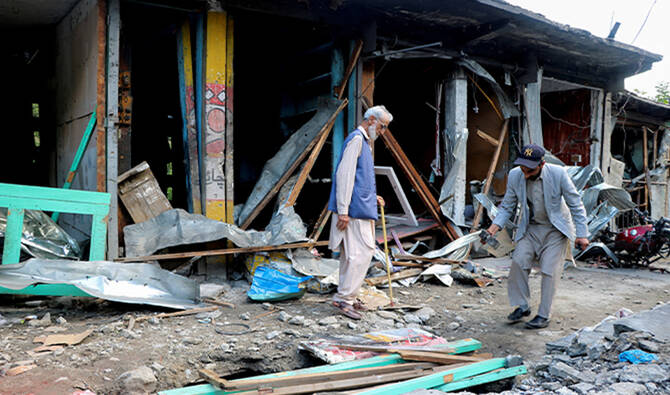

SRINAGAR, INDIAN-ADMINISTERED KASHMIR: A series of military strikes last week by India and Pakistan brought the nuclear-armed rivals closer to a broader war. The possibility of a nuclear conflagration seemed real and the fighting only stopped when global powers intervened.
Experts say the crisis deepened the neighbors’ rivalry as both crossed a threshold with each striking the other with high-speed missiles and drones. The tit-for-tat strikes also brought Kashmir again into global focus, as the US President Donald Trump offered mediation over the simmering dispute that has long been described as the regional nuclear flashpoint.
Paul Staniland, South Asia expert and a professor of political science at the University of Chicago, said the four days of fighting shows that “India now feels substantial space to directly target Pakistan, as well as that Pakistan is willing to escalate in response.”
Unlike in past years, when fighting was largely limited to Kashmir, the two armies last week fired missiles and drones at each other’s military installations deep inside their cities and exchanged gunfire and heavy artillery along their frontier in Kashmir.
Dozens of people were killed on both sides. Each claimed it inflicted heavy damage on the other and said its strikes met the country’s objectives.
Trump touts a possible ‘solution’ for Kashmir
The fighting began Wednesday after India retaliated for last month’s attack that killed 26 people, mostly Hindu tourists, in Kashmir, a Himalayan territory claimed in entirety by both nations. India blamed Pakistan for supporting the attackers, an accusation Islamabad denied, saying no evidence was shared.
The Indian military said it could again strike Pakistan if it felt threatened. Pakistan’s military also warned against any violation of the country’s sovereignty and vowed to respond.
Pakistan and India have fought two wars over Kashmir and the specter of two nuclear-armed foes once again trading blows over the region alarmed the international community. Trump on Saturday broke news that the two countries had agreed to stop fighting after US-led talks.
On Sunday, Trump once again offered to help and said he will work to provide a “solution” regarding the dispute over Kashmir.
Pakistan thanked the US and Trump for facilitating the ceasefire. India, however, has not said anything about Trump’s mediation offer and only acknowledged the ceasefire was reached after military contacts with Pakistan.
Trump’s Kashmir offer also provoked criticism against Prime Minister Narendra Modi’s government, which has insisted Kashmir is India’s internal issue and had opposed any third-party intervention, arguing it was fighting “Pakistan’s proxy war.”
Pakistan is trying to raise Kashmir as global issue
Pakistan’s position is that divided Kashmir is an internationally recognized dispute and must be solved according to the UN resolutions and wishes of Kashmiri people.
South Asia analyst Michael Kugelman called Trump’s offer “a diplomatic coup for Pakistan.”
“A core and consistent Pakistani foreign policy goal is to internationalize the Kashmir issue. And that’s exactly what has happened here, much to the chagrin of an Indian government that takes a rigid position that the issue is settled and there’s nothing to discuss,” he said.
Meanwhile, people on both sides of the border have heaved a sigh of relief after the ceasefire but some insisted a lasting peace will only be possible if Kashmir dispute is solved.
Praveen Donthi, senior analyst with the International Crisis Group, said “the two countries have to give Kashmiris a chair at the table of negotiations for a more durable peace process and faster resolution of the problem.”
He said Kashmiris have lost more lives due to the conflict than government forces on both sides.
“They always have more to lose … in the absence of mechanisms that resolve the Kashmir dispute,” Donthi said.
For residents in Kashmir, the dispute is not just about India and Pakistan, or mere geopolitics and diplomacy, but about survival and peace.
“Let’s be honest, India and Pakistan are fighting over Kashmir. So let it be resolved once and forever,” said student Shazia Tabbasum.


