

Pakistan to get $1 billion IMF tranche today, no large fiscal impact of India standoff — finmin

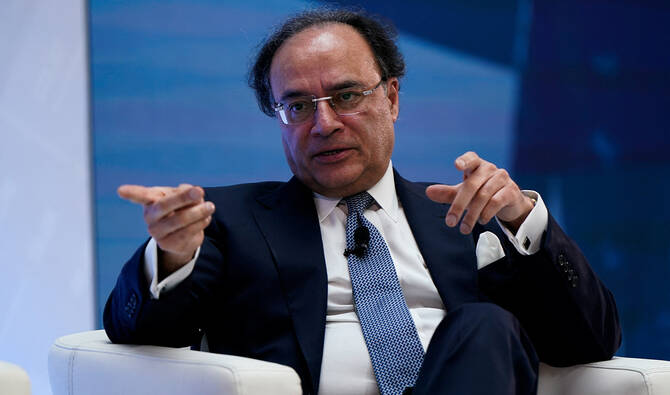
Pakistan Finance Minister Muhammad Aurangzeb participates in a panel titled “Navigating an Uncertain World” during the 2025 annual IMF/World Bank Spring Meetings in Washington DC, US, on April 25, 2025. (REUTERS/File)
Short Url
Updated 13 May 2025
Follow

Pakistan to get $1 billion IMF tranche today, no large fiscal impact of India standoff — finmin

  • IMF last week approved fresh $1.4 billion climate loan, $1 billion under bailout program 
  • Successful review approval brings disbursements to $2 billion within $7 billion loan program

KARACHI: Pakistan is expected to receive a $1 billion loan disbursement from the IMF today, Tuesday, as part of a larger $7 billion bailout agreement, Finance Minister Muhammad Aurangzeb has said.

The IMF last Friday approved a fresh $1.4 billion loan to Pakistan under its climate resilience fund and approved the first review of its $7 billion program, freeing about $1 billion in cash. The review approval brings disbursements to $2 billion within the $7 billion program. 

In a statement released after a virtual meeting on Monday between Aurangzeb and Johana Chua, head of emerging markets economies for Citigroup Global Markets, the finance ministry confirmed that Pakistan would receive the latest IMF tranche on Tuesday.

“The Minister also apprised the participants of the successful conclusion of a Staff Level Agreement with the International Monetary Fund (IMF) under the Extended Fund Facility (EFF), with the next tranche expected to be received tomorrow [Tuesday],” the statement said. 

“He further mentioned the approval of the Resilience and Sustainability Facility (RSF), calling it a milestone achievement for Pakistan.”

The loan disbursement comes amid a military standoff with arch-rival India, though Aurangzeb told Reuters in an interview on Monday the conflict would not have a large fiscal impact on Pakistan.

The finance minister described the conflict as a “short duration escalation” with minimal fiscal impact, stating it can be “accommodated within the fiscal space which is available to the government of Pakistan.”

When questioned about potential increased military spending in the upcoming budget, Aurangzeb deferred comment, saying it was premature to discuss specific plans. However, he said: “Whatever we need to do in terms of ensuring that our defense requirements are met will be met.”

Aurangzeb said he expects the Indus Water Treaty, which India unilaterally suspended, to be reinstated and rolled back to where it was.

He said there is not going to be any immediate impact from India’s suspension and Pakistan does not “even want to consider any scenario which does not take into account the reinstatement of this treaty.”

Tensions between India and Pakistan began mounting after the April 22 attack in Indian-administered Kashmir on Hindu tourists that killed 26 people, sparking the worst clashes between the nuclear-armed neighbors in more than two decades.

On Saturday, a ceasefire in the Himalayan region was announced by US President Donald Trump, following four days of fighting and diplomacy and pressure from Washington.

Pakistan’s federal budget for the next fiscal year, starting July, will be finalized within the next four weeks, with scheduled budget talks with the IMF to take place from May 14-23, according to the finance ministry. 


With inputs from Reuters


Pakistan condemns Netanyahu’s ‘hexagon of alliances’ plan, says alert to growing India-Israel defense ties

Updated 26 February 2026
Follow

Pakistan condemns Netanyahu’s ‘hexagon of alliances’ plan, says alert to growing India-Israel defense ties

  • Israel’s Netanyahu last week proposed an alliance of countries in and around Middle East against its adversaries
  • Pakistan maintains “robust military preparedness” to deter any potential aggression, says foreign office spokesperson

ISLAMABAD: Pakistan’s foreign office spokesperson on Thursday condemned Israeli Prime Minister Benjamin Netanyahu’s recent statement about forming a “hexagon of alliances” within or around the Middle East, saying Islamabad was alert to growing defense ties between New Delhi and Tel Aviv. 

Netanyahu on Sunday outlined plans to form a new regional bloc, describing it as a “hexagon of alliances” that he said could include Israel, India, Greece and Cyprus, along with other unnamed Arab, African and Asian states. He said the grouping would collectively stand against what he described as “radical” adversaries.

His comments came days before Indian Prime Minister Narendra Modi arrived in Israel on Wednesday for a two-day trip to bolster ties. The two are expected to discuss cooperation in science and technology, innovation, agriculture, water management, technology, defense and security during the trip. 

The statement drew a sharp response from Pakistan’s Senate, which unanimously passed a resolution on Tuesday rejecting Netanyahu’s remarks.

“I would also like to draw your attention to the recent resolution adopted by the Senate of Pakistan that strongly condemned such remarks and attempts to undermine Muslim unity,” Foreign Office spokesperson Tahir Andrabi told reporters during a weekly press briefing.

“We continue to condemn these provocative steps and statements by the leadership of the occupying power that threaten regional peace and stability,” he added.

Netanyahu had also said Israel’s goal was to create an axis of nations that see eye to eye against what he described as the “radical Shia” and “radical Sunni” axis of nations. 

Andrabi said attempts to divide the Muslim world along sectarian lines were a “nefarious design” on Netanyahu’s part.

India is Israel’s largest arms buyer and second-largest trading partner in Asia, after China. In response to a question on India’s growing defense ties with Israel, Andrabi said Pakistan remained cognizant of the risks posed by such cooperation.

“Yes, we remain seized of the defense ties between Israel and India,” the spokesperson said, noting that certain “systems and platforms” may have been used by India against Pakistan in the past.

“We are alive to the threats they pose to our security, sovereignty and territorial integrity, as well as to regional peace and stability.”

Andrabi said Pakistan maintained “robust military preparedness” to deter any potential aggression from hostile forces.

‘UTMOST CAUTION EXERCISED’

Andrabi spoke about Pakistan’s recent strikes against alleged militant camps in Afghanistan, saying Islamabad had conducted them in self-defense and with extreme caution to avoid casualties. 

Pakistan said it carried out airstrikes in Afghanistan against militant camps and hideouts in three provinces on Saturday night, killing over 100 militants. Afghanistan accused Pakistan of violating its territorial sovereignty and killing dozens of civilians. Kabul has vowed to retaliate. 

Andrabi said the strikes were carried out to ensure protection for the lives of the people of Pakistan and to prevent “imminent terrorist attacks.”

“These actions were directed solely against identified terrorist camps and hideouts, and utmost caution was exercised to prevent harm to civilians,” he said. 

He warned Pakistan would take necessary measures under its right to self-defense against “terrorist threats” emanating from Afghan territory.

On the safety of Pakistani nationals in Afghanistan following the strikes, Andrabi said Islamabad had raised the issue with Afghan authorities, adding that Islamabad expected “foolproof security” for Pakistani diplomats and civilians.