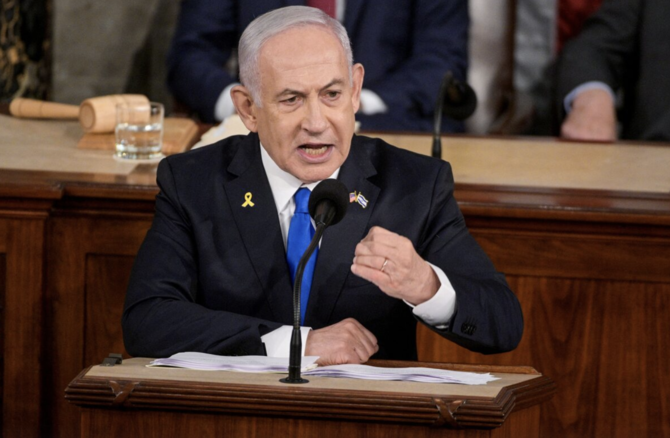
THE HAGUE: Israel has asked the International Criminal Court to dismiss its arrest warrants against Prime Minister Benjamin Netanyahu and former defense minister Yoav Gallant while ICC judges reconsider complex jurisdictional questions.
In a 14-page document dated May 9 but posted on the ICC website on Monday, Israel argued the warrants issued in November were null and void while judges weigh a previous Israeli challenge to the ICC’s jurisdiction in the case.
In a ruling that made headlines around the world, the ICC found “reasonable grounds” to believe Netanyahu and Gallant bore “criminal responsibility” for war crimes and crimes against humanity related to the war in Gaza.
The court also issued a war crimes warrant against top Hamas commander Mohammed Deif over the October 7 attacks that sparked the conflict. The case against Deif was dropped in February after his death.
Israel, not one of the ICC’s 125 members, challenged the court’s jurisdiction but judges on the ICC’s “Pre-Trial Chamber” dismissed the bid and issued the arrest warrants.
But last month, the ICC’s Appeals Chamber ruled the Pre-Trial Chamber was wrong to dismiss the challenge and ordered it to look again in detail at Israel’s arguments.
Israel says now that the arrest warrants should not stay in place while this complex and lengthy process is ongoing.
“Unless and until the Pre-Trial Chamber has ruled on the substance of the jurisdiction challenge... the prerequisite jurisdictional finding does not exist,” Israel argued.
“It follows that the arrest warrants issued on 21 November 2024 must be withdrawn or vacated pending the Pre-Trial Chamber’s determination of Israel’s jurisdictional challenge.”
Israel and its allies reacted furiously to the warrants issued on November 21, Netanyahu describing it as an “anti-Semitic decision” and then US president Joe Biden slamming it as “outrageous.”
Technically, any member of the ICC is required to arrest Netanyahu if he travels there, although the court has no independent power to enforce warrants.
Israel argued in its submission that Netanyahu could theoretically be arrested while the court was still weighing whether it had jurisdiction in the case.
“Depriving persons of their liberty on the basis of an arrest warrant issued in the absence of the necessary legal pre-conditions is an egregious violation of fundamental human rights and of the rule of law,” Israel argued.
Allowing the warrants to stay in place during the deliberations “is unlawful and undermines the legitimacy of the court,” said Israel.


![]()


Israel urges ICC to drop arrest warrants against PM
Short Url
https://arab.news/ykysr
Israel urges ICC to drop arrest warrants against PM
- In ruling that made headlines, ICC found “reasonable grounds” to believe Netanyahu and Gallant bore “criminal responsibility” for war crimes, crimes against humanity


Turkiye’s foreign minister says the US and Iran showing flexibility on nuclear deal, FT reports
- Hakan Fidan: “It is positive that the Americans appear willing to tolerate Iranian enrichment within clearly set boundaries”
- Washington has until now demanded Iran relinquish its stockpile of uranium enriched to up to 60 percent fissile purity
The United States and Iran are showing flexibility on a nuclear deal, with Washington appearing “willing” to tolerate some nuclear enrichment, Turkish Foreign Minister Hakan Fidan told the Financial Times in an interview published Thursday.
“It is positive that the Americans appear willing to tolerate Iranian enrichment within clearly set boundaries,” Fidan, who has been involved in talks with both Washington and Tehran, told the FT.
“The Iranians now recognize that they need to reach a deal with the Americans, and the Americans understand that the Iranians have certain limits. It’s pointless to try to force them.”
Washington has until now demanded Iran relinquish its stockpile of uranium enriched to up to 60 percent fissile purity, a small step away from the 90 percent that is considered weapons grade.
Iranian President Masoud Pezeshkian has said Iran would continue to demand the lifting of financial sanctions and insist on its nuclear rights including enrichment.
Fidan told the FT he believed Tehran “genuinely wants to reach a real agreement” and would accept restrictions on enrichment levels and a strict inspection regime, as it did in the 2015 agreement with the US and others. US and Iranian diplomats held talks through Omani mediators in Oman last week in an effort to revive diplomacy, after President Donald Trump positioned a naval flotilla in the region, raising fears of new military action. Trump on Tuesday said he was considering sending a second aircraft carrier to the Middle East, even as Washington and Tehran prepared to resume negotiations.
The Turkish foreign minister, however, cautioned that broadening the Iran-US talks to ballistic missiles would bring “nothing but another war.”
The US State Department and the White House did not respond to a request for comment outside regular business hours.
“It is positive that the Americans appear willing to tolerate Iranian enrichment within clearly set boundaries,” Fidan, who has been involved in talks with both Washington and Tehran, told the FT.
“The Iranians now recognize that they need to reach a deal with the Americans, and the Americans understand that the Iranians have certain limits. It’s pointless to try to force them.”
Washington has until now demanded Iran relinquish its stockpile of uranium enriched to up to 60 percent fissile purity, a small step away from the 90 percent that is considered weapons grade.
Iranian President Masoud Pezeshkian has said Iran would continue to demand the lifting of financial sanctions and insist on its nuclear rights including enrichment.
Fidan told the FT he believed Tehran “genuinely wants to reach a real agreement” and would accept restrictions on enrichment levels and a strict inspection regime, as it did in the 2015 agreement with the US and others. US and Iranian diplomats held talks through Omani mediators in Oman last week in an effort to revive diplomacy, after President Donald Trump positioned a naval flotilla in the region, raising fears of new military action. Trump on Tuesday said he was considering sending a second aircraft carrier to the Middle East, even as Washington and Tehran prepared to resume negotiations.
The Turkish foreign minister, however, cautioned that broadening the Iran-US talks to ballistic missiles would bring “nothing but another war.”
The US State Department and the White House did not respond to a request for comment outside regular business hours.
Latest updates


Recommended


© 2026 SAUDI RESEARCH & PUBLISHING COMPANY, All Rights Reserved And subject to Terms of Use Agreement.