

Pakistan welcomes Kurdish PKK’s disbandment, ending 40-year Turkiye insurgency

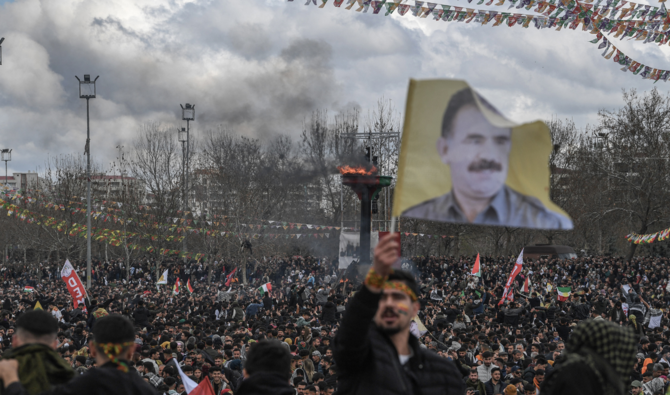
A man waves a flag depicting Abdullah Ocalan, Turkish-jailed founder of the Kurdistan Workers' Party (PKK) next to a bonfire during a gathering for Nowruz (aka Noruz or Newroz) celebrations marking the New Year of the Persian calendar and the first day of spring in Diyarbakir, south-eastern Turkey, on March 21, 2025. (AFP/ file)
Short Url
Updated 12 May 2025
Follow

Pakistan welcomes Kurdish PKK’s disbandment, ending 40-year Turkiye insurgency

  • Since the PKK launched its insurgency in 1984, the conflict has killed more than 40,000 people, exacted huge economic losses 
  • PKK’s decision will give President Tayyip Erdogan the opportunity to boost development in Turkiye’s mainly Kurdish southeast

ISLAMABAD: Pakistan on Monday welcomed the decision by the Kurdistan Workers Party (PKK) group, which has been locked in bloody conflict with the Turkish state for more than four decades, to disband and end its armed struggle.

Since the PKK launched its insurgency in 1984, the conflict has killed more than 40,000 people, exerted a huge economic burden and fueled social tensions. The PKK is designated a terrorist group by Turkiye and its Western allies.

Taking to X, Pakistani Prime Minister Shehbaz Sharif called the PKK’s dissolution a “historic development.”

“Pakistan welcomes the announcement of PKK’s dissolution, a significant step toward lasting peace and a terror-free Turkiye,” he wrote.

The Firat news agency, which is close to the group, reported on Monday that the PKK 12th Congress decided to “dissolve the PKK’s organizational structure and end the armed struggle.”

The PKK held the congress in response to a February call to disband from its jailed leader Abdullah Ocalan, who has been imprisoned on an island south of Istanbul since 1999. It said on Monday that he would manage the process.

On Mar. 1, the PKK announced a unilateral ceasefire, but attached conditions, including the creation of a legal framework for peace negotiations.

“The PKK has completed its historic mission,” the PKK statement said. “The PKK struggle has broken the policy of denial and annihilation of our people and brought the Kurdish issue to a point of solving it through democratic politics.”

The PKK’s decision will give President Tayyip Erdogan the opportunity to boost development in Turkiye’s mainly Kurdish southeast, where the insurgency has impaired the regional economy for decades.

A deputy leader of the pro-Kurdish DEM Party, the third largest in Turkiye’s parliament and which played a key role in facilitating Ocalan’s peace call, told Reuters the PKK decision was significant not just for Kurdish people but for the Middle East as a whole.

“It will also necessitate a major shift in the official state mentality of Turkiye,” DEM’s Tayip Temel said.

- With inputs from Reuters


Pakistan launches digital cash aid for low-income families during Ramadan, PM says

Updated 19 February 2026
Follow

Pakistan launches digital cash aid for low-income families during Ramadan, PM says

  • Ramadan relief moves from state-run Utility Stores to targeted digital wallet transfers
  • Government to transfer financial assistance through wallets to support sehri, iftar expenses

ISLAMABAD: Pakistan will provide financial assistance to low-income households through digital wallets during the fasting month of Ramadan, Prime Minister Shehbaz Sharif said on Thursday, announcing a government relief initiative aimed at helping families afford daily meals.

The support program comes as many Pakistanis continue to face elevated food and utility costs despite easing inflation, with Ramadan traditionally increasing household spending on staple foods, fruits and energy consumption.

For decades, government-run Utility Stores Corporation outlets were central to Ramadan relief in Pakistan, selling subsidized flour, sugar, ghee and pulses through special “Ramzan packages” that drew long queues in low-income neighborhoods. In recent years, however, authorities have steadily scaled back the system amid mounting losses, corruption complaints and logistical inefficiencies, shifting instead toward targeted cash transfers delivered through digital wallets and banking channels. 

The change reflects a broader policy move away from state-managed commodity distribution toward direct financial assistance intended to give households flexibility while reducing leakages in subsidy programs.

“The Government of Pakistan has launched a Ramadan package under which financial assistance will be transferred to deserving individuals through digital wallets so that households can maintain sehri and iftar meals,” Sharif said in a message issued by his office.

The prime minister said Ramadan encourages compassion and collective responsibility toward vulnerable segments of society, adding that welfare support was part of the state’s duty during the holy month.

Officials say the digital cash transfers approach improves transparency and reduces corruption risks while enabling faster payments nationwide, particularly in urban low-income communities.

But the shift to fully digital assistance also brings challenges. 

Access to smartphones and reliable mobile Internet remains uneven, particularly in rural areas and among older recipients, while many low-income households use SIM cards registered to someone else, complicating verification.