

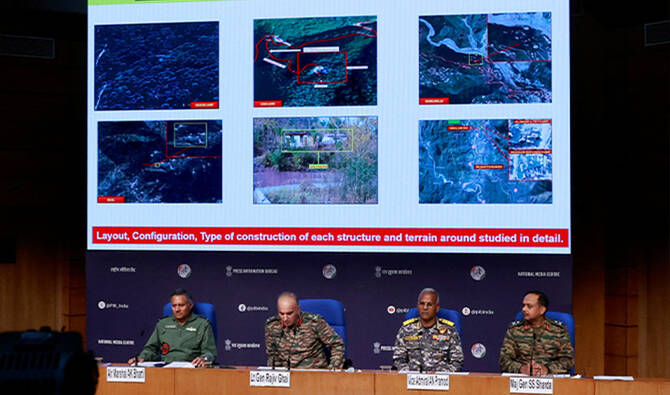

ISLAMABAD: India’s military strikes into Azad Kashmir and Pakistan last week killed more than 100 militants including prominent leaders, the head of India’s military operations said on Sunday.
Lt. Gen. Rajiv Ghai, the director general of military operations, said India’s armed forces struck nine militant infrastructure and training facilities, including sites of the Lashkar-e-Taiba group that India blames for carrying out major militant strikes in India and the disputed region of Kashmir.
“We achieved total surprise,” Ghai said at a news conference in New Delhi, adding Pakistan’s response was “erratic and rattled.”
The two countries agreed to a truce on Saturday after talks to defuse their most serious military confrontation in decades. The two armies exchanged gunfire, artillery strikes, missiles and drones that killed dozens of people.
As part of the ceasefire, the nuclear-armed neighbors agreed to immediately stop all military action on land, in the air and at sea. On Sunday, Pakistan’s military said it did not ask for a ceasefire, as claimed by India, but rather it was India that had sought the ceasefire.
At a televised news conference, Lt. Gen. Ahmad Sharif Chaudhry said Pakistan’s armed forces targeted a total of 26 Indian military installations in response to India’s missile strikes which were launched before dawn Wednesday.
He said the military had vowed it would respond to the Indian aggression, and it has fulfilled its commitment to the nation. Sharif warned that any threat to Pakistan’s sovereignty or territorial integrity would be met with a “comprehensive, retributive, and decisive” response.
He said Pakistan exercised “maximum restraint” during the counterstrike, employing medium-range missiles and other munitions, and that no civilian areas were targeted inside India.
Competing claims of how many killed
The escalation in violence began last week after a gun massacre of tourists in Indian-controlled Kashmir on April 22. India blamed the attack on Pakistan, which denied any involvement.
Ghai said at least 35 to 40 Pakistani soldiers were killed in clashes along the Line of Control, the de facto border that divides the disputed Kashmir region between India and Pakistan. Five Indian soldiers were also killed, he said.
Pakistan’s Information Minister Attaullah Tarar on Thursday said his country’s armed forces had killed 40 to 50 Indian soldiers along the Line of Control.
Following India’s Wednesday strikes, Pakistan sent drones multiple times in many locations in Kashmir and Indian cities that were neutralized, said Air Marshal A.K. Bharti, the operations head of the Indian air force. He said India responded with “significant and game-changing strikes” Saturday, hitting Pakistan’s air bases.
Bharti refused to comment on Pakistani claims of shooting down five Indian fighter jets, but said “we are in a combat scenario and losses are a part of combat.” He claimed India also “downed (a) few planes” but did not offer any evidence.
The Associated Press could not independently verify all the actions attributed to India or Pakistan.
Saturday’s ceasefire was shaken just hours later by overnight fighting in disputed Kashmir, as each side accused each other of repeatedly violating the deal. Drones were also spotted Saturday night over Indian-controlled Kashmir and the western state of Gujarat, according to Indian officials.
People on both sides of the Line of Control reported heavy exchanges of fire between Indian and Pakistani troops. The fighting subsided by Sunday morning.
In the Poonch area of Indian-administered Kashmir, people said the intense shelling from the past few days had traumatized them.
“Most people ran as shells were being fired,” said college student Sosan Zehra, who returned home Sunday. “It was completely chaotic.”
In Pakistan-controlled Kashmir’s Neelum Valley, which is 3 kilometers (2 miles) from the Line of Control, residents said there were exchanges of fire and heavy shelling after the ceasefire began.
“We were happy about the announcement but, once again, the situation feels uncertain,” said Mohammad Zahid.
Indian and Pakistan officials to speak Monday
US President Donald Trump was the first to post about the ceasefire deal, announcing it on his Truth Social platform. Indian and Pakistani officials confirmed the news shortly after.
Pakistan has thanked the US, and especially Trump, several times for facilitating the ceasefire.
India has not said anything about Trump or the US since the deal was announced. Indian Prime Minister Narendra Modi chaired a meeting on Sunday with top government and military officials.
India and Pakistan’s top military officials are scheduled to speak today, Monday.
India and Pakistan have fought daily since Wednesday along the rugged and mountainous Line of Control, which is marked by razor wire coils, watchtowers and bunkers that snake across foothills populated by villages, tangled bushes and forests.
They have routinely blamed the other for starting the skirmishes, while insisting they themselves were only retaliating.
Kashmir is split between the two countries and claimed by both in its entirety.
They have fought two of their three wars over the region and their ties have been shaped by conflict, aggressive diplomacy and mutual suspicion, mostly due to their competing claims


