

Israel’s blockade means Gaza’s hospitals cannot provide food to recovering patients

1 / 2
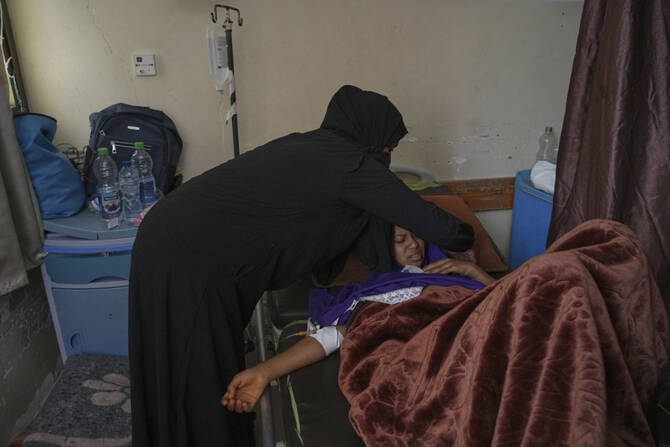
Salwa Faraj cares for her sister, Asmaa Faraj, who was injured in an Israeli army strike, at Nasser Hospital in Khan Younis, Gaza Strip, on May 6, 2025. (AP Photo/Abdel Kareem Hana)
2 / 2
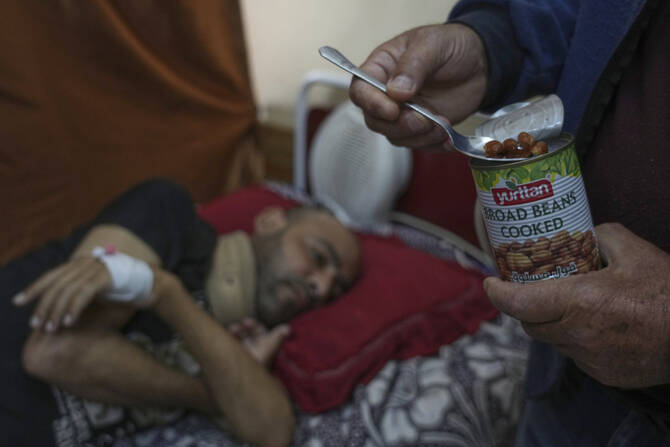
Sobhi al-Bursh, who was injured in a bombing and lost his foot, is fed beans brought from home by his father, Mohamed, at Nasser Hospital in Khan Younis, Gaza Strip, on May 6, 2025. (AP Photo/Abdel Kareem Hana)
Short Url
Updated 12 May 2025
Follow

Israel’s blockade means Gaza’s hospitals cannot provide food to recovering patients

  • Hospital patients are among the most vulnerable as Palestinians across Gaza struggle to feed themselves, with Israel’s blockade on food and other supplies entering the territory now in its third month

KHAN YOUNIS, Gaza Strip: It cost a fortune, she said, but Asmaa Fayez managed to buy a few zucchinis in a Gaza market. She cooked them with rice and brought it to her 4-year-old son, who has been in the hospital for the past week. The soup was his only meal of the day, and he asked for more.
“It’s all finished, darling,” Fayez replied softly. Still, it was an improvement from the canned beans and tuna she brings on other days, she said.
Hospital patients are among the most vulnerable as Palestinians across Gaza struggle to feed themselves, with Israel’s blockade on food and other supplies entering the territory now in its third month.
With hospitals unable to provide food, families must bring whatever they can find for loved ones.
“Most, if not all, wounded patients have lost weight, especially in the past two months,” Dr. Khaled Alserr, a general surgeon at Nasser Hospital in the southern city of Khan Younis, told The Associated Press. Nutritional supplements for intensive care unit patients are lacking, he said.
“Our hands are tied when it comes to making the best choice for patients. Choices are limited,” he said.
Hunger worsens as supplies dwindle
Malnutrition is on the rise across Gaza, aid groups say. Thousands of children have been found with acute malnutrition in the past month, but adults as well are not getting proper nutrients, according to the UN It estimates that 16,000 pregnant women and new mothers this year face acute malnutrition.
Since Israel’s blockade began on March 2, food sources have been drying up. Aid groups have stopped food distribution. Bakeries have closed. Charity kitchens handing out bowls of pasta or lentils remain the last lifeline for most of the population, but they are rapidly closing for lack of supplies, the UN says.
Markets are empty of almost everything but canned goods and small amounts of vegetables, and prices have been rising. Local production of vegetables has plummeted because Israeli forces have damaged 80 percent of Gaza’s farmlands, the UN says, and much of the rest is inaccessible inside newly declared military zones.
Fayez’s son, Ali Al-Dbary, was admitted to Nasser Hospital because of a blocked intestine, suffering from severe cramps and unable to use the bathroom. Fayez believes it’s because he has been eating little but canned goods. She splurged on the zucchini, which now costs around $10 a kilogram (2.2 pounds). Before the war it was less than a dollar.
Doctors said the hospital doesn’t have a functioning scanner to diagnose her son and decide whether he needs surgery.
Israel says it imposed the blockade and resumed its military campaign in March to pressure Hamas to release its remaining hostages and disarm.
Hamas ignited the war with its Oct. 7, 2023, attack on Israel, in which militants killed some 1,200 people, mostly civilians, and took 251 hostage, most of whom have been released in ceasefire agreements or other deals. Israel’s offensive has killed over 52,000 Palestinians, mostly women and children, according to Gaza’s Health Ministry, which does not say how many of the dead were civilians or combatants.
Concern over Israeli plans to control aid
Israeli officials have asserted that enough food entered Gaza during a two-month ceasefire earlier this year. Rights groups have disputed that and called the blockade a “starvation tactic” and a potential war crime.
Now Israeli plans to control aid distribution in Gaza, using private contractors to distribute supplies. The UN and aid groups have rejected the idea, saying it could restrict who is eligible to give and receive aid and could force large numbers of Palestinians to move — which would violate international law.

Those under care at hospitals, and their families who scrounge to feed them, would face further challenges under Israel’s proposal. Moving to reach aid could be out of the question.
Another patient at Nasser Hospital, 19-year-old Asmaa Faraj, had shrapnel in her chest from an airstrike that hit close to her tent and a nearby charity kitchen in camps for displaced people outside Khan Younis.
When the AP visited, the only food she had was a small bag of dates, a date cookie and some water bottles. Her sister brought her some pickles.
“People used to bring fruits as a gift when they visited sick people in hospitals,” said the sister, Salwa Faraj. “Today, we have bottles of water.”
She said her sister needs protein, fruits and vegetables but none are available.
Mohammed Al-Bursh managed to find a few cans of tuna and beans to bring for his 30-year-old son, Sobhi, who was wounded in an airstrike three months ago. Sobhi’s left foot was amputated, and he has two shattered vertebrae in his neck.
Al-Bursh gently gave his son spoonfuls of beans as he lay still in the hospital bed, a brace on his neck.
“Everything is expensive,” Sobhi Al-Bursh said, gritting with pain that he says is constant. He said he limits what he eats to help save his father money.
He believes that his body needs meat to heal. “It has been three months, and nothing heals,” he said.


US raid allegedly killed Syrian undercover agent instead of Daesh group official

Updated 52 min 3 sec ago
Follow

US raid allegedly killed Syrian undercover agent instead of Daesh group official

  • Neither US nor Syrian government officials have commented on the death, an indication that neither side wants the incident to derail improving ties
  • Weeks after the raid, interim President Ahmad Al-Sharaa visited Washington and announced Syria would join the global coalition against Daesh

DUMAYR, Syria: A raid by US forces and a local Syrian group aiming to capture an Daesh (IS) group official instead killed a man who had been working undercover gathering intelligence on the extremists, family members and Syrian officials have told The Associated Press.
The killing in October underscores the complex political and security landscape as the United States begins working with interim Syrian President Ahmad Al-Sharaa in the fight against remnants of IS.
According to relatives, Khaled Al-Masoud had been spying on IS for years on behalf of the insurgents led by Al-Sharaa and then for Al-Sharaa’s interim government, established after the fall of former President Bashar Assad a year ago. Al-Sharaa’s insurgents were mainly Islamists, some connected to Al-Qaeda, but enemies of IS who often clashed with it over the past decade.
Neither US nor Syrian government officials have commented on Al-Masoud’s death, an indication that neither side wants the incident to derail improving ties. Weeks after the Oct. 19 raid, Al-Sharaa visited Washington and announced Syria would join the global coalition against IS.
Still, Al-Masoud’s death could be “quite a setback” for efforts to combat IS, said Wassim Nasr, a senior research fellow with the Soufan Center, a New York-based think tank focused on security issues.
Al-Masoud had been infiltrating IS in the southern deserts of Syria known as the Badiya, one of the places where remnants of the extremist group have remained active, Nasr said.
The raid targeting him was a result of “the lack of coordination between the coalition and Damascus,” Nasr said.
In the latest sign of the increasing cooperation, the US Central Command said Sunday that American troops and forces from Syria’s Interior Ministry had located and destroyed 15 IS weapons caches in the south.
Confusion around the raid
The raid occurred in Dumayr, a town east of Damascus on the edge of the desert. At around 3 a.m., residents woke to the sound of heavy vehicles and planes.
Residents said US troops conducted the raid alongside the Syrian Free Army, a US-trained opposition faction that had fought against Assad. The SFA now officially reports to the Syrian Defense Ministry.
Al-Masoud’s cousin, Abdel Kareem Masoud, said he opened his door and saw Humvees with US flags on them.
“There was someone on top of one of them who spoke broken Arabic, who pointed a machine gun at us and a green laser light and told us to go back inside,” he said.
Khaled Al-Masoud’s mother, Sabah Al-Sheikh Al-Kilani, said the forces then surrounded her son’s house next door, where he was with his wife and five daughters, and banged on the door.
Al-Masoud told them that he was with General Security, a force under Syria’s Interior Ministry, but they broke down the door and shot him, Al-Kilani said.
They took him away, wounded, Al-Kilani said. Later, government security officials told the family he had been released but was in the hospital. The family was then called to pick up his body. It was unclear when he had died.
“How did he die? We don’t know,” his mother said. “I want the people who took him from his children to be held accountable.”
Faulty intelligence
Al-Masoud’s family believes he was targeted based on faulty intelligence provided by members of the Syrian Free Army.
Representatives of the SFA did not respond to requests for comment.
Al-Masoud had worked with Al-Sharaa’s insurgent group, Hayat Tahrir Al-Sham, in its northwestern enclave of Idlib before Assad’s fall, his cousin said. Then he returned to Dumayr and worked with the security services of Al-Sharaa’s government.
Two Syrian security officials and one political official, who spoke on condition of anonymity because they were not authorized to comment publicly, confirmed that Al-Masoud had been working with Syria’s interim government in a security role. Two of the officials said he had worked on combating IS.
Initial media reports on the raid said it had captured an IS official. But US Central Command, which typically issues statements when a US operation kills or captures a member of the extremist group in Syria, made no announcement.
A US defense official, when asked for more information about the raid and its target and whether it had been coordinated with Syria’s government, said, “We are aware of these reports but do not have any information to provide.” The official spoke on condition of anonymity in accordance with regulations.
Representatives of Syria’s defense and interior ministries, and of US envoy to Syria Tom Barrack, declined to comment.
Increased coordination could prevent mistakes
At its peak in 2015, IS controlled a swath of territory across Iraq and Syria half the size of the United Kingdom. It was notorious for its brutality against religious minorities as well as Muslims not adhering to the group’s extreme interpretation of Islam.
After years of fighting, the US-led coalition broke the group’s last hold on territory in late 2019. Since then, US troops in Syria have been working to ensure IS does not regain a foothold. The US estimates IS still has about 2,500 members in Syria and Iraq. US Central Command last month said the number of IS attacks there had fallen to 375 for the year so far, compared to 1,038 last year.
Fewer than 1,000 US troops are believed to be operating in Syria, carrying out airstrikes and conducting raids against IS cells. They work mainly alongside the Kurdish-led Syrian Democratic Forces in the northeast and the Syrian Free Army in the south.
Now the US has another partner: the security forces of the new Syrian government.
Airwars, a London-based conflict monitor, has reported 52 incidents in which civilians were harmed or killed in coalition operations in Syria since 2020.
The group classified Al-Masoud as a civilian.
Airwars director Emily Tripp said the group has seen “multiple instances of what the US call ‘mistakes,’” including a 2023 case in which the US military announced it had killed an Al-Qaeda leader in a drone strike. The target later turned out to be a civilian farmer.
It was unclear if the Oct. 19 raid went wrong due to faulty intelligence or if someone deliberately fed the coalition false information. Nasr said that in the past, feuding groups have sometimes used the coalition to settle scores.
“That’s the whole point of having a hotline with Damascus, in order to see who’s who on the ground,” he said.