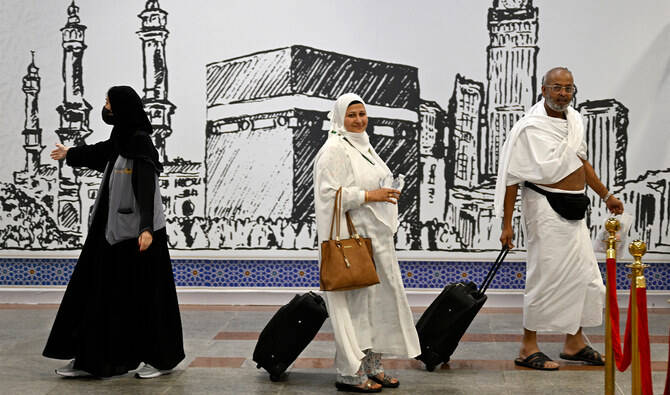
ISLAMABAD: Pakistan’s Minister for Religious Affairs Sardar Muhammad Yousaf on Saturday praised Saudi authorities for the arrangements made for this year’s Hajj pilgrims, describing the facilities as comfortable and well-managed.
The remarks came during his visit to Makkah, where he met officials and inspected facilities for Pakistani pilgrims, including medical services and accommodation in Mina.
“The arrangements made by the Custodian of the Two Holy Mosques, King Salman bin Abdulaziz, and Crown Prince Mohammed bin Salman for the guests of Allah Almighty are truly commendable,” the Associated Press of Pakistan quoted Yousaf as saying.
“We appreciate the efforts to ensure comfort, safety and well-being of all pilgrims,” he added.
The minister urged Pakistani pilgrims to fully comply with the rules and guidelines issued by Saudi authorities, stressing they were designed to facilitate a smooth pilgrimage experience.
Yousaf also toured the Pakistan Hajj Medical Mission and received a briefing on the facilities available for pilgrims.
He later made a surprise visit to Mina camps managed by the Saudi company Al Rajhi, expressing satisfaction with services such as air-conditioned tents, sofa-cum-beds and dedicated storage spaces.
The minister reiterated Pakistan’s commitment to providing high-quality services to its pilgrims and emphasized that no lapses in care would be tolerated.
Hajj is expected to take place between June 4 and 9 this year. Pakistan launched special Hajj flights on April 29 and has since transported thousands of pilgrims to Madinah.


Pakistan’s religious affairs minister commends Saudi Hajj arrangements during Makkah visit
https://arab.news/jjapc
Pakistan’s religious affairs minister commends Saudi Hajj arrangements during Makkah visit

- Sardar Yousaf urges Pakistani pilgrims to follow Saudi guidelines for a smooth Hajj experience
- He visits Pakistan’s Hajj Medical Mission and camps in Mina to review facilities for pilgrims

Pakistan says defense pact with Saudi Arabia elevated brotherly ties to ‘new heights’
- Pakistan, Saudi Arabia signed strategic defense pact last year pledging aggression against one will be treated as attack on both
- Deputy PM Ishaq Dar says enduring bonds with Islamic and Arab nations form vital pillar of Pakistan’s foreign policy
ISLAMABAD: Deputy Prime Minister Ishaq Dar said on Wednesday that Pakistan’s defense pact with Saudi Arabia elevated its brotherly ties with the Kingdom to “new heights,” stressing that close ties with Arab and Islamic nations form a key pillar of Islamabad’s foreign policy.
Pakistan and Saudi Arabia signed a Strategic Mutual Defense Agreement on Sept. 17 last year, pledging that aggression against one country would be treated as an attack on both, enhancing joint deterrence and formalizing decades of military and security cooperation.
Both nations agreed in October 2025 to launch an economic cooperation framework to strengthen trade and investment ties.
“In the Middle East, our landmark Strategic Mutual Defense Agreement with Saudi Arabia has elevated our brotherly ties to new heights,” Dar said while speaking at the Pakistan Governance Forum 2026 event in Islamabad.
The Pakistani deputy prime minister was speaking on the topic “Navigating International Relations Amidst Changing Geo-Politics.”
Dar noted that Pakistan has reinforced partnerships with other Middle Eastern nations such as the UAE, Qatar, Jordan, Oman, Egypt and Bahrain. He said these partnerships have yielded “concrete agreements” in investment, agriculture, infrastructure, and energy sectors.
“Our enduring bonds with Islamic and Arab nations form a vital pillar of our foreign policy, and we will continue to expand our partnerships across Asia, Latin America, and Africa,” he said.
Dar pointed out that the presidents of Kazakhstan, Uzbekistan and Kyrgyzstan have undertaken visits to Pakistan in recent months, reflecting Central Asian nations’ desire to boost cooperation with Islamabad.
On South Asia, the Pakistani deputy PM said Pakistan has successfully transformed its fraternal ties with Bangladesh into “a substantive partnership.”
“Similarly, the trilateral mechanism involving China, Pakistan, and Bangladesh has been launched with a view to expanding and deepening regional cooperation and synergy,” the Pakistani minister said.
He said Islamabad has strengthened its “all-weather” partnership with China via the second phase of the multi-billion-dollar China-Pakistan Economic Corridor agreement and “unwavering support” from both sides for each other’s core interests.
Dar said Pakistan had also reinvigorated its partnership with the US, advancing cooperation in trade, technology, investment, and regional stability.
“This calibrated approach has enhanced our ability to navigate complexity with skill and confidence, ensuring that our national interests are served without compromising our core foreign policy principles,” he said.


