

Pakistan, China, Afghanistan vow cooperation on security and economy at Kabul meeting

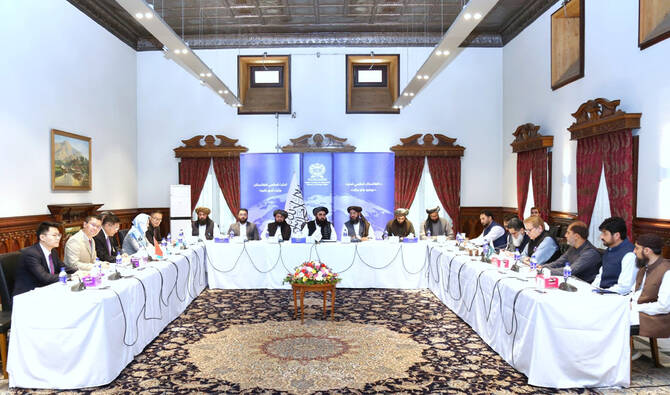
Representatives of Afghanistan, Pakistan and China attending trilateral meeting hosted by Afghanistan’s acting foreign minister, Amir Khan Muttaqi, on economic and security outlook of the region in Kabul, Afghanistan, on May 10, 2025. (@Zabehulah_M33/X)
Short Url
Updated 10 May 2025
Follow

Pakistan, China, Afghanistan vow cooperation on security and economy at Kabul meeting

  • Representatives of the three countries met under a trilateral mechanism launched in 2017
  • They discussed the forthcoming foreign ministers’ conference expected to take place in Kabul

PESHAWAR: A trilateral meeting hosted by Afghanistan in Kabul on Saturday focused on economic and security outlook of the region, according to Pakistan’s special envoy Mohammad Sadiq, as the participants pledged to deepen cooperation in various fields.

The meeting marked the latest round of talks under the trilateral dialogue mechanism between Afghanistan, China and Pakistan that was launched in 2017 to promote political trust, counterterrorism coordination and economic integration.

Afghanistan’s acting foreign minister, Amir Khan Muttaqi, hosted the talks, which also included China’s special envoy Yue Xiaoyong.

“The first meeting of the Pakistan-China-Afghanistan trilateral in Kabul today... provided the occasion for convergence of views on economic and security cooperation as well as regional stability,” Sadiq, Pakistan’s special representative for Afghanistan, said in a post on social media platform X.

All three sides reviewed progress on commitments made during the last dialogue and agreed to convene the sixth round of foreign ministers’ meeting in Kabul at a future date, according to a report published by Afghanistan’s Ariana News.

The officials also discussed broader preparations for an upcoming meeting of foreign ministers from Afghanistan’s neighboring countries, and reaffirmed their intention to expand political and economic engagement.

Muttaqi highlighted the importance of strengthening bilateral and trilateral ties, while the Chinese and Pakistani envoys reiterated their commitment to good-neighborly relations based on mutual respect and non-interference.

China and Pakistan are among the few countries to maintain ongoing engagement with the Taliban-led government in Kabul, though neither formally recognizes it.

Both Beijing and Islamabad have called for stability in Afghanistan to enable cross-border connectivity and curb the threat of militant spillover.


Pakistan saw up to 17% drop in cross-border attacks after Afghan border closure — think tank

Updated 5 sec ago
Follow

Pakistan saw up to 17% drop in cross-border attacks after Afghan border closure — think tank

  • CRSS calls 2025 the deadliest year in a decade with 3,417 violence-linked fatalities nationwide
  • Violence remained concentrated in the western provinces as security forces killed 2,060 militants

ISLAMABAD: Pakistan recorded a sharp decline in cross-border militant attacks and violence-linked fatalities in the final months of 2025 after it closed its border with Afghanistan in October, even as the country endured its deadliest year in a decade overall, according to an annual security report released by a local think tank on Wednesday.

Pakistan has frequently accused Afghanistan of sheltering proscribed armed factions, such as the Tehreek-e-Taliban Pakistan (TTP) and the Balochistan Liberation Army (BLA), in the past, while also pointing a finger at the Taliban administration in Kabul for “facilitating” their attacks against Pakistani civilians and security forces.

The Center for Research and Security Studies (CRSS) said in its report that terrorist attacks fell by nearly 17% in December, following a 9% decline in November, after Pakistan shut the border on Oct. 11. It noted that violence-linked fatalities among civilians and security personnel also declined in the final quarter of the year, falling by nearly 4% and 19% respectively in November and December.

“Pakistan recorded a significant drop in cross-border terrorist attacks and violence-linked fatalities after it closed down the border to Afghanistan,” CRSS said.

Despite the late-year decline, the think tank said 2025 “went by as the most violent year for Pakistan in a decade,” with overall violence surging nearly 34% year-on-year.

Fatalities rose from 2,555 in 2024 to 3,417 in 2025 — an increase of 862 deaths — extending a five-year upward trend in violence that coincides with the Taliban’s return to power in Afghanistan in 2021, the report said.

“2025 marked another grim year for Pakistan’s security landscape,” it added, noting that violence has increased every year since 2021, with annual surges of nearly 38% in 2021, over 15% in 2022, 56% in 2023, nearly 67% in 2024 and 34% in 2025. 

REGIONAL CONCENTRATION

Violence remained heavily concentrated in Pakistan’s northwestern Khyber Pakhtunkhwa (KP) and southwestern Balochistan provinces, which together accounted for more than 96% of all fatalities and nearly 93% of violent incidents nationwide.

KP was the worst-hit region, recording 2,331 fatalities in 2025 — a 44% increase from 1,620 deaths in 2024 — accounting for more than 82% of the net national rise in violence.

Balochistan saw fatalities rise from 787 to 956, an increase of nearly 22%.

In contrast, Punjab and Sindh recorded relatively low levels of violence, together accounting for less than 3% of total casualties, which CRSS said pointed to “relative containment of violence despite the provinces’ large populations.”

The report also flagged the spread of violence into previously calmer regions, with Azad Jammu and Kashmir recording 15 fatalities in 2025 after reporting no violence a year earlier.

MILITANT DEATH TOLL

CRSS said 2025 was also the deadliest year in a decade for militant groups, with outlaws accounting for more than 60% of all fatalities.

“2025 turned out to be the deadliest year for outlaws in a decade,” the report said, with 2,060 militants killed during at least 392 security operations, surpassing the combined fatalities of civilians and security personnel.

Security forces, however, remained the primary targets of militant groups.

The army and Frontier Corps recorded 374 fatalities, including 22 officers, while police suffered 216 casualties.

The TTP claimed responsibility for the largest share of attacks on security personnel, followed by the BLA, the Baloch Liberation Front (BLF) and Daesh’s regional chapter.