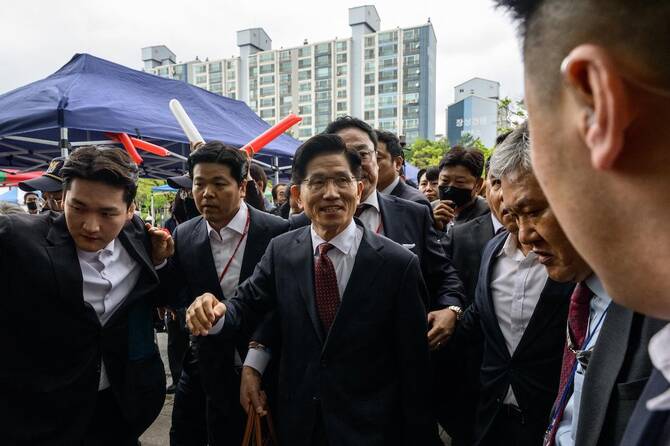
South Korean conservative party moves to switch presidential candidates as election turmoil deepens

Former labour minister Kim Moon-soo (C) arrives at a party national convention to choose South Korea's conservative People Power Party's (PPP) candidate for the upcoming presidential election. (File/AFP)
Short Url
Updated 10 May 2025
Follow

South Korean conservative party moves to switch presidential candidates as election turmoil deepens

  • The replacement still requires confirmation through an all-party vote Saturday and approval by the party’s national committee Sunday
  • Han and Kim have lagged well behind Lee in recent opinion polls. Lee, who spearheaded the Democrats’ efforts to oust Yoon

SEOUL, South Korea: South Korea’s embattled conservative party has taken the unprecedented step of nullifying its primary and replacing presidential candidate Kim Moon Soo with former Prime Minister Han Duck-soo just one week after Kim’s selection, deepening internal turmoil ahead of the June 3 presidential by-election.
Saturday’s move by the People Power Party’s leadership, which Kim denounced as an “overnight political coup,” underscores the desperation and disarray within the party following the ouster of former President Yoon Suk Yeol over his ill-fated attempt to impose martial law in December.
Kim, a staunch conservative and former labor minister under Yoon, was named the PPP’s presidential candidate on May 3 after winning 56.3 percent of the primary vote, defeating a reformist rival who had criticized Yoon’s martial law. But the PPP’s leadership, dominated by Yoon loyalists, has spent the past week pressuring Kim to step aside and back Han, whom they believe stands a stronger chance against liberal Democratic Party frontrunner Lee Jae-myung.
Han served as acting president after Yoon was impeached by the legislature in December and officially removed by the Constitutional Court in April. He resigned from office May 2 to pursue a presidential bid, arguing his long public service career qualifies him to lead the country amid growing geopolitical uncertainty and trade challenges intensified by the policies of US President Donald Trump.
After failed talks between Han and Kim to unify their candidacies, the PPP’s emergency committee canceled Kim’s nomination in the early hours of Saturday and officially registered Han as a party member and its new presidential candidate.
The replacement still requires confirmation through an all-party vote Saturday and approval by the party’s national committee Sunday, which is the deadline for candidates to register with the election authorities.
Han in a message issued through the party claimed “if we unite, we can surely win.”
Speaking at a news conference, Kim lamented “democracy in our party died” and vowed to take unspecified legal and political steps, but it remained unclear whether any realistic path existed to restore his candidacy without the party’s cooperation.
Kim had opposed the legislature’s impeachment of Yoon on Dec. 14, though he said he disagreed with Yoon’s decision to declare martial law on Dec. 3. Kim had gained popularity among hard-line PPP supporters after he solely defied a Dec. 11 demand by an opposition lawmaker that all Cabinet members stand and bow in a gesture of apology for Yoon’s martial law enactment at the Assembly.
Han and Kim have lagged well behind Lee in recent opinion polls. Lee, who spearheaded the Democrats’ efforts to oust Yoon, ridiculed the PPP efforts to switch candidacies, telling reporters Thursday, “I have heard of forced marriages but never heard of forced unity.”
Lee has long cultivated an image as an anti-establishment figure capable of tackling South Korea’s entrenched inequality and corruption. However, critics view him as a populist who fuels division and vilifies opponents, warning that his leadership could further polarize the country.
He currently faces five trials for corruption and other criminal charges. If he becomes president, those trials likely will stop because of special presidential immunity from most criminal charges.


Villagers massacred in South Sudan food aid trap

Local residents tend to their livestock in Pajiek Payam, Ayod County, South Sudan, on July. 21, 2025. (AP)
Updated 6 sec ago
Follow

Villagers massacred in South Sudan food aid trap

  • Civilians killed after being lured from homes with promise of aid, witnesses say

NAIROBI: More than a dozen civilians were killed after being lured from their homes by fighters allied to South Sudan’s government under the pretense of being registered for humanitarian food aid, according to two people who survived the attack.

The killings took place on Saturday morning in the village of Pankor, in Ayod county, in the conflict-hit Jonglei state, about 400km north of the capital, Juba. 
Women and children were among the victims.

HIGHLIGHTS

• The two survivors said that 22 people were killed and several more were injured. • Photos showed bodies of women and young men, some with their hands bound behind their backs, who appear to have been shot at close range.

Several dozen fighters arrived in pickup trucks and announced over a loudspeaker that they had come to register residents for food assistance, said the two survivors.
“They gathered them in a luak,” said one witness, referring to a traditional mud hut used to house cattle. 
“People were thinking they would get aid or some help.”
The fighters then bound the hands of several men and opened fire on the group. 
The two survivors said that 22 people were killed and several more were injured. 
The government-appointed county commissioner said 16 people were killed. 
Photos showed bodies of women and young men, some with their hands bound behind their backs, who appear to have been shot at close range. 
The images, which were shared with AP by an opposition representative, are too graphic to publish.
Makuach Muot, 34, traveled to Pankor on Sunday for the funerals of eight relatives. 
Most of the village’s residents had fled fighting months earlier, he said, leaving behind mainly elderly people and young children.
Army spokesman Maj. Gen. Lul Ruai Koang could not be reached for comment.
James Chuol Jiek, the government-appointed county commissioner of Ayod, confirmed that more than a dozen people, mostly women and children, had been killed in the attack.
He said the gunmen belonged to the Agwelek militia, a force drawn from the Shilluk ethnic group that has not been fully integrated into the national army but that has been deeply involved in recent military operations.
Jiek said the fighters had left their barracks overnight without their commander’s knowledge. 
He said they told him the killings were revenge for attacks by a Nuer militia on Shilluk villages in 2022, during which hundreds of civilians were killed or abducted.
The government county commissioner condemned the killings and said that several officers had been arrested and that the army had disarmed 150 fighters from the battalion involved. 
He disputed that people had been lured out for an aid registration. “This is an opposition lie,” he said.
In January, Agwelek militia commander Lt. Gen. Johnson Olony was filmed ordering his forces to kill civilians during military operations in Jonglei state. “Spare no lives,” he said. 
“When we arrive there, don’t spare an elderly, don’t spare a chicken, don’t spare a house or anything.”
His remarks drew widespread rebuke from the UN and others. Olony has since apologized.
Armed clashes, aerial bombardments, and years of extreme flooding have left more than half of Ayod county’s population facing severe food insecurity.
Ayod county lies in northern Jonglei state, an opposition stronghold and a flashpoint in renewed fighting that the UN estimates displaced 280,000people since December. 
Aid groups have warned that access restrictions to opposition-held parts of the state were endangering civilian lives.
Residents of northern Jonglei are overwhelmingly from the Nuer ethnic group of suspended vice president and opposition leader Riek Machar.
Opposition officials have repeatedly called the government’s actions in Nuer areas of the country “genocidal.” 
Reath Tang Muoch, a senior official in the SPLM-IO, called Olony’s remarks “an early indicator of genocidal intent.”