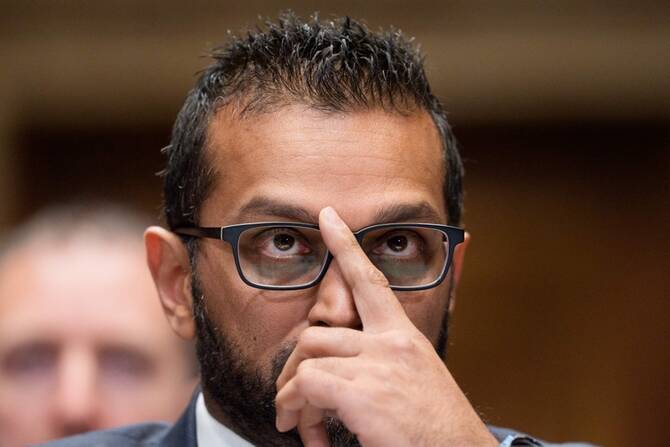
WASHINGTON: FBI Director Kash Patel said Thursday that he would make the bureau’s mission “work on whatever budget we’re given,” striking a different tone from comments a day earlier in which he called for the agency to be funded at far higher levels than what the Trump administration had proposed.
The 2026 budget proposal released on Friday calls for a funding cut of about $545 million for the FBI as part of what the White House said was a desire to “reform and streamline” the bureau and reduce “non-law enforcement missions that do not align” with the priorities of President Donald Trump
Patel told lawmakers at a House Appropriations subcommittee hearing on Wednesday that the FBI needs “more than what has been proposed” to operate as it should and that it “can’t do the mission on those 2011 budget levels.”
But on Thursday, appearing at a separate hearing of a Senate Appropriations subcommittee, he took a different stance when asked by Democratic Sen. Chris Van Hollen of Maryland about his earlier testimony that the FBI required substantially more money than what the Trump budget plan had called for.
“My view is that we agree with this budget as it stands and make it work for the operational necessity of the FBI, and as the head of the FBI, I was simply asking for more funds because I can do more with more money,” he said.
He added that he would “make the mission work on whatever budget we’re given.”

A day after saying FBI needs more resources, Patel strikes different tone to Congress on budget plan
Short Url
https://arab.news/v4zy8
A day after saying FBI needs more resources, Patel strikes different tone to Congress on budget plan
Pakistanis fleeing Iran describe strikes shaking ground under their feet
QUETTA: Pakistanis fleeing Iran described explosions and missile strikes across Tehran shaking the ground under their feet and engulfing buildings in fire and smoke in a city emptied of many of its residents. The conflict has widened sharply, with a US submarine sinking an Iranian warship off Sri Lanka on Wednesday and NATO air defenses destroying an Iranian missile fired toward Turkiye.
Governments have been scrambling to evacuate stranded citizens, with most of the region’s airspace closed due to the risk of missiles hitting passenger planes.
“I was in the classroom when a powerful explosion rocked our university building,” Hareem Zahra, 23, a student at the Tehran University of Engineering, told Reuters after crossing Pakistan’s land border with Iran.
“We saw thick smoke coming from many buildings on fire,” she said, adding Tehran was under attack until the moment she left.
TEHRAN LOOKED DESERTED
Nearly 1,000 students, businessmen and pilgrims have fled Iran since the war started out of a total 35,000 Pakistanis in the country, Mudassir Tipu, Pakistan’s ambassador to Tehran, said.
“There are now serious challenges. As you know there is no Internet in most parts of Iran,” he said. Iran has retaliated with a barrage of ballistic missiles targeting Israel and Washington’s allies in the Gulf, including Qatar, Kuwait, the UAE, and Saudi Arabia, following US and Israeli air strikes that killed Supreme Leader Ayatollah Ali Khamenei on Saturday.
Tehran has looked deserted since the conflict began, said Nadir Abbas, 25, a student of Persian literature at a university in the Iranian capital.
“I saw a drone hit a basketball court where six girl players lost their lives.”
Reuters could not verify his account.
’DESTRUCTION EVERYWHERE’ Islamabad is walking a diplomatic tightrope as it attempts to maintain warming ties with Washington while expressing solidarity with Iran.
Pakistan is home to the second-largest Shiite population in the world after Iran and being drawn into the conflict could lead to instability at home as well as complications evacuating its citizens.
“The first attack happened right next to my hospital,” said Sakhi Aun Mohammad, a student at Tehran University of Medical Sciences. After he reached the border, an Iranian friend called to check if he was safe, saying: “’Thank God, you have gone to Pakistan, all of you are safe, but your hostel has been attacked’.” A Pakistani diplomat who is still in Tehran said attacks took place every four or five hours, adding one missile struck a building next to his office. “At times you will feel as if something exploded right at your feet,” he said. “The last time I got out was at night. Buildings had collapsed, some others were on fire. There is destruction everywhere.”
He added: “It is almost like a ghost town.”
Governments have been scrambling to evacuate stranded citizens, with most of the region’s airspace closed due to the risk of missiles hitting passenger planes.
“I was in the classroom when a powerful explosion rocked our university building,” Hareem Zahra, 23, a student at the Tehran University of Engineering, told Reuters after crossing Pakistan’s land border with Iran.
“We saw thick smoke coming from many buildings on fire,” she said, adding Tehran was under attack until the moment she left.
TEHRAN LOOKED DESERTED
Nearly 1,000 students, businessmen and pilgrims have fled Iran since the war started out of a total 35,000 Pakistanis in the country, Mudassir Tipu, Pakistan’s ambassador to Tehran, said.
“There are now serious challenges. As you know there is no Internet in most parts of Iran,” he said. Iran has retaliated with a barrage of ballistic missiles targeting Israel and Washington’s allies in the Gulf, including Qatar, Kuwait, the UAE, and Saudi Arabia, following US and Israeli air strikes that killed Supreme Leader Ayatollah Ali Khamenei on Saturday.
Tehran has looked deserted since the conflict began, said Nadir Abbas, 25, a student of Persian literature at a university in the Iranian capital.
“I saw a drone hit a basketball court where six girl players lost their lives.”
Reuters could not verify his account.
’DESTRUCTION EVERYWHERE’ Islamabad is walking a diplomatic tightrope as it attempts to maintain warming ties with Washington while expressing solidarity with Iran.
Pakistan is home to the second-largest Shiite population in the world after Iran and being drawn into the conflict could lead to instability at home as well as complications evacuating its citizens.
“The first attack happened right next to my hospital,” said Sakhi Aun Mohammad, a student at Tehran University of Medical Sciences. After he reached the border, an Iranian friend called to check if he was safe, saying: “’Thank God, you have gone to Pakistan, all of you are safe, but your hostel has been attacked’.” A Pakistani diplomat who is still in Tehran said attacks took place every four or five hours, adding one missile struck a building next to his office. “At times you will feel as if something exploded right at your feet,” he said. “The last time I got out was at night. Buildings had collapsed, some others were on fire. There is destruction everywhere.”
He added: “It is almost like a ghost town.”
© 2026 SAUDI RESEARCH & PUBLISHING COMPANY, All Rights Reserved And subject to Terms of Use Agreement.


