

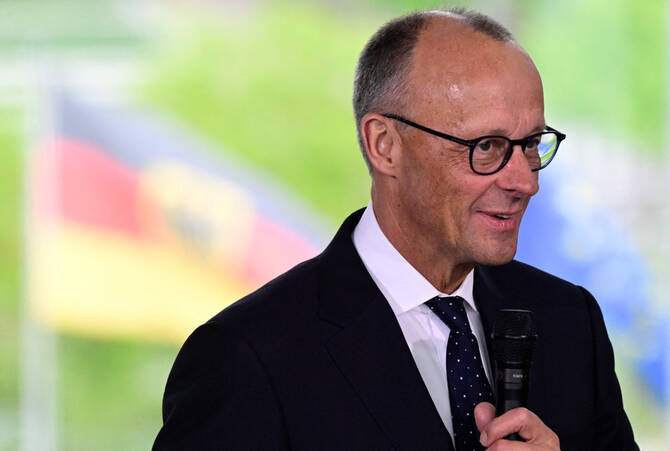

BERLIN: Germany’s new Chancellor Friedrich Merz discussed the Ukraine war and trade rows with US President Donald Trump on Thursday and said the United States remained Berlin’s “indispensable” partner, using their first phone call to attempt to heal frayed ties.
Since Trump returned to the White House, he has rattled Europe with head-pinning changes in security and trade policy, while his top administration officials have strongly supported Germany’s far-right AfD party.
Merz, despite being an avowed transatlanticist, has called for Europe to become more independent of its traditional NATO ally and said after his February election win that he had “no illusions” about the new tone from Washington.
But in their talk on Thursday, the conservative Merz “assured the American President that, 80 years after the end of the Second World War, the USA remains an indispensable friend and partner of Germany,” said a statement from Berlin.
“Both agreed to a close exchange and announced mutual visits to the USA and Germany,” it added without giving dates.
Merz’s spokesman Stefan Kornelius highlighted broad agreement to jointly resolve major crises, from the Ukraine war to the escalating US-EU trade row sparked by Trump’s blizzard of tariffs.
The new chancellor “shared the President’s call for a swift end to the killing in Ukraine” and said that “Russia must now agree to a ceasefire to create space for negotiations.”
The statement added that “Trump said he would strongly support Germany’s efforts, together with France, Great Britain, Poland and other European partners, to achieve lasting peace.”
The call came after Merz took power on Tuesday in a bumpy first day during which he was only elected in a second-round vote my MPs, having lost the first one in a surprise upset.
His inauguration ended half a year of political paralysis in Europe’s top economy since center-left ex-chancellor Olaf Scholz’s government collapsed last November 6, the day Trump was re-elected to the White House.
Trump’s inauguration came about a month before the German election on February 23 and heavily impacted the final stretch of the campaign.
The new US president reached out directly to Russia to end the Ukraine war and fueled doubts about the future strength of NATO, while threatening a trade war that would harm especially export power Germany.
Merz, straight after winning the election, urged the speedy formation of a new coalition government, warning that “the world isn’t waiting for us.”
He said his “absolute priority will be to strengthen Europe as quickly as possible so that, step by step, we can really achieve independence from the USA” in security matters.
During the campaign, the anti-immigration Alternative for Germany (AfD) won strong backing from Trump ally Elon Musk, the technology billionaire, who called it the “best hope” for Germany.
Last week, after Germany’s domestic intelligence agency designated the AfD a “right-wing extremist” party, US Secretary of State Marco Rubio called the move “tyranny in disguise.”
Vice President JD Vance wrote on X that “the West tore down the Berlin Wall together. And it has been rebuilt — not by the Soviets or the Russians, but by the German establishment.”
Merz on Tuesday condemned what he labelled the recent “absurd observations” from the United States and said he “would like to encourage the American government... to largely stay out of” German domestic politics.
A politician with longstanding US ties, Merz said he had always felt “from America that they can clearly distinguish between extremist parties and parties of the political center.”
Merz also noted on Tuesday that “I did not interfere in the American election campaign” that elected Trump.
The Berlin statement after the first Trump-Merz phone call made no mention of the row over the AfD.


