

US secretary of state Rubio urges Islamabad and New Delhi to step back

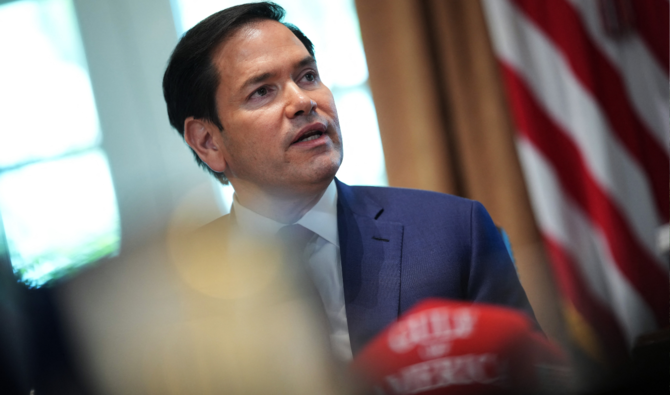
U.S. Secretary of State Marco Rubio speaks during a Cabinet meeting at the White House on April 30, 2025 in Washington, DC. (AFP)
Short Url
Updated 08 May 2025
Follow

US secretary of state Rubio urges Islamabad and New Delhi to step back

  • Marco Rubio holds separate phone calls with Pakistani PM and Indian external affairs minister 
  • Urges Pakistan and India to improve communications, engage in “direct dialogue” to de-escalate 

ISLAMABAD: US Secretary of State Marco Rubio on Thursday held separate telephone calls with Pakistan’s premier and the external affairs minister of India and urged the two nations to engage in “direct dialogue” to de-escalate their ongoing conflict, the state department said. 

India hit Pakistan and Pakistan-administered Kashmir, called Azad Kashmir, with missiles on Wednesday and Pakistan said it shot down five Indian aircraft in retaliation in their worst clash in over two decades. Pakistan said 31 civilians were killed in the Indian strikes while New Delhi says it targeted “terror camps.”

On Thursday, Pakistan said it had shot down 29 drones launched by India while New Delhi said it had “neutralized” Islamabad’s attempts to target military targets with drones and missiles.

“He expressed US support for direct dialogue between India and Pakistan and encouraged continued efforts to improve communications,” the state department said in two separate statements after Rubio spoke to Pakistani Premier Shehbaz Sharif and Indian External Affairs Minister Subrahmanyam Jaishankar. 

“The Secretary emphasized the need for immediate de-escalation.”

India is an important US partner for Washington, which aims to counter China’s rising influence, while Pakistan remains an ally, despite its diminished importance after the US withdrawal from neighboring Afghanistan in 2021.

Both India and Pakistan claim Muslim-majority Kashmir in full, with each controlling only part and having fought wars in the past over the region.

The latest standoff was triggered by an April 22 attack in Indian-administered Kashmir that New Delhi blamed on Pakistan, which has denied the claims and called for a neutral investigation.


Pakistan, seven Muslim nations back Palestinian technocratic body, stress Gaza-West Bank unity

Updated 15 January 2026
Follow

Pakistan, seven Muslim nations back Palestinian technocratic body, stress Gaza-West Bank unity

  • The National Committee for the Administration of the Gaza Strip was announced on January 14
  • Muslim nations call for consolidation of the ceasefire and unimpeded humanitarian aid into Gaza

ISLAMABAD: Pakistan and seven other Muslim-majority countries on Thursday welcomed the formation of a temporary Palestinian technocratic body to administer Gaza, stressing that it must manage daily civilian affairs while preserving the institutional and territorial link between the Gaza Strip and the West Bank amid the ongoing peace efforts.

In a joint statement, the foreign ministers of Pakistan, Egypt, Jordan, Saudi Arabia, Qatar, Türkiye, Indonesia and the United Arab Emirates said the newly announced National Committee for the Administration of the Gaza Strip would play a central role during the second phase of a broader peace plan aimed at ending the war and paving the way for Palestinian self-governance.

“The Ministers emphasize the importance of the National Committee commencing its duties in managing the day-to-day affairs of the people of Gaza, while preserving the institutional and territorial link between the West Bank and the Gaza Strip, ensuring the unity of Gaza, and rejecting any attempts to divide it,” the statement said.

The committee, announced on Jan. 14, is a temporary transitional body established under United Nations Security Council Resolution 2803 and is to operate in coordination with the Palestinian Authority, the ministers said.

The statement said the move forms part of the second phase of US President Donald Trump’s Comprehensive Peace Plan for Gaza, which the ministers said they supported, praising Trump’s efforts to end the war, ensure the withdrawal of Israeli forces and prevent the annexation of the occupied West Bank.

The top leaders of all eight Muslim countries attended a meeting with Trump in New York last September, shortly before he unveiled the Gaza peace plan.

The ministers also called for the consolidation of the ceasefire, unimpeded humanitarian aid into Gaza, early recovery and reconstruction and the eventual return of the Palestinian Authority to administer the territory, leading to a just and sustainable peace based on UN resolutions and a two-state solution on pre-1967 lines with East Jerusalem as the Palestinian capital.