


KARACHI: The Pakistan military said on Thursday it had shot down 25 Israeli-made Harop drones launched by India at multiple locations, a day after Indian strikes in the country raised fears of a larger military conflict between the nuclear-armed neighbors.
India said it struck nine “terrorist infrastructure” sites on Wednesday, some of them linked to an attack by militants that killed 26 in Indian-administered Kashmir on Apr. 22. Pakistan said 31 were killed in the Indian strikes and vowed to retaliate, subsequently saying it had shot down five Indian aircraft and a combat drone.
The conflict between India and Pakistan has been confined in recent decades mostly to the disputed mountainous region of Kashmir. But the air strikes on Wednesday morning, which also hit the towns of Bahawalpur and Muridke in the heart of the country, were seen in Islamabad as a major escalation.
Early on Thursday morning, reports started emerging from multiple Pakistani cities of explosions and firing. The military’s media wing subsequently confirmed that India was “attacking Pakistan with Israeli-made Harop drones in panic.”
The Harop is a standoff loitering munition attack weapon system designed to locate and precisely attack targets, manufactured by Israel Aerospace Industries.
“So far, 25 Israeli-made Harop drones have been shot down by the Pakistani army’s soft kill (technical) and hard kill (weapons),” the army said in a statement. “The debris of Israeli-made Harop drones is being collected from different areas of Pakistan.”
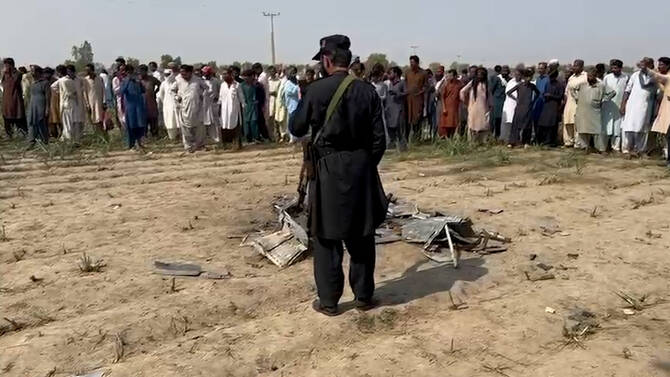
A paramilitary official stands near an Indian drone in Ghotki, in the border region of Pakistan's southern Sindh province, on May 8, 2025. (Qazi Agan Shar)
In the context of military defense, hard kill refers to destroying or neutralizing an incoming threat, such as a missile or drone, by physically destroying it or its components. Soft kill, on the other hand, aims to defeat the threat by disrupting its guidance or communication signals, often using electronic countermeasures or decoys.
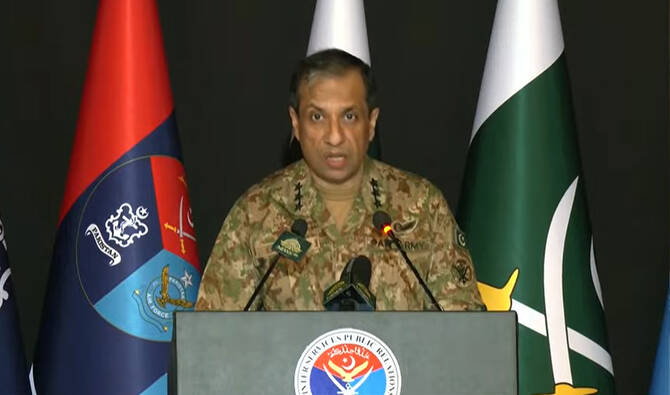
Drones had been “neutralized” in Lahore, Gujranwala, Chakwal, Rawalpindi, Attock, Bahawalpur, Miano, Chhor and near Karachi, military spokesman Lt. Gen. Ahmed Sharif Chaudhry said in a separate televised statement.
One drone, he added, had managed to “partially” engage a military target near Lahore, the capital of Pakistan’s largest province of Punjab.
“Four men of the Pakistan Army have been injured in this attack near Lahore and partial damage to an equipment has occurred,” Chaudhry said.
“As we speak, the process of India sending across these Harop drones, this naked aggression, continues, and the armed forces are on a high degree of alert and neutralizing them.”
Earlier in the day, police reported a civilian casualty in the southern Sindh province, also confirmed by Chaudhry, when a drone crashed in the Sarfaraz Leghari village, located in Ghotki district.
“This morning, a drone fell over two villagers... killing one man and injuring another,” Senior Superintendent of Police Dr. Samiullah Soomro told Arab News over the phone, saying more details would be confirmed following a visit to the site.
Eyewitnesses in Ghotki said the drone hovered over the village before it was hit by Pakistani forces in the morning, following which it crashed near a canal.
“My brother Mukhtiar Ahmed, who was only 25, was martyred,” Jabbar Laghari, a local schoolteacher, said. “He leaves behind three children. My father was also injured.”
India and Pakistan have fought three wars in the past, two of them over Kashmir, which they both claim in full but rule in part.
Since April 22, they have intensified firing and shelling across their de-facto Line of Control border in Kashmir.
For decades India has accused Pakistan of supporting militants in attacks on Indian interests, especially in Indian-administered Kashmir. Pakistan denies such support and in turn accuses India of backing separatist and other insurgents in Pakistan, which New Delhi denies.
On Thursday, India warned that any Pakistan military action would be met with “a very, very firm response.”
“Our response was targeted and measured. It [is] not our intention to escalate the situation,” Foreign Minister Subrahmanyam Jaishankar said in a speech to his visiting Iranian counterpart.
“However, if there are military attacks on us, there should be no doubt that it will be met with a very, very firm response.”
Jaishankar met Iran’s Foreign Minister Abbas Araghchi, who is visiting New Delhi days after visiting Pakistan, as Tehran seeks to mediate between the neighbors.
Araghchi, in a statement on his arrival in India, said that it was “natural that we want to reduce tensions” between India and Pakistan.
“We hope that the parties will exercise restraint to avoid an escalation of tensions in the region,” Araghchi said.
– With inputs from AFP


